Indian Express
Indian Express··3 min read
Providing accommodation to judges is state’s duty to ensure judicial independence: Karnataka High Court
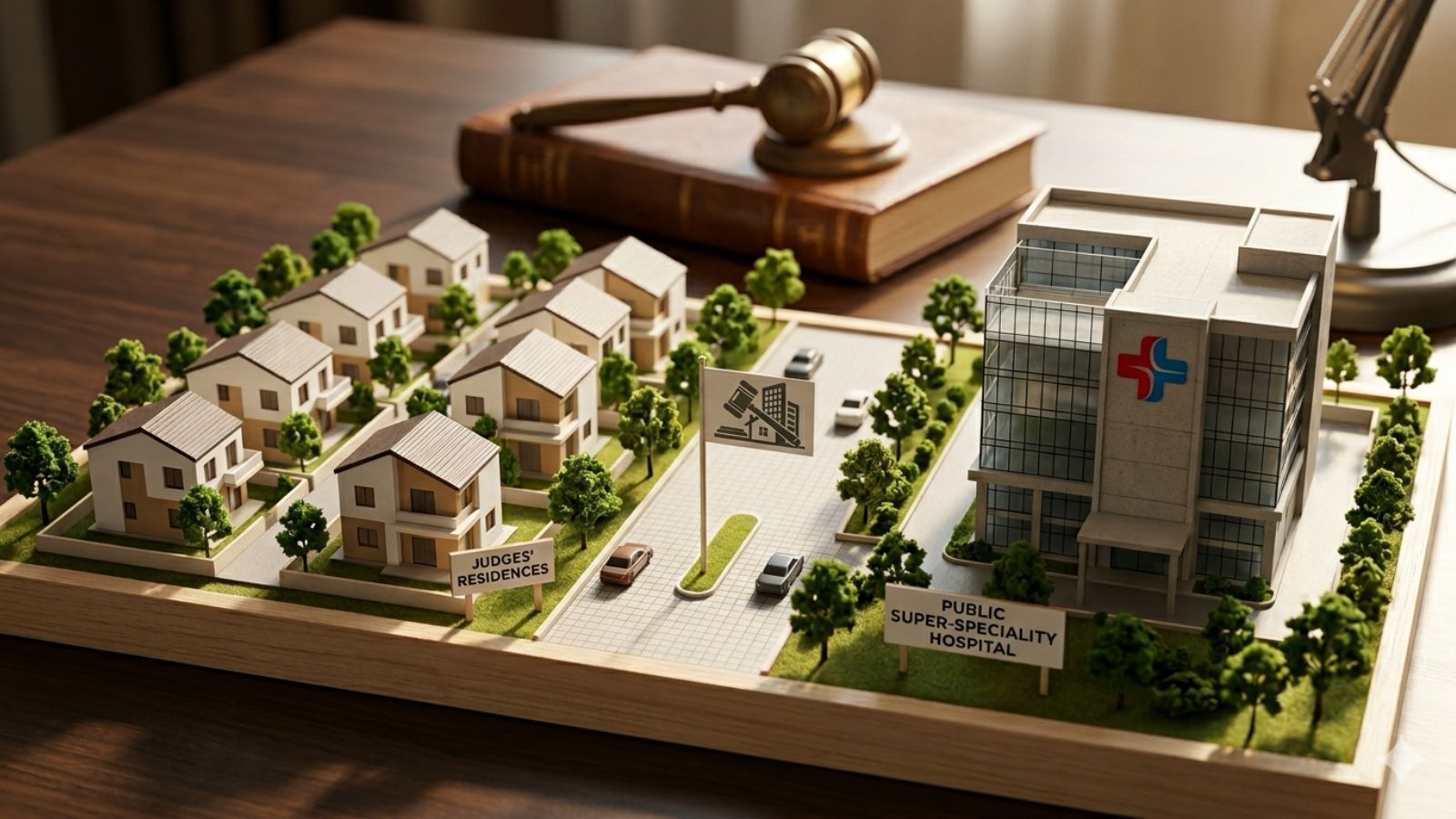
The Karnataka High Court Friday dismissed a public interest litigation (PIL) petition challenging a state government order that directed the transfer of seven acres of land belonging to the Karnataka Veterinary Animal and Fisheries Science University (KVAFSU) in Hebbal, Bengaluru. Out of the transferred parcel, four acres are earmarked for constructing residential quarters for High Court judges, while the remaining three acres are allocated for a public super-speciality hospital.
A division bench of Justice D K Singh and Justice T M Nadaf dismissed the petition filed by Karnataka Veterinary Association and others, observing that the allocation does not harm public interest.
“We do not find that the allotment of 4 acres of land which is adjacent to Nyayagrama in any manner will impede or is against the public interest, but it is in furtherance of the larger public interest, i.e., to ensure the independence of the Judiciary, which is the basic foundation of the Constitution,” it said.
In its order, the bench underscored, “It is the duty of the State to provide fully furnished official accommodation, befitting the stature of the constitutional authority of Judges of the High Court.”
Shrinking campus argument
The petitioners had challenged the government order dated January 8, 2026, which authorised the land diversion. Senior Advocate K N Phanindra, representing the veterinary associations, argued that shrinking the campus would severely impair undergraduate and postgraduate programmes.
He contended that introducing large-scale residential quarters and human healthcare services inside an animal sciences campus would pose biosecurity threats and public health risks, while disrupting future research and teaching capabilities.
Phanindra added that although the university campus spans 317.73 acres, the institution does not possess “excess” land to spare, given its long-term expansion layout.
Story continues below this ad
On the other hand, Senior Advocate Prabhuling K Navadgi, representing the High Court, argued that the petitioners lack locus standi to challenge the government order. They have failed to demonstrate any legal rights, let alone an enforceable right, Navadgi said.
He submitted that the government order was issued pursuant to a high-level meeting held on September 4, 2025, between the Chief Justice of the High Court and the Karnataka chief minister, which was subsequently ratified by a Cabinet decision.
Navadgi presented data showing that the university holds land far in excess of regulatory mandates. “As per the minimum requirements, a veterinary college is required to have approximately 150 acres of land. The transfer of seven acres out of the total available acreage would not affect the institution’s regulatory compliance,” he argued.
He also cited Rule 2A of the High Court Judges Rules, 1956, making it the bounden duty of the state to provide suitable housing.
Story continues below this ad
Infrastructure shortfalls
The bench noted that out of a sanctioned strength of 62 judges, only 19 official government residences, including the Chief Justice’s residence, are currently available in Bengaluru. This shortage has forced multiple sitting judges to reside in private rented accommodations that do not befit their constitutional stature, it said.
In its order, the court noted, “The independence of Judiciary is a fundamental, basic-structure feature of the Constitution, and the conditions of service of High Court and Supreme Court Judges (including salary, pension, housing, libraries, training, transport and retirement age) are part of the framework that sustains judicial independence.”
“The Judges of the High Court and Supreme Court are entitled for fully furnished official accommodations, which are embedded in the Judge’s service conditions and essential facilities necessary to secure judicial independence,” the court noted.
“No public interest is abridged or acted against in providing 4 acres of land to the High Court for construction of official residences to the Hon’ble judges and 3 acres of land for constructing the super-speciality hospital for the general public,” it said.
Story continues below this ad
The Karnataka High Court housing deficit
Sanctioned judicial strength: 62
Actual working strength (as of March 2026): 48
Available government bungalows: 19
Judges living in rented homes: 12
Judges living in self-owned homes: 11
Judges living in government guest houses: 1
Judges stationed at circuit benches: 3 (2 at Dharwad, 1 at Kalaburagi)
View original source — Indian Express ↗
Related stories

The Punch
PoliticsJun 15, 2026 · 1 min
Reps extend 2025 capital budget implementation to September
The Punch
The Punch
PoliticsJun 15, 2026 · 1 min
Avoid political influence, Adeleke warns corps members ahead of Osun poll
The Punch
The Punch
PoliticsJun 15, 2026 · 1 min
Reps aspirant sues NDC for N5bn over ‘scrapped’ primary
The Punch
The Punch
NewsJun 15, 2026 · 1 min
Ojukwu varsity dismisses two profs, three others for gross misconduct
The Punch