Indian Express
As Noida International Airport begins operations, what growth prospects look like
Monday (June 15) transported the National Capital Region (NCR) into the age of dual airports, as the Noida International Airport (NIA) in Uttar Pradesh’s Jewar started commercial operations.
India’s largest airline, IndiGo, operated the inaugural trip with the special flight 6E 2278 from Lucknow, which touched down on the NIA runway just before 8 am. The same aircraft, VT-IOM, then took off for Bengaluru, operating the second leg of the special flight and marking the first commercial departure from the NIA.
Designed and built by an arm of Zurich Airport International AG, the airport opened after a nearly two-year delay. Its operationalisation comes as the aviation sector is grappling with headwinds amid the West Asia crisis, forcing airlines to prune schedules and pause network expansion plans. Acknowledging the crisis as a short-term challenge, the NIA management expressed confidence in the long-term growth potential of India’s aviation market.
NIA Vice Chairman Christoph Schnellmann told The Indian Express, “We won the bid to design and build this airport at the end of 2019. Three months later, the bottom dropped out of the aviation market across the world. No one was flying anymore (due to the Covid-19 pandemic). I think to our credit, the shareholders and the lenders, everyone stood by and remained committed to this project.”
“The years since have proven them and us right. We saw traffic in India rebound very quickly, faster than in many parts of the world. That’s the approach we take to the current crisis as well. It’s a challenging time for aviation, but if we zoom out and look at where the industry has come from in the past 15-20 years, and what the outlook is, we remain incredibly confident,” he added.
Over 40 daily domestic flights in July, overseas flights by year-end
According to the airport’s management, NIA will have 12 daily domestic flights in June, which will grow to over 40 in July. Akasa Air flights will begin on Tuesday (June 16). The Air India group, under strain amid West Asia headwinds and other factors, is not operating here for the time being.
Story continues below this ad
The airport operator expects international flight operations to begin by the end of the year, with short-haul international flights initially catering to regions like West Asia and Southeast Asia.
According to Schnellmann, apart from Indian airlines with international operations, there is interest among foreign carriers to operate to and from the NIA to these regions. “We have very specific interest from foreign carriers also… The West Asia crisis has made some of it a little bit less predictable, but the interest is there from Indian as well as international airlines,” he said.
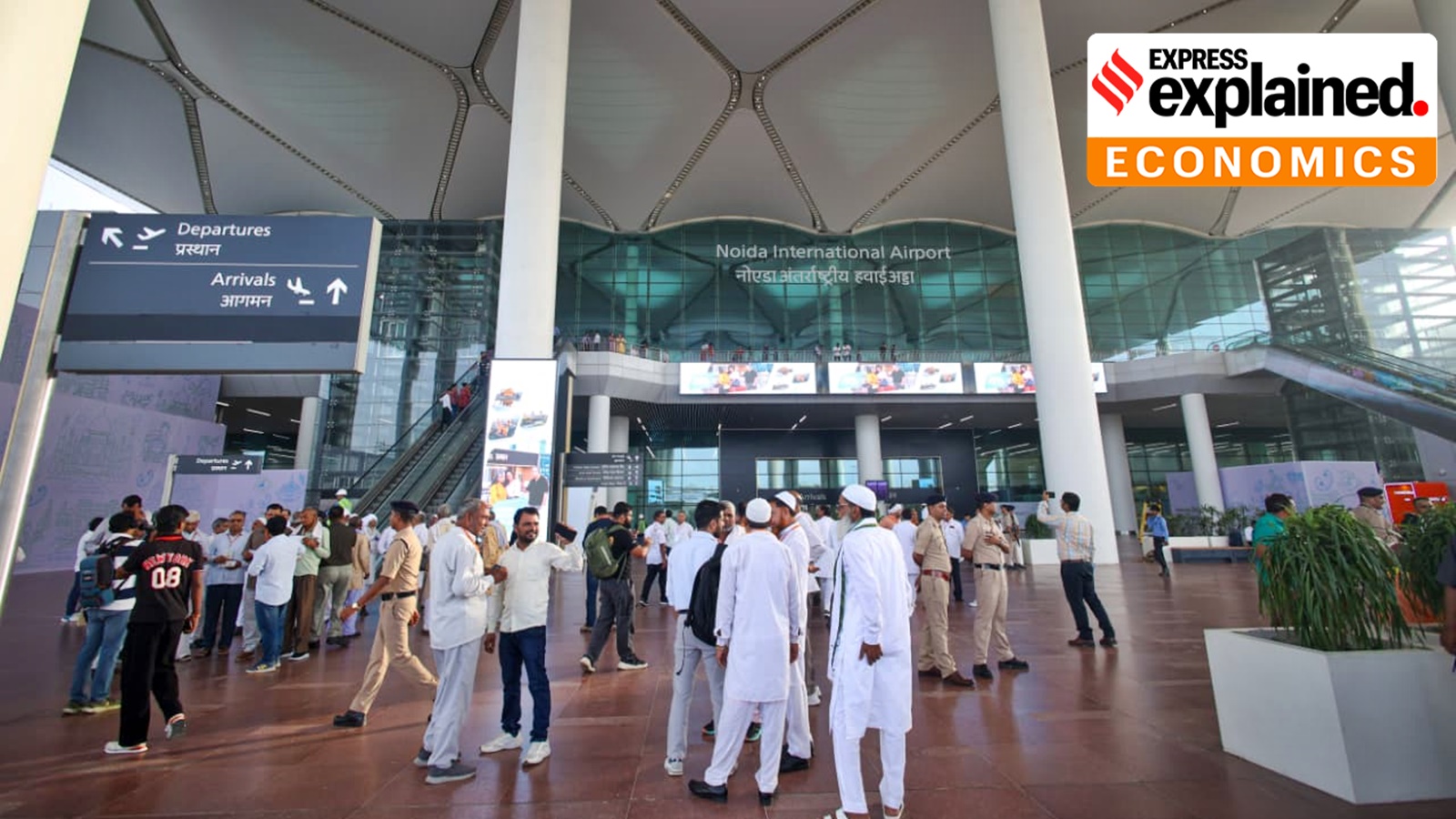
Travellers at the Noida International Airport, Jewar in Uttar Pradesh on Monday. (Express photo by Praveen Khanna)
Noida Airport’s initial network development
According to industry experts, the NIA is likely to be used initially by airlines to mount additional flights connecting the NCR to major metropolitan cities, particularly during the peak hours when the larger Delhi airport is chock-a-block. It is also likely to be used to operate ultra-short-haul flights on regional routes, apart from densifying and expanding the network between the NCR and tier II and III cities.
Among domestic flights, IndiGo is starting operations with eight daily flights — four each from Monday and Tuesday — connecting the NIA with Hyderabad, Amritsar, Bengaluru, and Jammu, and vice versa. Akasa Air will start its NIA operations with four daily flights connecting the airport with Bengaluru and Navi Mumbai.
Story continues below this ad
From July, IndiGo will notably increase its presence, taking daily flights to 28 (departures plus arrivals) with another four flights that will operate four times a week, two flights thrice a week, and another two twice-a-week flights. It will include destinations like Lucknow, Chandigarh, Dehradun, Bhopal, Jaipur, Jodhpur, Bareilly, Pantnagar, Kishangarh, and Dharamsala.
“IndiGo will directly connect the airport to over 16 destinations across India. This also enables seamless, one-stop connectivity between 14 city pairs like Amritsar to Jodhpur; Bareilly to Bhopal, Jaipur, and Jodhpur; Dharamshala to Jodhpur; Chandigarh to Bareilly, Kishangarh, and Pantnagar; Jammu to Jodhpur; Jaipur to Dharamshala and Pantnagar; Kishangarh to Bhopal; Pantnagar to Jaipur and Jodhpur and so on,” IndiGo said Monday.
Akasa Air has not announced expansion plans so far, but said that the NIA will evolve into a key pillar of its network architecture. It also remains to be seen how the Air India group will build its network from the NIA, if and when it starts operations.
Why Noida airport may be a slow-starter vis-à-vis Navi Mumbai
With the Navi Mumbai International Airport (NMIA) launching commercial operations last December, India’s financial capital became the first Indian megacity to be served by two major airports, bringing relief amid the capacity constraints at Mumbai airport.
Story continues below this ad
Both NMIA and NIA are secondary airports that will initially operate under the shadow of the much larger primary airports for broader urban regions. Yet, some key differences are bound to shape the manner and scale of operations, at least in the initial few years.
While NMIA is bound to have a strong start with rapid scale-up, NIA may be relatively slow on these counts initially. In the long run, though, it is expected to cement Delhi NCR’s position as India’s primary aviation hub.
This is because Mumbai’s primary airport — Chhatrapati Shivaji Maharaj International Airport (CSMIA) — is already saturated owing to space constraints. At any given point in time, only one of its two intersecting runways can operate. This essentially means that any additional capacity in the Mumbai Metropolitan Region (MMR) must come from NMIA. This is a boon of sorts for NMIA, as airlines looking to expand their network in and out of the financial capital must do so through the new airport, providing it with almost ready demand and traffic.
However, Delhi’s Indira Gandhi International Airport (IGIA) — India’s largest airport with three terminals and four runways — still has scope to expand its passenger handling, as well as flight capacity, and is not as terribly congested as CSMIA. It plans to expand its passenger handling capacity from the current 105 million to around 125 million over the next few years.
Story continues below this ad
Future prospects of Noida International Airport
After a few years, when the IGIA is saturated, NIA most certainly will become the driver and beneficiary of aviation growth in the region. Notably, Delhi is the biggest hub for leading Indian carriers, IndiGo and Air India.
NIA’s ready catchment will include flyers from western Uttar Pradesh and some other parts of the NCR that solely relied on IGIA, but the existing Delhi airport has unmatched size, scale, and destination network that the Jewar airport will take a while to build.
It is also worth noting that IGIA and NIA, unlike the CSMIA and NMIA, will be run by different operators — IGIA by GMR and NIA by Zurich Airport, which would add to the competitive streak. Both CSMIA and NMIA are operated by Adani Airport Holdings.
Furthermore, the location of NIA — away from large urban settlements — will be a challenge in the absence of rapid multi-modal connectivity. Despite having expressway connectivity, it is located 80 km from central Delhi and around 60 km from central Noida. Although there are plans to have rapid rail and even high-speed rail connectivity for the NIA, those projects will take a few years.
Story continues below this ad
On the other hand, IGIA has excellent connectivity with two metro lines, including the express line that connects the airport to central Delhi in about 20 minutes.
In comparison, the NMIA is in the vicinity of large urban settlements of Navi Mumbai, and is less than 40 km from south Mumbai. From areas like Kalyan and Thane, the NMIA is only a few kilometres further away than the CSMIA. The MMR’s existing suburban railway network also supports connectivity to NMIA. This provides a large catchment area for the airport.
In the long term, though, NIA’s location away from densely populated areas could mean better capacity expansion potential vis-à-vis NMIA. NIA’s location also positions it as a major air cargo and logistics hub in northern India.
View original source — Indian Express ↗
Related stories

Lovin Malta
TechnologyJun 15, 2026 · 1 min
Watch: ‘Cancer Treatment But Make It Influencer Like’ – Local Creator Shares Journey
Lovin Malta

ZDNet
TechnologyJun 15, 2026 · 1 min
I installed a $17 solar panel onto my doorbell camera, and it's easily my best smart home investment
ZDNet

Lovin Malta
TechnologyJun 15, 2026 · 1 min
Watch: Drivers Urged To Avoid Selmun Hill Following Traffic Incident
Lovin Malta

BBC
TechnologyJun 15, 2026 · 1 min
Social media ban - bold and blunt, but no silver bullet
BBC