Indian Express
Indian Express··3 min read
Revisiting the ‘Dancing Girl’: The Harappan bronze figurine and its NCERT representation
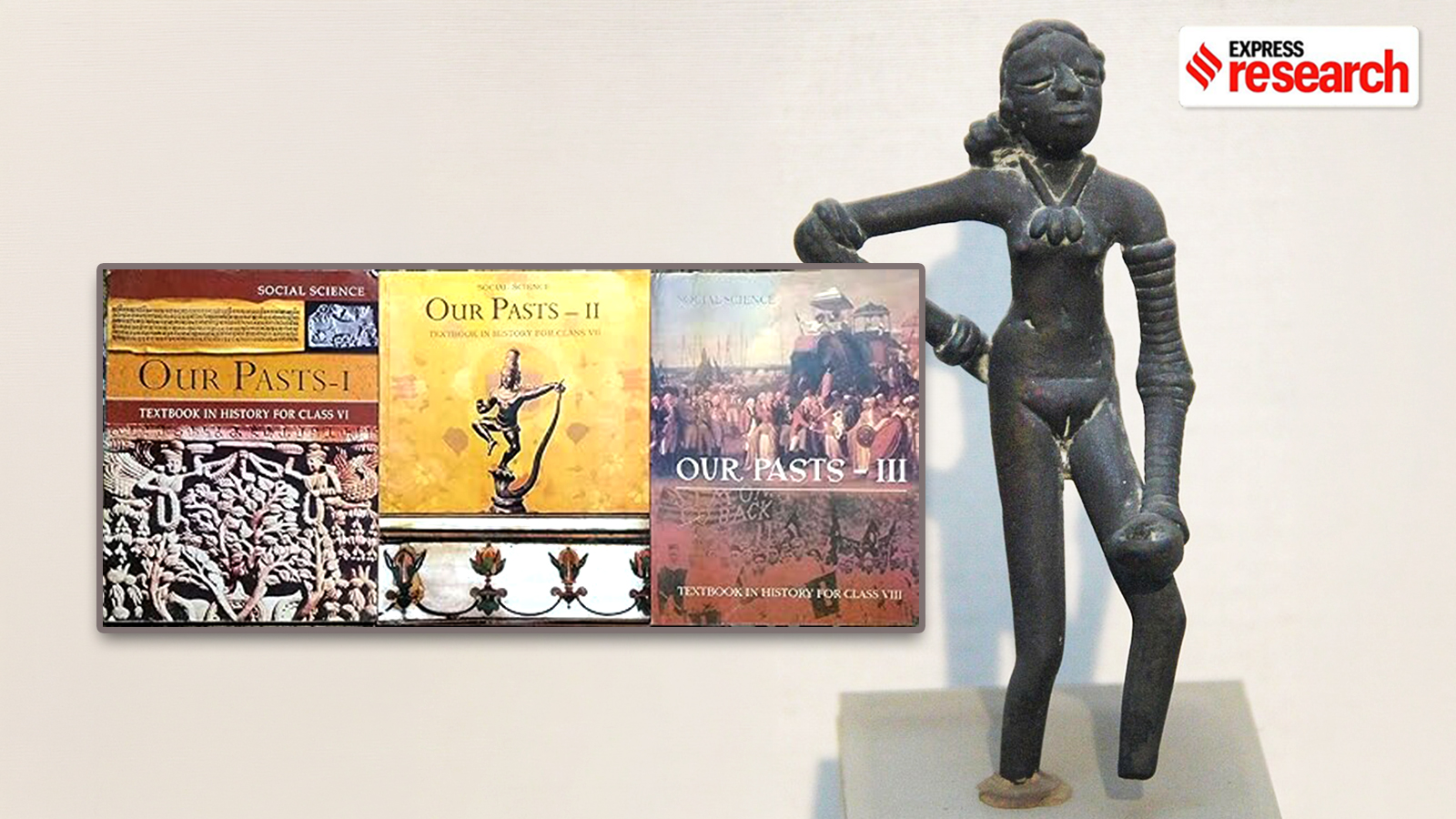
The iconic Harappan bronze figurine known as the “Dancing Girl” has been shown in a revised form in the latest NCERT textbook, with the illustration depicting her torso as covered. The change has drawn attention to one of the most recognisable artefacts of the Indus Valley Civilisation, first excavated nearly a century ago.
The “Dancing Girl” was one of two bronze female figurines found at Mohenjo-Daro, discovered in a small house in the south-western quarter of the city during the 1926–27 excavations. The 10.8 cm figurine depicts a slender woman standing with her right hand on the back of her hip and her left hand resting on her left thigh, just above the knee.
Her head is tilted back, and she has a defiant, nonchalant air about her. Her hair is swept back into a low, loose bun at the nape of her neck.
In A History of Ancient and Early Medieval India (2009), historian and academic Upinder Singh writes, “She may have once held some object in this hand. She is naked. She wears a necklace and has 24-25 of bangles on her left arm and just 4 on her right arm.”
Singh notes in her work that archaeologist John Marshall named her the “Dancing Girl” because he thought she had the air of a semi-impudent “nautch girl.”
‘Most celebrated representative’
For one thing, writes John Keay in India: A History (2010), her features, including her full lips and broad nose, “are distinctly proto-Australoid, a type not usually associated with the Central Asian culture of Namazga.”
Keay argues that skeletons unearthed in the Indus Valley attest to the Harappan people belonging to several racial types, among them one related to Australia’s Indigenous peoples and still represented in parts of India: the proto-Australoid type.
Story continues below this ad
Furthermore, although most of the surviving Harappan stone sculptures were found at Harappa itself, where contacts with Namazga appear to have been closest, the “Dancing Girl” was found at Mohenjodaro, whose external trade was more oriented toward the Persian Gulf and Mesopotamia.
“A better case will need to be made before the Harappans are robbed of their most celebrated representative,” says Keay.
Lost-wax method
According to Singh, the figurine was made using the lost-wax method. “The lost-wax method,” she writes, “involves first making a wax model and then covering it with a clay coating, leaving some holes as passageways.
When the clay-covered moulds are heated in ovens, the wax melts out.” Singh notes that once the mould cools, the outer clay envelope is chipped off, and the craftsperson can then put the finishing touches on the solid bronze statue.
Story continues below this ad
Admired even after 4,000 years
“But the ‘dancing girl’ may not have been dancing at all, and even if she was, she may not represent a professional dancer,” writes Singh.
Keay agrees that, although she was probably not dancing, “the ‘Dancing Girl’ is unquestionably “a pleasing little thing.”
Naked except for a chunky necklace and an assortment of bangles, this figurine, according to Keay, is not the usual Indian sex symbol. He suggests that she could be absent-mindedly surveying her wardrobe, were it not for the way her head is thrown back, as if challenging a suitor.
“Decidedly, she wants to be admired”, and, 4,000 years later, she still is.
View original source — Indian Express ↗
Related stories

The Punch
PoliticsJun 15, 2026 · 1 min
Macron warns Iran against imposing Hormuz tolls
The Punch
The Punch
PoliticsJun 15, 2026 · 1 min
Reps extend 2025 capital budget implementation to September
The Punch
The Punch
PoliticsJun 15, 2026 · 1 min
Avoid political influence, Adeleke warns corps members ahead of Osun poll
The Punch
The Punch
PoliticsJun 15, 2026 · 1 min
Reps aspirant sues NDC for N5bn over ‘scrapped’ primary
The Punch