Times of Israel
UK PM Starmer announces ban on social media for under-16s
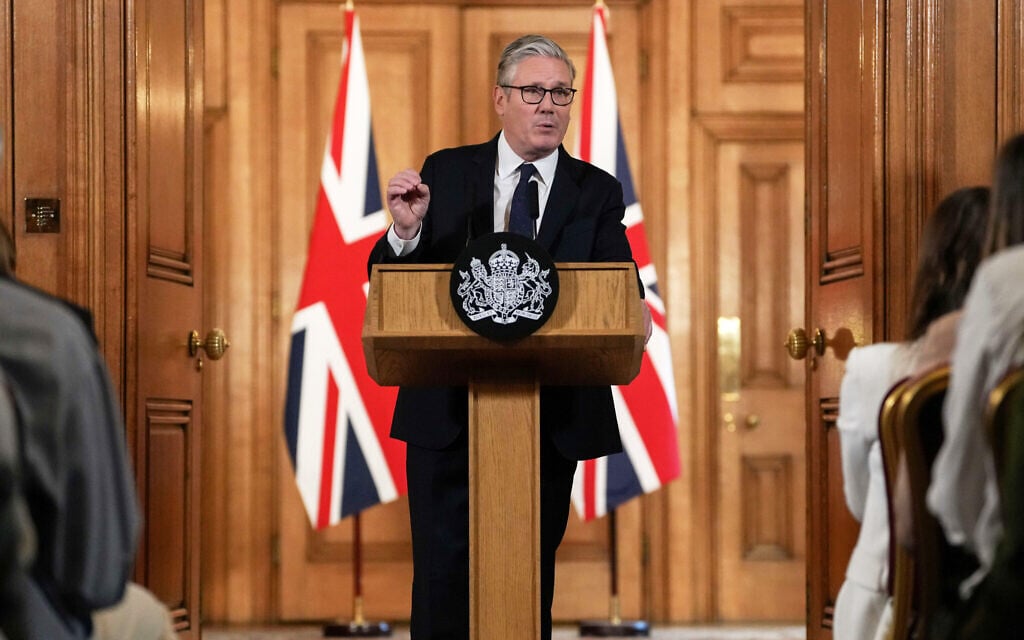
LONDON (AP) — Britain will ban under-16s from using a range of social media apps, its Prime Minister Keir Starmer said Monday, calling it “a big moment for our country.”
Starmer told a news conference that he will fight back if technology companies resist the move, intended to protect children from harmful content and excessive screen time. He said he is “not prepared to compromise on the safety and happiness of our children.”
The move makes the UK part of growing global movement to tighten online safety for children. Australia, Canada, Brazil and Indonesia have introduced legislation or announced age-based restrictions or requirements for children’s access to social media.
France, Spain, Denmark, Thailand and South Korea are among others studying or developing similar approaches.
Starmer said the UK measures “possibly go a bit further” than Australia’s ban, which bars under-16s from holding social media accounts and allows for multimillion-dollar fines for tech firms if they don’t remove them.
Get The Times of Israel's Daily Edition
by email and never miss our top stories
By signing up, you agree to the terms
The UK said its ban will apply to platforms including Snapchat, TikTok, YouTube, Instagram, Facebook and X, but not messaging services like WhatsApp and Signal.
Starmer said the government will also act to prevent strangers from contacting children on gaming and live-streaming platforms. He said the ban will take effect early next year.
Starmer, elected just under two years ago is under pressure to step down from members of his own party over what they see as poor leadership and could face a leadership challenge in the coming days or weeks. He is seeking to bring in consequential measures that can serve as a legacy.
The prime minister, who has two teenage children, said success for the ban would mean “a massive drop off of children on social media” and “a cultural change, a sense that actually you can grow up differently.”
Starmer said the government is “confident that this ban can be effective,” despite skepticism from some children’s advocates.
The decision follows a public comment period in which the government got 116,000 responses from parents, the tech industry and children. The number of responses was second only to one seeking input about same-sex marriage in 2012.
The vast majority of respondents — more than 90% — wanted an under-16 ban, the government said.
???? WATCH: School children react to the UK social media ban for under-16s live on BBC News pic.twitter.com/BC9NSegMrf
— Politics UK (@PolitlcsUK) June 15, 2026
Esther Ghey, whose 16-year-old daughter Brianna was killed in 2023 by two teenagers who had accessed harmful content online, said the ban would “potentially save so many children’s lived,” but had to be accompanied by other measures.
She told the BBC that she is happy “that the government are now investing in after-school clubs, because we can’t just take things away from children.”
The ban could further inflame tensions with the US, which has warned that regulations should be narrow and not violate free speech protections, according to a statement from the US Embassy in London. It said it was also concerned that regulations would place greater burdens on American technology companies.
Starmer said he expected to discuss the issue with US President Donald Trump and other world leaders at a Group of Seven summit in France that starts Monday.
“I honestly think that across world leaders, there has always been a recognition that leaders have to take steps to protect children,” he said. “I don’t think that’s controversial. There will always be arguments as to exactly what the limits of that are and what rules should be in place, but I don’t see that as a problem.”
Jon Crowcroft, a communications systems professor at University of Cambridge, said people supporting social bans are well-meaning but probably misguided, and changes could prevent children from accessing sites they need.
“There is a real risk this will drive some users to worse sites and policing devices is close to impossible technically,” Crowcroft said. “Policing platforms is far easier, if only regulators would bother.”
View original source — Times of Israel ↗
Related stories

BBC
TechnologyJun 15, 2026 · 1 min
Social media ban - bold and blunt, but no silver bullet
BBC

TechRadar
TechnologyJun 15, 2026 · 1 min
Early Prime Day deals just dropped at Amazon UK — get up to 65% off Ring, Blink, Ninja, Apple, Sonos, and more
TechRadar

TASS
TechnologyJun 15, 2026 · 1 min
Russia hopes US will not abandon Ukrainian issue — Lavrov
TASS
South China Morning Post
TechnologyJun 15, 2026 · 1 min
China credit data shows sluggish demand, more household deleveraging amid weak investment
South China Morning Post