Indian Express
Tunnel hoods in Mumbai-Ahmedabad bullet train project: What they are, why they matter
The tunnels in the Mumbai-Ahmedabad High Speed Rail (MAHSR), India’s first bullet train project, are entering the next phase of construction after the critical breakthroughs, where it will incorporate a unique feature being introduced for the first time in Indian Railways: tunnel hoods.
The 508-km project has seven mountain tunnels in Maharashtra and one mountain tunnel in Gujarat. Each tunnel will have tunnel hoods or entrance hoods at both ends. The entrance hood — meaning the entrance — in Gujarat’s only tunnel in Valsad has taken shape and is nearing completion.
“This is the first time such tunnel hood technology has been designed and implemented for railway tunnels in India. It has been designed to mitigate the tunnel boom effect caused by pressure waves generated by high-speed trains,” said the National High Speed Rail Corporation Limited (NHSRCL), the project’s implementing agency.
Why are tunnel hoods needed?
Maharashtra’s bullet train tunnels are situated in Palghar district, where the alignment cuts through the difficult terrains of the Sahyadri mountains. Here, the tunnels replace viaducts, and engineering becomes more complex.
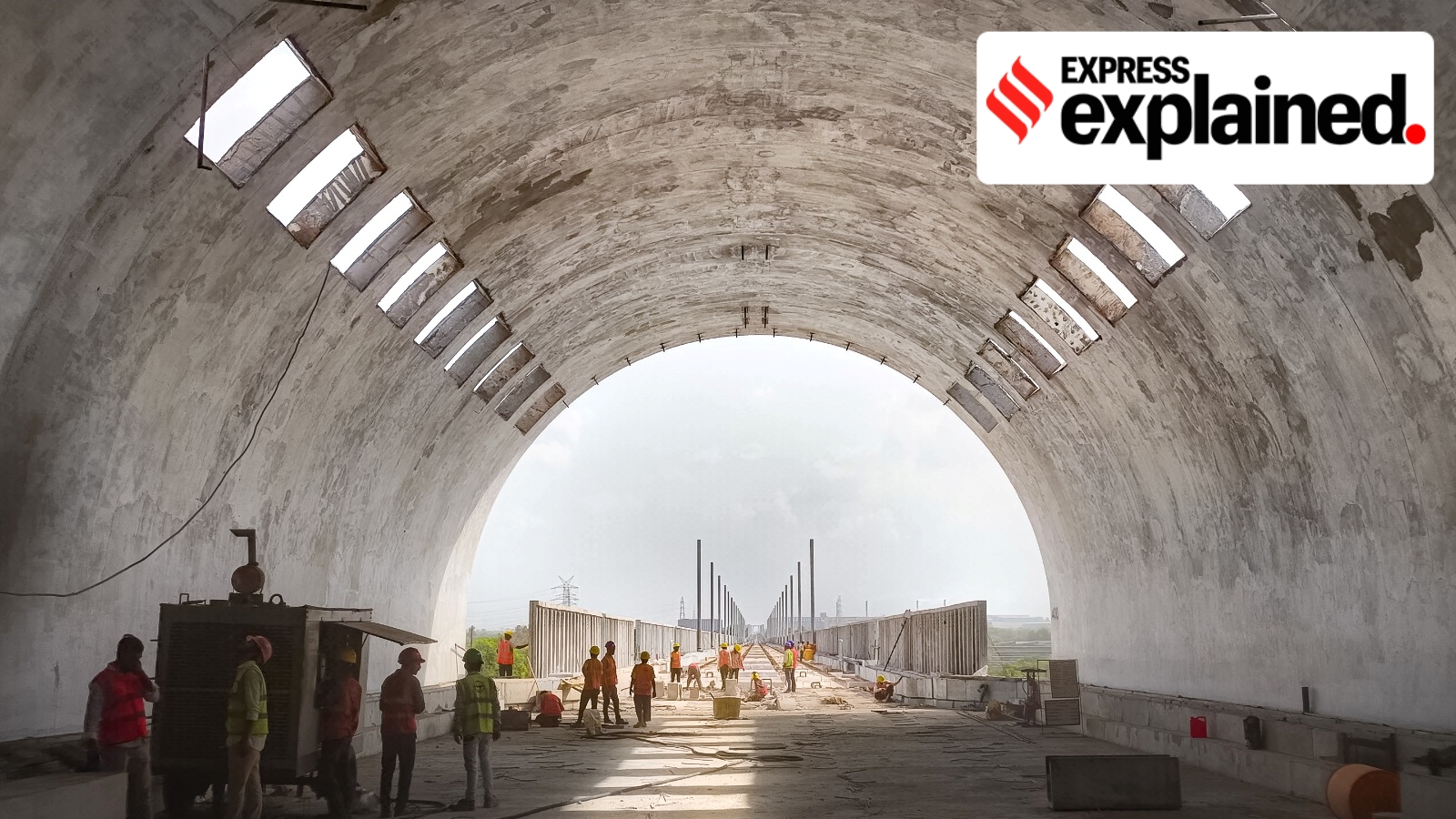
Tunnel hoods are cylindrical-shaped structures that have pressure-relief vents or windows and are built at the entrance and exit of the main tunnel. It is a common feature on high-speed rail systems in countries operating bullet trains, where trains travel at speeds exceeding 300 km per hour.
On the requirement of tunnel hoods, a senior NHSRCL official said that when a high-speed train enters a tunnel, it pushes a large volume of air ahead of it, similar to a piston moving inside a cylinder.
“This sudden compression of air generates pressure waves that travel through the tunnel. If not properly managed, these pressure waves can create booming noise, similar to the explosion, when a train exits the tunnel,” the official said.
Story continues below this ad
“Tunnel hoods act as a transition zone between the open environment and the confined tunnel space. By allowing air to enter and exit more gradually, they help control pressure changes and improve the overall aerodynamic performance of the system,” the official added.
The windows in the tunnel hood help release this air pressure generated by the high-speed trains gradually. The number of windows varies from one tunnel to another. According to NHSRCL, the seven tunnels in Palghar will have tunnel hood windows ranging from 20 to 26. Apart from this, the size of these hoods ranges from 31 metres to 45 m on each side, which increases the overall length of the tunnel.
On the requirement of tunnel hoods, a senior NHSRCL official said that when a high-speed train enters a tunnel, it pushes a large volume of air ahead of it, similar to a piston moving inside a cylinder. Photo: Express
For instance, mountain tunnel no. 6 (MT-6) in Palghar is originally 390 m long, but the 32 m tunnel hoods with 20 windows on each side increase the total length of tunnel to 454 m. The work on this particular tunnel began on January 31, 2025, and breakthrough was achieved in 360 days. Breakthrough is a critical point when tunnels being excavated from both sides finally meet in the middle as per the alignment, ensuring continuous passage.
A senior official of engineering and infrastructure major L&T, which is building bullet train mountain tunnels, said that entrance hood technology will upgrade India’s tunnel construction system.
Story continues below this ad
“This project is about not only building India’s first bullet train, but it has also been a great learning experience for us as well. In tunnel construction, we have to improvise every day. Our geologist does that. In this, the overburden was less, that is why it is challenging. The average excavation per day was 0.5 m to 1 m,” the L&T official told The Indian Express.
What is the overall status of tunnels?
Of the project’s total length of 508 km, the tunnels account for 27.4 km. This includes 21 km of underground tunnels, with the remaining 6.4 km composed of surface tunnels or mountain tunnels. The seven tunnels in Palghar cover a distance of 6.05 km and one tunnel in Valsad is 350 m.
On June 2, MT-7 achieved a breakthrough — the third mountain tunnel to do so, and the fourth overall. MT-7, which is 417 m long and 14 m wide, is situated between Vapi (Gujarat) and Boisar (Maharashtra) stations.
Regarding the ambitious 21-km-long underground tunnel, a breakthrough of a 4.88-km underground section between Ghansoli and Shilphata was achieved in September 2025. This is part of the bigger tunnel being constructed between Bandra-Kurla Complex (BKC) and Shilphata in Maharashtra.
Story continues below this ad
The remaining 16 km of the tunnel will be excavated by a tunnel boring machine, which is currently being assembled at two sites — Vikhroli in Mumbai and Sawli in Navi Mumbai. This underground stretch also includes a 7-km-long undersea section beneath the Thane Creek.
The first section of the 48-km Surat-Bilimora stretch of the 508-km project is scheduled to be operational by August 2027. The entire project from Ahmedabad to Mumbai is targeted to be operational by 2029.
View original source — Indian Express ↗
Related stories

Portugal Resident
TechnologyJun 15, 2026 · 1 min
GNR to deploy 28 drones to help detect wildfires this summer
Portugal Resident

ZDNet
TechnologyJun 15, 2026 · 1 min
Container made it easy to run Linux on my MacBook - here's how I set it up
ZDNet

Engadget
TechnologyJun 15, 2026 · 1 min
EA created an entire division to push more in-game ads
Engadget

VentureBeat
TechnologyJun 15, 2026 · 1 min
Vibe coding can build your pipeline. It can't explain it six months later
VentureBeat