Indian Express
Indian Express··3 min read
Why are we afraid of the Dancing Girl of Mohenjo-daro?
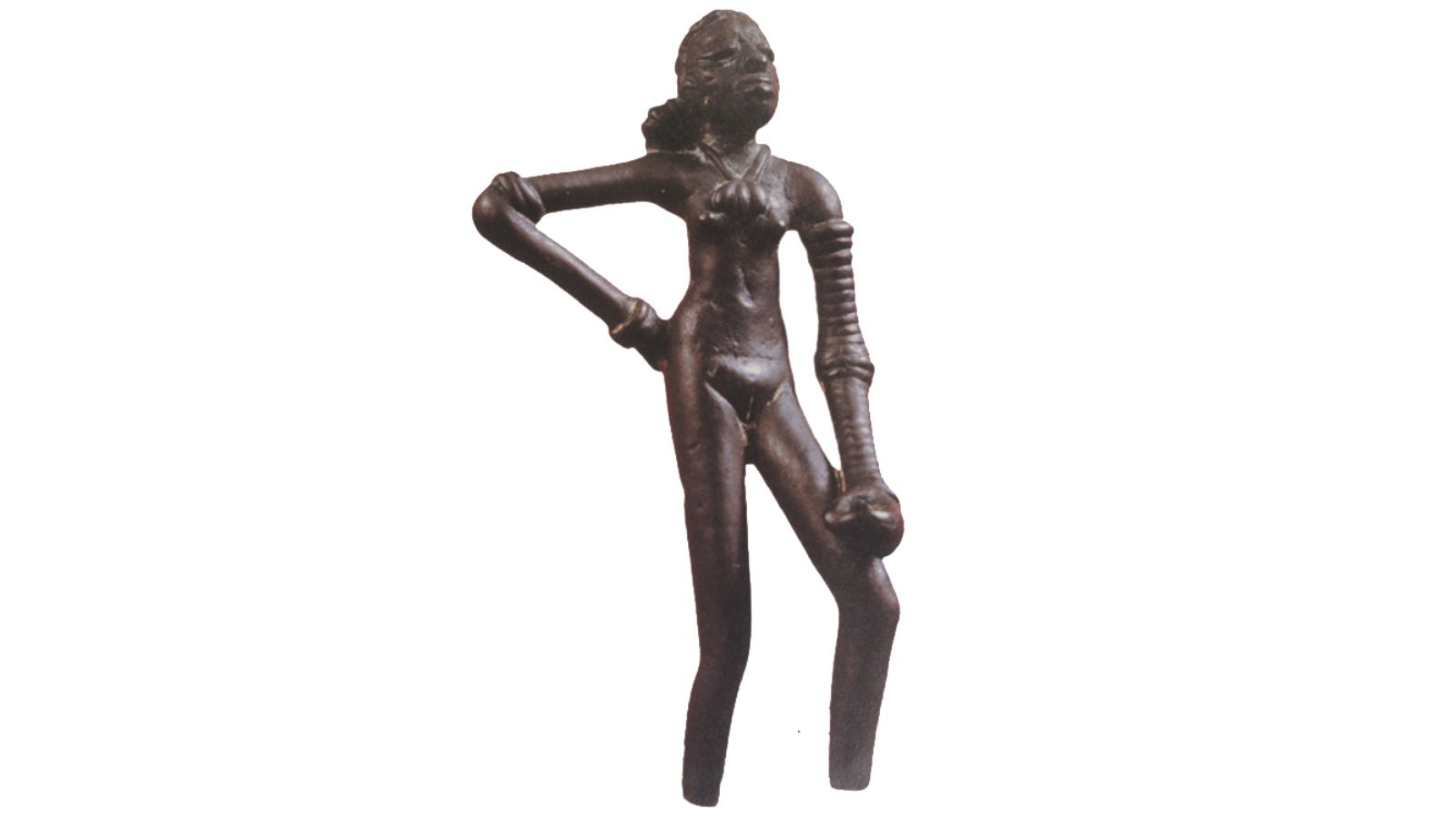
Around 2500 BCE, the artisans of Mohenjo-daro made a small palm-sized metal figurine. It was of a nude girl, standing, her unruly hair pulled back in a bun, a hand on her hip, the other one, laden with bangles, placed casually on a bent front leg. Her resting bitch face seems to say, “oh yeah?” as the gaze of her 10.5-cm bronze physique sizes you up.
When this Indus Valley artefact was unearthed by British archaeologist Ernest Mackay in 1926, in present day Sindh, Pakistan, the advanced metallurgy, the detailing and the distinct Harappan artistry won admiration from around the world. The statue only proved what a progressive egalitarian civilisation it was for its time. And because the world largely saw her as a semi-impudent nautch girl, hand on hip, beating time to the music with her feet, the name ‘Dancing girl’ stuck.
Although she’s locked away safe behind a glass case in the National Museum of New Delhi, she is amused to find herself amidst a stormy controversy every few years.
She’s heard the questions before from prying eyes. Was she a nautch girl? A courtesan? A defiant teenager? A housewife refusing to make rotis? A warrior with a weapon fallen from her hand? A jilted lover? A chieftain stirring up a rebellion? A member of a cult caught in a ritual? A tribal goddess being worshipped? The face of ‘Occupy Harappa’?
But after 4,500 years since she roamed the earth, in circa 2026 the NCERT stomped into the scene to ask: Wait, why is she wearing so little? And parading in our children’s history textbooks? Quick, cover her up. Thanks to an AI touch up, she now appears in textbooks as though dropped in a bucket of cement, devoid of details or expression.
Because more than nudity, perhaps what’s most frightening to the ruling class is the gaze of a woman who knows her worth and has nothing to prove.
In the early 1900s, the famous Tamil Poet Subramania Bharathiyar famously wrote his vision for the modern woman, or Pudhuman Penne.
“Nimirndhu nannadai nerkonda paarvaiyum,
Nilatthil yaarkum anjathey nerikalum,
Thimirndhu nyaana serukkum iruppathaal,
Semmai maathar thirambuva thillayaam.”
“Her head held high, she walks while looking everyone in the eye,
She is a fearless possessor of integrity and wisdom born out of conviction,
The resolute woman does not falter or feel inferior.”
Bharathiyar, a poet and social reformer spent years of his life rejecting an oppressive society that kept women subservient. He argued that a nation cannot be truly free if half of its population is denied education, agency and dignity.
What he put in poetry, the dancing girl encapsulates, by her physical existence. If you listen closely, the two are showing us where we have come from and where we are headed. If the role of art is to expand our imagination, then this forced “digitised” modesty is a failure of our own. We have spent a century projecting our anxieties onto a palm-sized piece of metal — questioning her morality, her nudity, and her defiance. Perhaps what truly unnerves the powers-that-be is what her reflection demands: A woman who refuses to falter, who walks with her head held high, and who, even after two millennia, is still waiting for us to finally meet her gaze.
The writer is a Delhi-based researcher
View original source — Indian Express ↗
Related stories

The Punch
NewsJun 15, 2026 · 1 min
Rivers CP leads enforcement against covered, unregistered number plates
The Punch
The Punch
BusinessJun 15, 2026 · 1 min
State police won’t fix insecurity, Ezekwesili warns, urges full restructuring
The Punch
The Punch
PoliticsJun 15, 2026 · 1 min
Resident doctors protest repeated assaults in Ondo hospital
The Punch
The Punch
NewsJun 15, 2026 · 1 min
Accord Party’s deregistration judgment violates Court of Appeal order – Adeleke
The Punch