Indian Express
Indian Express··5 min read
Paws, claws, and prose: 6 authors and their beloved pets
Pets. We always have a deep sense of belonging to these four-legged creatures. There is a sense of space and security that arrives while petting them. Humans and animals tend to form a curious relationship, one that hits all the chords and embraces you towards the certainty of having one.
There is quite a bit of record one can find when it comes to the relationship that literary figures and writers had with their pets. It is sort of fascinating to understand their relationship, especially the ones that have been recorded in detail. Some have talked about the love they had for their pets, while others have been recorded having the most joyous time around them.
These are some of pets, who tagged along with the authors who made them their muse, during significant stages of their journeys.
1. Mark Twain and Bambino (the cat):
Mark Twain grew deeply fond of Bambino, a cat, he had bought for his daughter, during her prolonged illness. Clara Twain wrote in ‘My Father, Mark Twain’ that initially, she had snuck in a black kitten in her bedroom. But she was asked to dispose of it soon after. She ended up making a present of it to her father. Bambino became his primary roommate, keeping the mourning author company by sitting on his bed while he read, wrote, and grumbled, and even swatting billiard balls back to Twain across his pool table.
2. Elizabeth Barrett Browning and Flush (the cocker spaniel):
Browning’s cocker spaniel was a gift to her from her friend, Mary Mitford. A sporting dog by genes, Flush gave up his outdoor life. He slept at her feet, ate cakes, custards, and heavily buttered bread straight from her hands, and kept her company through years of isolation. Elizabeth was so devoted to him that she wrote two major poems about him, most notably “To Flush, My Dog”, where she wrote: “This dog only, waited on, / Knowing that when light is gone, / Love remains for shining.”
‘Flush is my constant companion, my friend, my amusement, lying with his head on one page of my folios while I read the other.’ (Credit: wikimedia commons)
Flush was also kidnapped twice, but was rescued by Browning soon after. Browning and Flush’s bond remained unturned, despite him biting Robert Browning during the early days, when they were planning about their elopement and he used to pay visit to Elizabeth. Flush instantly became a legendary dog, especially authors like Virginia Woolf. She ended up writing a book titled Flush: A Biography written in 1933 that tells the story of the Elizabeth Barrett Browning through the perspective of her loyal cocker spaniel.
From The Archives: From loyal pets to menacing monsters: How dogs feature in famous books
3. Charles Dickens and Grip (the raven):
Charles Dickens, one of the most prominent writers of the Victorian era, owned a raven. Grip was treated just like a family dog or cat, allowed to wander freely around their home at 1 Devonshire Terrace near Regent’s Park. He stood about 18 inches tall and he quickly established herself as the dominant force in the house.
Story continues below this ad
Grip now lives in the Rare Books Department of the Free Library of Philadelphia. (Credit: Wikipedia)
In one of the instances, Grip used is massive beak to chip off and eat pieces of painted surfaces around the estate, including the family carriage. In 1841, the stable was freshly repainted, and Grip ingested a lethal amount of lead-based paint chips. Dickens, quite worried about his condition, called a vet, who advised for large doses of castor oil.
However, even that wasn’t enough. On March 12, 1841, Dickens wrote a dark humoured letter to his friend, the artists, Daniel Maclise about his raven’s death. In his letter he also mentioned, ‘On the clock striking twelve he appeared slightly agitated, but he soon recovered, walked twice or thrice along the coach-house, stopped to bark, staggered, exclaimed Halloa old girl! (his favourite expression) and died.’ After Grip died, Dickens also had him taxidermied.
4. EB White and Minnie (the daschund):
Author EB White was a huge dog lover, and owned dozens of dogs during his lifetime. However, Minnie, a daschund played a crucial part in his life. She was a dedicated homebody whose ideal day would look like ‘a warm bed, preferably with an electric heating pad, a friend in bed with her, and plenty of shut-eye, night and days.’
Minnie became famous in 1951, when the ASPCA (American Society for the Prevention of Cruelty to Animals) mistakenly sent White a stern legal notice accusing him of “harbouring an unlicensed dog” in New York. The letter White wrote back to them was legendary. In the letter he also mentioned that “If by ‘harbouring’ you mean getting up two or three times every night to pull Minnie’s blanket up over her, I am harbouring a dog all right. The blanket keeps slipping off… with this night duty of mine, the way the blanket slips and all, I haven’t had any real rest in years. Minnie is twelve.”
Story continues below this ad
5. Virginia Woolf with Pinka (the cocker spaniel) and Mitz (the marmoset):
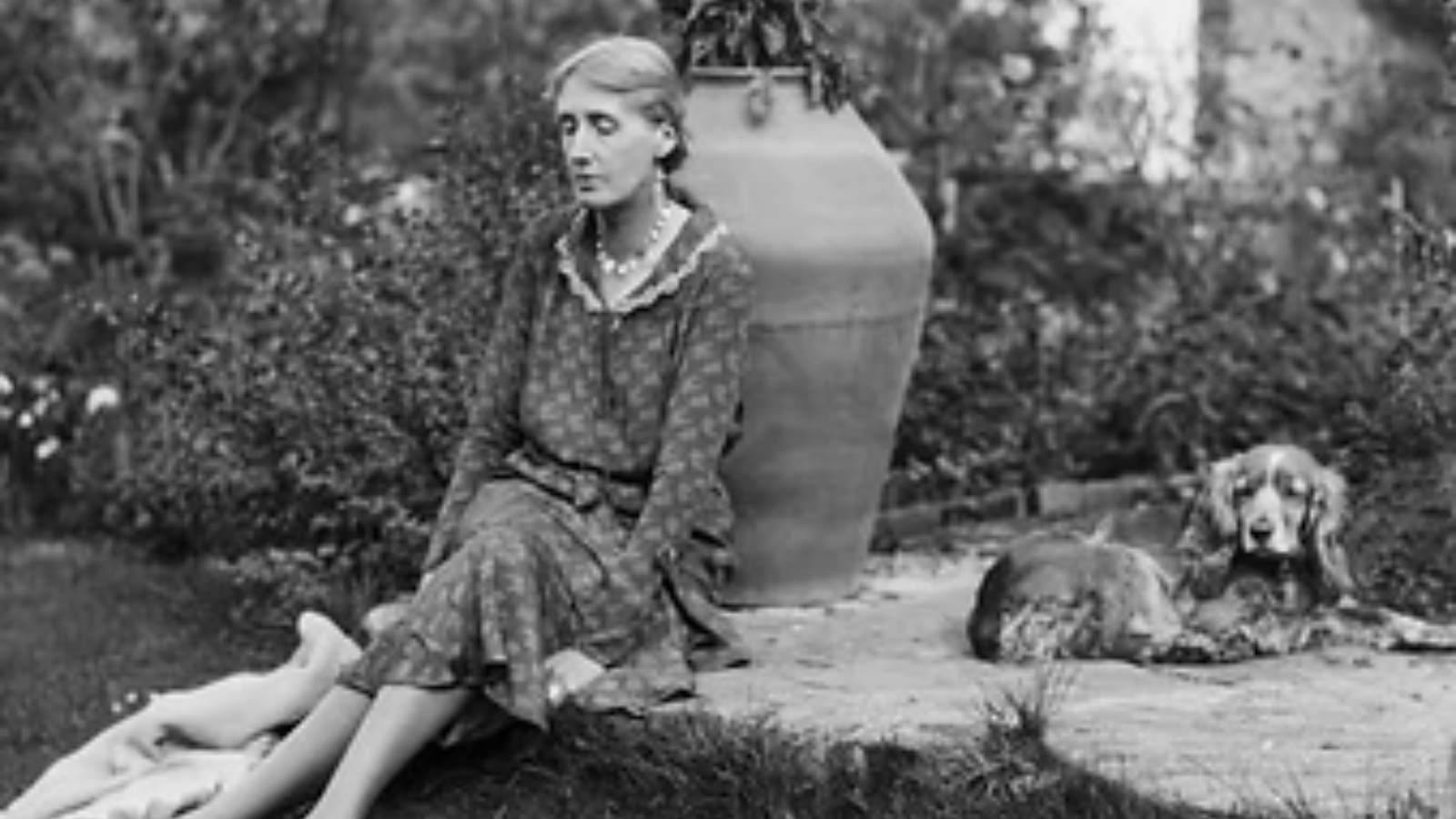
In 1926, a beautiful, golden-brown black-masked Cocker Spaniel puppy named Pinka was gifted to Virginia Woolf by her close friend and lover, Vita Sackville-West. Pinka followed Virginia everywhere, sleeping at her feet while she wrote, and serving as a calming, grounding presence during her severe mental health struggles.
Mitz was a frail marmoset monkey who originally belonged to a director of the London Zoo. When the monkey became too sick and weak, Leonard Woolf, Virginia Woolf’s husband, who loved exotic animals, took her in during the mid-1930s. Against all odds, the Woolfs nursed Mitz back to health. To go for a vacation in Italy, the Woolfs made a dangerous decision to travel through Nazi Germany. Cramming through the crowd in their car, the aggressive Nazis became joyous as they saw Mitz, since they had never seen a creature like a marmoset monkey. Virginia later noted that the monkey had quite literally saved their lives that day. Later, author Sigrid Nunez wrote about the monkey in the 1998 biographical novella, Mitz: The Marmoset of Bloomsbury.
From Dolittle to Tarzan: What iconic primatologist Jane Goodall read as a child
6. John Steinbeck and Charley (the poodle):
John Steinbeck owned a ten year old French Poodle named Charley, without whom, he refused to travel alone. In 1960, Steinbeck felt like he had lost touch to his very own country and ended up travelling around the country with his dog, Charley. He then, produced a book titled, ‘Travels with Charley: In Search of America.’
Through it all, Charley was his anchor. Talking to Charley became Steinbeck’s primary way of processing his thoughts. (Credit: amazon.in)
Charley became a full-time companion to Steinbeck, and someone who’d help him process his philosophical thoughts. The great American trip ended in New York. However, he dedicated the entire book to Charley, and it remains one of the most significant works that talk about the transition of America during the period.
View original source — Indian Express ↗
Related stories

The Punch
NewsJun 15, 2026 · 1 min
Rivers CP leads enforcement against covered, unregistered number plates
The Punch
The Punch
BusinessJun 15, 2026 · 1 min
State police won’t fix insecurity, Ezekwesili warns, urges full restructuring
The Punch
The Punch
PoliticsJun 15, 2026 · 1 min
Resident doctors protest repeated assaults in Ondo hospital
The Punch
The Punch
NewsJun 15, 2026 · 1 min
Accord Party’s deregistration judgment violates Court of Appeal order – Adeleke
The Punch