Indian Express
UPSC Key: Dancing Girl of Mohenjo-daro, Hiuen Tsang and Queen Pineapple
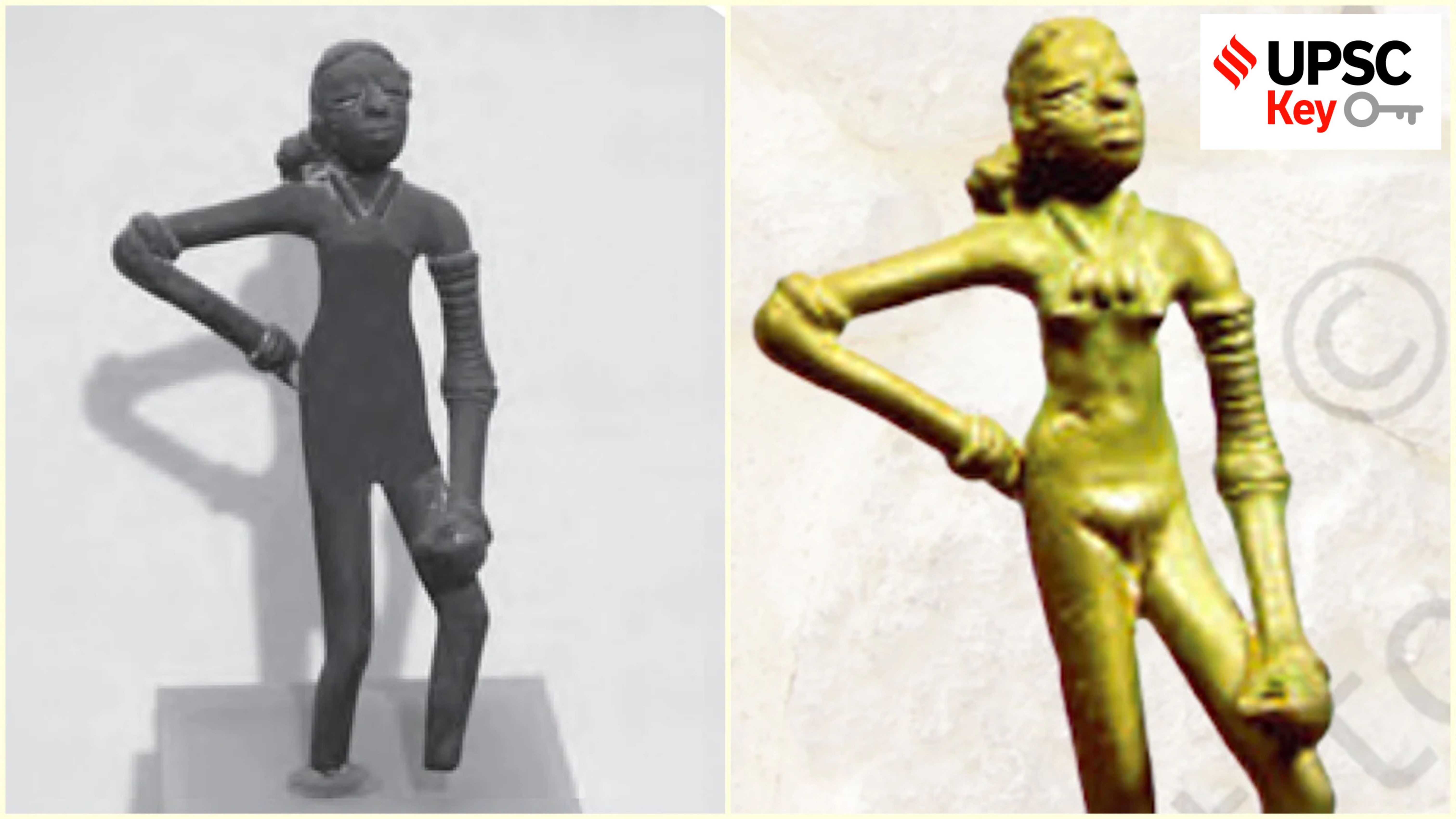
In NCERT Art textbook, ‘Dancing Girl’ covered up
Syllabus:
Preliminary Examination: Current events of national and international importance.
Mains Examination:
• General Studies I: Indian culture will cover the salient aspects of Art Forms, literature and Architecture from ancient to modern times.
• General Studies II: Government policies and interventions for development in various sectors and issues arising out of their design and implementation.
What’s the ongoing story: An image of one of the most recognisable artefacts of the Indus Valley Civilisation, the iconic “Dancing Girl” of Mohenjo-daro, appears in a new avatar in an NCERT textbook — with the bare torso covered.
Key Points to Ponder:
• What do you know about the iconic “Dancing Girl” of Mohenjo-daro?
• The Dancing Girl figurine was made using which technique?
• What is the recent controversy with the iconic “Dancing Girl” of Mohenjo-daro?
• What does the Dancing Girl figurine reveal about the artistic achievements of the Harappans?
• How does the Dancing Girl figurine contribute to the understanding of Harappan social and cultural life?
• To what extent do artifacts such as the Dancing Girl and Priest-King help historians interpret Harappan society?
• Should educational content prioritise historical accuracy over contemporary social sensitivities?
• How debates over historical symbols and artifacts reflect broader social and cultural concerns?
Key Takeaways:
• This is despite the fact that at an earlier discussion related to the famous bronze figurine, one of the Government’s own experts had pushed back, and prevailed, over objections raised by some members of NCERT over what they said was the nude depiction.
• The retouched photograph now features in the opening chapter, “History of Arts”, of Madhurima — the new arts education textbook for Class 9. In the image, the figurine’s torso has been shaded over from the shoulders down, obscuring anatomical details visible in photographs of the original and giving the impression that she is clothed.
• The depiction is significant because the “Dancing Girl” has appeared in NCERT textbooks for at least 25 years, including during the NDA government when Murli Manohar Joshi was in charge of Education as Minister of the then Human Resource Development ministry. A review by this newspaper of earlier editions shows that while the figurine has long featured in school textbooks, its torso had never previously been covered.
• The retouched image appears in a textbook that is part of NCERT’s first-ever arts education series, introduced from Classes 1 to 10 under the National Education Policy (NEP) and the National Curriculum Framework (NCF) to integrate arts into mainstream education. Textbooks from Classes 1 to 9 have been released so far.
• The approximately four-inch-high “Dancing Girl”, discovered at Mohenjo-daro, depicts a young girl with her hair tied in a bun, adorned with bangles, a bracelet and a necklace. Her confident posture and the sophistication of her craftsmanship have made her one of the defining symbols of the Harappan civilisation.
• Archaeologists have long viewed the figurine as evidence of the civilisation’s advanced metallurgical knowledge. The original is housed in the National Museum in New Delhi.
• In an interview with The Indian Express published on May 27, historian Michel Danino, who headed the textbook development committee for NCERT’s new Class 6 Social Science books, had disclosed that the NCERT objected to placing the “Dancing Girl” on the opening page of a chapter on Indus Valley Civilisation because the figurine was nude and could become “controversial”.
• “I even told NCERT that if the Dancing Girl is not age-appropriate, then perhaps children of that age should not be allowed into the National Museum either because the figurine is displayed there,” Danino had said. While he initially resisted the suggestion, he eventually agreed to move the image from the chapter opener to an inside page and reduce its size. The image, however, was retained in the textbook.
• Asked whether the masking of the torso was linked to concerns over nudity, NCERT Director Dinesh Prasad Saklani told The Indian Express: “No, I don’t think there is any specific reason. In Grade 6 SST (Social Science Textbook), the Dancing Girl is very much there along with many other findings related to Harappan civilisation as it is one of them. For art textbooks you may also contact the related TDT (Textbook Development Team) members.”
Do You Know:
• The Indus Civilisation (3300-1300 BC with its mature stage dated to 2600-1900 BC), also known as the Harappa-Mohenjodaro Civilisation, had been long forgotten till its discovery was announced in 1924. While sites and artefacts from the civilisation were in discussion since the early 19th century, it was not until the 1920s that they were correctly dated and recognised as part of a full-fledged ancient civilisation, much like the ones in Mesopotamia and Egypt.
• After the initial recognition as an ancient civilisation, a spate of excavations were conducted in the two major sites that were known till then – Harappa and Mohenjodaro. The Dancing Girl was discovered in one such excavation in 1926, by British archaeologist Ernest McKay in a ruined house in the ‘ninth lane’ of the ‘HR area’ of Mohenjodaro’s citadel.
• Even though Mohenjodaro and Harappa became part of Pakistani territory after the Partition, the Dancing Girl remained in India as part of an agreement. Today, the bronze figurine sits in the National Museum of India as artefact no. HR- 5721/195, enthralling visitors in the museum’s famous Indus Civilisation gallery, often referred to as its “star object”.
• Over the years, the Dancing Girl has been an object of fascination for archaeologists and historians. Of particular interest has been the pose the woman strikes and what that means.
The figurine has “the pleasing stance of a young and spirited woman”, historian Romila Thapar wrote in The Penguin History of Early India: From Origins to AD 1300 (2002). “This young woman has an air of lively pertness, quite unlike anything in the work of other ancient civilisations,” historian AL Basham wrote in his classic The Wonder that was India (1954).
• Mortimer Wheeler, director of the Archaeological Survey of India (ASI) between 1944 and 1948, described the figurine as his favourite. “A girl perfectly, for the moment, perfectly confident of herself and the world. There’s nothing like her, I think, in the world,” Wheeler wrote. John Marshall, Director-General of the ASI from 1902 to 1928 who oversaw the initial excavations in Harappa and Mohenjodaro, described the figurine as “a young girl, her hand on her hip in a half-impudent posture, and legs slightly forward as she beats time to the music with her legs and feet”.
• What can be inferred from the bronze statuette, though, is the degree of sophistication of Harappan artistry and metallurgy. The Dancing Girl is evidence of the civilisation’s knowledge of metal blending and lost-wax casting – a complicated process by which a duplicate sculpture is cast from an original sculpture to create highly detailed metallic artefacts.
• Moreover, the very existence of a figurine such as the Dancing Girl, indicates the presence of high art in Harappan society. While art has probably been around since the very beginning of human existence, the degree of its sophistication indicates a society’s advancement. The Dancing Girl by all appearances is not an object built for some utilitarian purpose – artists took great time to create an artefact of purely symbolic, aesthetic value.
Other Important Articles Covering the same topic:
📍What Mohenjodaro’s Dancing Girl figurine tells us about the prehistoric civilisation
Previous year UPSC Prelims Question Covering similar theme:
1. The famous female figurine known as ‘Dancing Girl’, found at Mohenjo-daro, is made of (UPSC CSE, 2025)
(a) carnelian
(b) clay
(c) bronze
(d) gold
Trade to AI: India, France set new targets
Syllabus:
Preliminary Examination: Current events of national and international importance.
Mains Examination: General Studies II: Bilateral, regional and global groupings and agreements involving India and/or affecting India’s interests.
What’s the ongoing story: A mechanism to double annual bilateral trade from the existing $16 billion in five years; an India-France Innovation Roadmap 2030; a joint working group focussed on AI (artificial intelligence) governance; an economic security dialogue; increased cooperation on defence and space — these were among the key outcomes of the bilateral meeting between Prime Minister Narendra Modi and French President Emmanuel Macron in Nice, France, on Sunday.
Key Points to Ponder:
• India-France Innovation Roadmap 2030-what are the key takeaways?
• India and France long-standing strategic partnership that spans defence, space, and energy cooperation—Know in detail
• What is the significance of Indo-French cooperation in the Indo-Pacific region?
• Know the role of India-France cooperation in the field of renewable energy.
• How India-France cooperation contribute to India’s clean energy goals and global climate commitments?
• Know the importance of civil nuclear cooperation between India and France.
• What are the strategic and economic implications of civil nuclear cooperation between India and France?
• Know the impact of Indo-French defence collaboration, with a focus on technology transfer and self-reliance in defence manufacturing.
• How does India’s engagement with France in artificial intelligence and emerging technologies align with its Digital India and Make in India initiatives?
Key Takeaways:
• A mechanism to double annual bilateral trade from the existing $16 billion in five years; an India-France Innovation Roadmap 2030; a joint working group focussed on AI (artificial intelligence) governance; an economic security dialogue; increased cooperation on defence and space — these were among the key outcomes of the bilateral meeting between Prime Minister Narendra Modi and French President Emmanuel Macron in Nice, France, on Sunday.
• Modi, who arrived in Nice on Saturday, is scheduled to travel to Slovakia from June 14-16. He will be back in France for the G7 meeting in Evian-les-Bains on June 16-17, and is also scheduled to go to Paris.
• Addressing Macron in a post on X, Modi said: “Nice to have met you in Nice. A productive first leg indeed. The India-France partnership will keep scaling new heights. See you in Evian and Paris.”
• This was their first meeting since the elevation of India-France ties to a ‘special global strategic partnership’ earlier this year.
Do You Know:
• India-France defence cooperation spans the entire spectrum from air and naval assets, to helicopter engines and missiles. Some flagship examples include the Rafales acquired by the Indian Air Force and Navy, Scorpene submarines and Shakti helicopter engines. During Macron’s visit to India in January 2024, it was decided to set up a H125 Helicopter Final Assembly Line (FAL) in Vemagal, Karnataka. Set up by Tata Advanced Systems Limited (TASL) in partnership with Airbus, the FAL was inaugurated in February 2026.
Other Important Articles Covering the same topic:
📍India-France Innovation Roadmap 2030
Previous year UPSC Prelims Question Covering similar theme:
2) Consider the following countries: (UPSC CSE, 2025)
I. United Arab Emirates
II. France
III. Germany
IV. Singapore
V. Bangladesh
How many countries amongst the above are there other than India where international merchant payments are accepted under UPI?
(a) Only two
(b) Only three
(c) Only four
(d) All the five
POLITICS
India, China in talks over joint UNESCO nomination for Xuanzang’s work
Syllabus:
Preliminary Examination: History of India
Mains Examination: General Studies I: Indian culture will cover the salient aspects of Art Forms, literature and Architecture from ancient to modern times.
What’s the ongoing story: To speed up the process of safeguarding heritage, the BRICS countries are deliberating on filing joint nominations for various UNESCO lists. In this line, India and China are in advanced stages of discussions over a joint nomination for ‘The Great Tang Records on the Western Regions’, a narrative of Chinese Buddhist monk and scholar Xuanzang’s travels through medieval India in the 7th century.
Key Points to Ponder:
• Who was Chinese Buddhist monk and scholar Xuanzang?
• The Chinese Buddhist monk and scholar Xuanzang’s travels through medieval India in which century?
• How did Hiuen Tsang describe India?
• Which book did Hiuen Tsang write about India?
• What is Hiuen Tsang’s legacy?
• Who was the ruler of India when Hiuen Tsang visited?
• Which dynasty did Hiuen Tsang belong to?
• Why is Xuanzang/ Hiuen Tsang considered one of the most important foreign travellers in Indian history?
• Know the role of Nalanda University in promoting cultural exchanges across Asia.
• What is Intangible Cultural Heritage (ICH)?
• What is the Intangible Cultural Heritage of India?
• Know about India-China bilateral relations and use of cultural diplomacy to strengthen ties between the nations.
Key Takeaways:
• The proposal, led by China and to be supported by India, is presently under consideration with the Ministry of External Affairs, as per sources. China had earlier reached out through diplomatic channels to convey an interest in pursuing a joint nomination for an inscription in UNESCO’s Intangible Cultural Heritage List.
• The accounts of Xuanzang, also known as Hiuen Tsang, who spent 19 years travelling through India, remain a source for the study of early medieval India. He studied at the Nalanda University and captured the political, social and religious practices of the time in his accounts.
• India also aims at securing a place for Panchtantra on the UNESCO list along with Iran as the fables have been a staple of Persian literature and folklore for over 1,500 years; as also for the philosophy of Satyagraha along with South Africa, official sources told The Indian Express.
• This has come out of deliberations at the recent BRICS Culture Working Group meeting under India’s chair, which was attended by delegations from Brazil, China, South Africa, the UAE, Indonesia and Iran, with representatives from Russia, Ethiopia, and Egypt joining in hybrid mode.
• The second meeting of the BRICS Culture Working Group was held in Varanasi earlier this month. At the inaugural session, Union Culture Secretary, Vivek Aggarwal, highlighted that BRICS countries are home to some of the world’s oldest civilisations while also representing vibrant and evolving contemporary cultural landscapes.
• The recommendations from the Second Culture Working Group meeting will be sent to the BRICS Cultural Track ministerial meeting in August in Bhopal, so that they could be reflected in the joint statement by BRICS Culture Ministers.
• At a panel discussion on “Collaborative Approaches for Safeguarding Shared Heritage: Joint Nominations under the UNESCO World Heritage Convention, Intangible Cultural Heritage, and the Memory of the World Programme”, held during the meeting, delegates explored opportunities for collaborative nominations among BRICS countries.
• The idea is to skip the queue since each country is allowed only two dossiers during the two-year cycle of UNESCO heritage lists, and most BRICS nations have a lot of heritage that needs safeguarding. As per officials, there is no limit on nations filing joint nominations, with the dossier led by one country, backed by others.
Do You Know:
• UNESCO’s Intangible Cultural Heritage (ICH) lists preserve living expressions and traditions, such as oral traditions, performing arts, and festivals. India currently has 16 officially inscribed elements on this prestigious register.
• The Chinese traveller kept a journal of his travels between 627 AD and 643 AD, a large part of which were in India. Hiuen Tsang is supposed to have visited the court of Harshavardhana of Kannauj, who ruled from 606 AD to 647 AD as the last great emperor of north India before the establishment of the Delhi Sultanate in the 13th century.
• In Si-Yu-Ki, or ‘The Buddhist Records of the Western World’, (the first English translation of which was published in 1884 by the Orientalist scholar Samuel Beal) the Chinese traveller Hiuen Tsang (also transcribed as Hsuan Tsang and Xuan Zhuang) wrote about India.
Other Important Articles Covering the same topic:
📍History Headline: The story of Nalanda, in the words of Chinese pilgrims
Previous year UPSC Prelims Question Covering similar theme:
3) The Chinese traveler Yuan Chwang (Hiuen Tsang) who visited India recorded the general conditions and culture of India at that time. In this context, which of the following statements is/are correct? (UPSC CSE, 2013)
1. The roads and river-routes were completely immune from robbery.
2. As regards punishment for offences, ordeals by fire, water and poison were the instruments for determining the innocence or guilt of a person.
3. The tradesmen had to pay duties at ferries and barrier stations.
Select the correct answer using the codes given below.
(a) 1 only
(b) 2 and 3 only
(c) 1 and 3 only
(d) 1, 2 and 3
4) Fa-hien (Faxian), the Chinese pilgrim, travelled to India during the reign of (UPSC CSE, 2025)
(a) Samudragupta
(b) Chandragupta II
(c) Kumaragupta I
(d) Skandagupta
Previous year UPSC Prelims Question Covering similar theme:
📍Safeguarding the Indian art heritage is the need of the moment. Discuss (UPSC, 2018)
NATION
Make way for the ‘Queen’: Tripura eyes global status for state fruit
Syllabus:
Preliminary Examination: Current events of national and international importance.
What’s the ongoing story: For generations, the family of this farmer in Tripura’s Killa region has been growing pineapples. As the state gears up to organise the Tripura Global Pineapple Festival at New Delhi later this month, it has given farmers like him the hope that the GI-tagged fruit of their labour will finally get its global moment under the sun.
Key Points to Ponder:
• What you know about Tripura queen pineapple?
• The Queen Pineapple is particularly known for what?
• What are the climatic conditions generally suitable for pineapple cultivation?
• Know the significance of the Queen Pineapple for Tripura’s economy.
• What is a Geographical Indication (GI)? How does it benefit farmers and producers?
• What are the opportunities and challenges in promoting the Queen Pineapple as a global agricultural brand?
Key Takeaways:
• As the fruit seeks to make its presence officially felt in the national capital, the government of the second-smallest northeast Indian state says it has already decided on the next big steps in its bid to make ‘Tripura Pineapple’ a global brand.
Do You Know:
• The queen pineapple was declared the state fruit of Tripura in 2018, four years after it attained the GI tag in 2014 for its golden-yellow hue and a distinct aroma besides its juicy flesh laden with vitamins, calcium, magnesium, potassium and iron.
• The fruit is at the core of the three-year-long ‘Mission Queen Pineapple of Tripura’, one such Centrally-funded farm-to-plate programme worth Rs 236 crore launched on May 27. The state is currently witnessing execution of a slew of developmental projects assisted by various Central bodies, including the Jyotiraditya Scindia-led Ministry of Development of North Eastern Region (MDoNER).
• Pineapple is cultivated in more than half of the landlocked state’s eight districts and especially by its significant tribal population which constitutes over 30% of Tripura.
Besides the fruit, its ancillary products such as thread derived from its leaves, besides chocolates, jams and jellies will also make their debut at the three-day festival which will kick off at Major Dhyan Chand National Stadium on June 27 – the International Pineapple Day.
• Pineapple is cultivated in more than half of the landlocked state’s eight districts and especially by its significant tribal population which constitutes over 30% of Tripura.
Other Important Articles Covering the same topic:
📍What is the ‘kew’ variety of pineapples that Tripura CM Manik Saha sent to Bangladesh PM Sheikh Hasina?
Previous year UPSC Prelims Question Covering similar theme:
5) India enacted the Geographical Indications of Goods (Registration and Protection) Act, 1999 in order to comply with the obligations to (UPSC CSE, 2018)
(a) ILO
(b) IMF
(c) UNCTAD
(d) WTO
THE EDITORIAL PAGE
Our parched cities need to make every drop count, recycle water
Syllabus:
Preliminary Examination: Current events of national and international importance
Mains Examination: General Studies III: Conservation, environmental pollution and degradation, environmental impact assessment
What’s the ongoing story: Parameswaran Iyer, Arunabha Ghosh, Nitin Bassi Writes-Institutional reforms are needed to enable urban local bodies to set up special-purpose instruments to manage reuse projects and convert them into a business opportunity.
Key Points to Ponder:
• What is water recycling?
• What is the Water Crisis?
• What the concept of a circular water economy?
• What are the factors leading to the water crisis in India?
• What are the implications of the rising water crisis in India?
• What are the steps taken by GOI to mitigate the Water Crisis?
Key Takeaways:
Parameswaran Iyer, Arunabha Ghosh, Nitin Bassi Writes-
• The annual per capita water availability in India is about 1,500 m3, which is likely to fall below 1,200 m3 by 2050, edging us closer to the water scarcity threshold of 1,000 m3. The reduced water availability, coupled with the water scarcity during scorching summers and increasing heatwaves, calls for more proactive water action.
• One intervention with immense (and thus far unrealised) potential is integrating the reuse of treated used water (domestic sewage), especially for non-potable purposes such as irrigating horticultural crops, landscaping, construction, public conveniences, textile manufacturing, lake rejuvenation, and wherever there is no direct contact with humans.
• As per an analysis by the Council on Energy, Environment and Water (CEEW), this can unlock a market and investment
opportunity worth over Rs 3 lakh crore and generate 1,00,000 additional jobs by 2047. Also, implementing a circular water economy will help ease water stress. For instance, Thane city can bridge its existing water deficit of 53 million litres per day through scaling up the reuse of treated used water. Four interrelated actions can unlock these benefits.
Do You Know:
• A 2024 Council on Energy, Environment and Water (CEEW) study found that climate change is no longer a distant threat but a present-day crisis reshaping India’s water landscape. Erratic monsoons, critical to 55 per cent of India’s agriculture, have become increasingly unpredictable. A 2024 Council on Energy, Environment and Water (CEEW) study found that 55 per cent of tehsils experienced a 10 per cent increase in heavy rainfall over the past decade, triggering floods that devastate crops and infrastructure. Conversely, 33 per cent of India’s land is drought-prone, with soil moisture declining in 48 per cent of its geographical area, as per a 2024 Conscious Planet study. Rising temperatures accelerate glacial melt in the Himalayas, threatening the long-term flow of rivers like the Ganga and Indus, which sustain millions. The World Bank projects that climate-induced water scarcity could reduce India’s GDP by up to 12 per cent by 2050, potentially resulting in billions of dollars in economic losses.
Other Important Articles Covering the same topic:
📍India is grappling with a water crisis. It must act now
Previous year UPSC Prelims Question Covering similar theme:
6) With reference to ‘Water Credit’, consider the following statements: (UPSC CSE, 2021)
1. It puts microfinance tools to work in the water and sanitation sector.
2. It is a global initiative launched under the aegis of the World Health Organization and the World Bank.
3. It aims to enable the poor people to meet their water needs without depending on subsidies.
Which of the statements given above are correct?
(a) 1 and 2 only
(b) 2 and 3 only
(c) 1 and 3 only
(d) 1, 2 and 3
Previous year UPSC Prelims Question Covering similar theme:
📍What are the salient features of the Jal Shakti Abhiyan launched by the Government of India for water conservation and water security? (UPSC, 2020)
ECONOMY
Behind RBI’s return to ‘terrible’ 2013 idea to lift foreign inflows
Syllabus:
Preliminary Examination: Current events of national and international importance.
Main Examination: General Studies III: Indian Economy and issues relating to planning, mobilization, of resources, growth, development and employment.
What’s the ongoing story:Last deployed in 2013, the Foreign Currency Non-Resident (Bank) deposit swap scheme was widely seen as being too expensive for RBI to announce this time around. But the logic is the same: the costs seem to be worth the benefits.
Key Points to Ponder:
• What is Foreign Currency Non-Resident (Bank), or FCNR(B)?
• Why FCNR(B) deposits are significant in India’s external sector management?
• What is the role of NRIs in strengthening India’s foreign exchange position?
• What is the current account deficit?
• What is the interest rates and capital inflows?
• How can FCNR(B) deposits contribute to exchange rate stability?
Key Takeaways:
• Speaking in August 2016, just before his term as Governor of the Reserve Bank of India (RBI) was to end, Raghuram Rajan said there were multiple ideas the authorities were considering to attract foreign money in August-September 2013 amid the market volatility caused by the speculation around tightening of monetary policy by the US Federal Reserve. “However, there was one that I found completely idiotic. I thought this was a terrible, terrible thing to do.”
• That idea was the swap scheme for banks’ Foreign Currency Non-Resident (Bank) deposits, or FCNR(B) deposits: these are fixed-term deposits designed for Non-Resident Indians, Persons of Indian Origin, and Overseas Citizens of India. Such deposits allow account holders to park their earnings abroad in freely convertible foreign currencies without having to convert them into rupees.
• Banks would get a 3.5% subsidy on the foreign funds they raised through these deposits, allowing them to offer attractive interest rates to those abroad. The facility ended up being wildly successful, resulting in an inflow of $26 billion and helping turn around investor confidence in the rupee and India.
• But it was not always clear it would do the job. In fact, not only did Rajan think it was “idiotic” and “terrible”, but a clever suggestion from bankers to get the RBI to pay for the exchange rate risk these deposits entailed. Such were his misgivings that he even asked the outgoing Governor, D Subbarao, to announce the swap scheme before his exit on September 4, 2013.
Do You Know:
• Now, nearly 13 years later, the FCNR(B) swap scheme is back. And while the removal of the capital gains tax on Foreign Institutional Investors’ (FIIs) investments in government bonds (meaning tax levied when FIIs earn profits upon selling or redeeming such financial assets) as well the withholding tax (similar to a tax deducted at source on interest income) has captured much of the imagination, it is this swap scheme that will do much of the heavy lifting when it comes to bringing in foreign inflows.
RBI’s 2013 swap scheme effect on FCNR(B) deposits.
• The FCNR(B) swap scheme is even more potent this time around. In 2013, the RBI provided a 3.5% subsidy to banks. Now, it will fully bear the exchange rate risk on new three- to five-year deposits mobilised until September 30.
• Interest rates on three-year FCNR(B) deposits are currently around 3.35%, while domestic deposits of the same tenure offer 6.5% interest. Meanwhile, three-year US government bonds are trading just above 4% yield. As such, banks can offer “attractive” interest rates of 5.5% and above on FCNR(B) deposits, according to Soumya Kanti Ghosh, Group Chief Economic Adviser at State Bank of India. Ghosh added in a report on Friday that taking an annual currency hedging cost of around 2.5%, the total cost for the RBI ends up being around 12.5% for a five-year deposit, “implying $125 million cost embedded per billion (dollars) raised”.
• It is this estimated $125 million cost (this time around) that changed Rajan and the RBI’s thinking back in 2013. The cost of hedging for the RBI is high only if a lot of money comes in – but if a lot of money does come in, the rupee would appreciate. And a stronger rupee would not only reduce the hedging cost for the RBI but also reduce India’s import bill.
• The savings from a stronger rupee would be much greater now, considering India’s import bill in 2025-26 was $775 billion. The government and the RBI have blown the steps taken in 2013 out of the water and delivered a “Balance of Payments (BoP) package” that has exceeded market expectations; so much so that economists now expect India to have a surplus or near-zero BoP from earlier expectations of a deficit of around $60 billion and even higher in some cases.
Other Important Articles Covering the same topic:
📍Over 20% returns: How NRIs could make a killing after banks hike FCNR(B) deposit rates
Previous year UPSC Prelims Question Covering similar theme:
7) Consider the following: (UPSC CSE, 2021)
1. Foreign currency convertible bonds
2. Foreign institutional investment with certain conditions
3. Global depository receipts
4. Non-resident external deposits
Which of the above can be included in Foreign Direct Investments?
(a) 1, 2 and 3 only
(b) 3 only
(c) 2 and 4 only
(d) 1 and 4 only
EXPLAINED
India’s push beyond E20 fuel: Reasons, and pitfalls
Syllabus:
Preliminary Examination: Current events of national and international importance.
Mains Examination: General Studies II: Conservation, environmental pollution and degradation, environmental impact assessment.
What’s the ongoing story: The Union government Wednesday exempted higher ethanol-petrol blends (22%-30% ethanol) from central excise duty, putting their tax treatment on a par with the 20% ethanol blend (E20) that’s currently the standard at pumps.
Key Points to Ponder:
• What do you understand by ethanol blend (E20)?
• What is Ethanol?
• Why is the government pushing for blends beyond E20?
• How will this transition to higher blends work?
• What is the concept of flex-fuel vehicles and their role in biofuel adoption?
• Know the India’s Ethanol Blended Petrol (EBP) Programme.
• What are second-generation biofuels?
• What are the economic and environmental benefits of ethanol blending in India?
• What are the major challenges associated with India’s push beyond E20 fuel?
Key Takeaways:
• The government has also proposed amendments to recognise 85% ethanol-blended fuel and 100% ethanol fuel under the Central Motor Vehicles Rules.
• Both measures signal the government’s intent to prepare the country’s vehicular and fuel ecosystems for the next stage of ethanol adoption. But they also have differing implications.
• The first measure — the transition from E20 fuel to higher blends — is aimed at most petrol cars. The second move — the draft amendment to recognise E85 and higher fuel — targets an entirely new category called flex fuel vehicles. Such vehicles are designed to operate on varying blends of petrol and ethanol but are still some way away from being widely introduced to the Indian market.
Fuel flex vehicle.
• For now, it is the first proposal that has caused concern among carmakers and motorists — especially considering their experience with the initial transition to the E20 ethanol blend from E10.
Do You Know:
• Last year, India achieved 20% ethanol blending in petrol, five years before target.
E20 fuel, denoting 80 parts petrol to 20 parts of ethanol, is now the standard petrol variant nationwide. For people with E10 certified vehicles or older ones, the transition to E20 came in just three years, with little warning of the pitfalls. The experience left motorists, especially those owning older cars and two-wheelers, feeling short changed. There are multiple problems with using a higher ethanol blend in petrol for engines not designed for these blends.
—Engine damage: Ethanol has a higher content of water, which is corrosive. So, E20 or higher ethanol blends could damage the parts of the internal combustion engine. This is especially true for older engines and the ones used on two-wheelers, where high-grade aluminium or steel casts are not used for the engine block.
—Mileage: Many customers had flagged a drop in mileage after the E10 to E20 shift. The drop could be between 5-12%, depending on when the car was manufactured. The Petroleum Ministry, however, has said that the drop in mileage would be “marginal”.
—The only option: Vehicle owners in India currently do not have an option to choose different fuels at the petrol pump, unlike their counterparts in Brazil — a country that has successfully and structurally integrated ethanol with its automobile ecosystem. Brazilian law, unlike India, also provides for a discount for higher ethanol blends.
—Ignition issue: Regular ICE cars running on higher ethanol blends are hard to start on winter mornings because ethanol burns at a higher temperature than petrol.
—Exponentially worse performance: While a fuel with 10% ethanol (E10) makes little difference to a car’s performance, anything above that level is said to cause problems in engines that aren’t specifically built for it. And this performance worsens exponentially as the blending levels increase. The impact could be higher in the transition from E20 to E25 than from E10 to E20. E25 is what the government is now targeting as the base fuel, up from the current E20.
• The E25 transition will require additional engineering and validation work around engine calibration, fuel-system durability, corrosion resistance and material compatibility. All this, just months after the E20 transition. Vehicle costs will increase and likely fall on the consumer.
Ethanol supply to OMCs.
Other Important Articles Covering the same topic:
📍Can you use E85 fuel in your car? Here’s what to check first
Previous year UPSC Prelims Question Covering similar theme:
8) According to India’s National Policy on Biofuels, which of the following can be used as raw materials for the production of biofuels? (UPSC CSE, 2020)
1. Cassava
2. Damaged wheat grains
3. Groundnut seeds
4. Horse gram
5. Rotten potatoes
6. Sugar beet
Select the correct answer using the code given below:
(a) 1, 2, 5 and 6 only
(b) 1, 3, 4 and 6 only
(c) 2, 3, 4 and 5 only
(d) 1, 2, 3, 4, 5 and 6
YOUR HEALTH
How India cut child deaths faster than the world
Syllabus:
Preliminary Examination: Current events of national and international importance.
Main Examination: General Studies II: Issues relating to development and management of Social Sector/Services relating to Health, Education, Human Resources.
What’s the ongoing story: India’s emergence as a global leader in reducing child mortality is among the most significant public health achievements of the past decade. According to the United Nations Inter-Agency Group for Child Mortality Estimation (UN IGME) 2025 Report, released in March 2026, India recorded a 41 per cent decline in under-five mortality and a 37 per cent decline in neonatal mortality between 2014 and 2024, substantially higher than the global reductions of 18 per cent and 15 per cent respectively.
Key Points to Ponder:
• What is the definition of child mortality rate?
• What is the Infant Mortality Rate (IMR)?
• What were the causes of death in children in India?
• What is the current child mortality rate in India?
• What is the difference between infant mortality and child mortality?
• What are the trends in India’s IMR in the last decade as per the United Nations Inter-Agency Group for Child Mortality Estimation (UN IGME) 2025 Report?
• What are the factors behind the reduction in children and infant mortality in India?
• What are the initiatives taken by the government to reduce the CMR and IMR?
Key Takeaways:
• The UN SDG (Sustainable Development Goal) targets for Under-five Mortality Rate (U5MR) and Neonatal Mortality Rate (NMR) are 25 and 12, per 1000 livebirths, respectively. With U5MR of 28 and NMR of 18 already in 2024 (as per Sample Registration System), India is poised to attain these targets before the 2030 timeline.
• Delivering equitable health services across remote tribal belts, difficult terrains, densely populated urban settlements and socio-economically vulnerable communities remains one of the most complex public health challenges globally. Yet India has demonstrated that large-scale improvements in child survival are achievable when services are systematically organised around the needs of mothers and children, supported by strong public systems, digital accountability and frontline health workers. Targeted attention to aspirational districts and blocks has further helped reduce inequities and accelerate progress in historically underserved regions.
• At the core of this transformation lies a deliberate shift from episodic interventions to a structured life-cycle approach anchored in the Reproductive, Maternal, Newborn, Child and Adolescent Health plus Nutrition (RMNCAH+N) strategy. Over the past decade, India has operationalised this framework by progressively aligning maternal health, newborn care, immunisation, nutrition and early childhood development into a single continuum of care.
Do You Know:
• The journey begins with maternal health. Healthy pregnancies form the foundation of child survival. India has strengthened antenatal care, maternal nutrition, early risk detection and referral systems to ensure timely and preventive care during pregnancy. As per the NFHS-6 (2023–24) report released recently, 76.2 per cent of mothers received antenatal care in the first trimester. Institutional deliveries increased from 88.6 per cent in NFHS-5 (2019–21) to 90.6 per cent in NFHS-6 (2023–24), while births attended by skilled health personnel rose from 89.4 per cent to 91.3 per cent during the same period. These improvements reflect strengthened access to skilled care at critical stages of childbirth.
• The most vulnerable period for survival begins immediately after birth. India has responded by building one of the world’s largest facility-based newborn care systems. More than 1,100 special newborn care units and neonatal intensive care units, supported by 2,868 newborn stabilisation units, now provide specialised care to over 15 lakh sick and small newborns annually. Mother-newborn care units (MNCUs) are enabling zero separation of mothers and infants, strengthening breastfeeding practices, and promoting kangaroo mother care, thereby improving survival among low-birth-weight babies.
Other Important Articles Covering the same topic:
📍NFHS-6 data on child nutrition carries sobering warnings
Previous year UPSC Prelims Question Covering similar theme:
9) Consider the following statements in relation to Janani Suraksha Yojana: (UPSC CSE, 2023)
1. It is a safe motherhood intervention of the State Health Departments.
2. Its objective is to reduce maternal and neonatal mortality among poor pregnant women.
3. It aims to promote institutional delivery among poor pregnant women.
4. Its objective includes providing public health facilities to sick infants up to one year of age.
How many of the statements given above are correct?
(a) Only one
(b) Only two
(c) Only three
(d) All four
PRELIMS ANSWER KEY
1.(c) 2.(b) 3.(b) 4.(d) 5.(d) 6.(c) 7.(a) 8.(a) 9.(b)
For any queries and feedback, contact [email protected]
Subscribe to our UPSC newsletter. Stay updated with the latest UPSC articles by joining our Telegram channel – IndianExpress UPSC Hub, and follow us on Instagram and X.
View original source — Indian Express ↗
Related stories

ZDNet
TechnologyJun 15, 2026 · 1 min
RefreshOS is a top contender for new Linux users - here's why
ZDNet

TechRadar
TechnologyJun 15, 2026 · 1 min
This Dell laptop deal is a steal for work and study — and I'm impressed with the specs for this price
TechRadar

The Guardian
TechnologyJun 15, 2026 · 1 min
‘The genie’s out the bottle’: parents react to UK under-16s social media ban
The Guardian

TechRadar
TechnologyJun 15, 2026 · 1 min
Move over Samsung and Google — you can currently get the 'intentionally outlandish' Nothing Phone (3) for its lowest…
TechRadar