Indian Express
JCPOA: Another Iran deal a decade ago and the concessions it secured
5 min readNew DelhiUpdated: Jun 15, 2026 08:43 PM IST
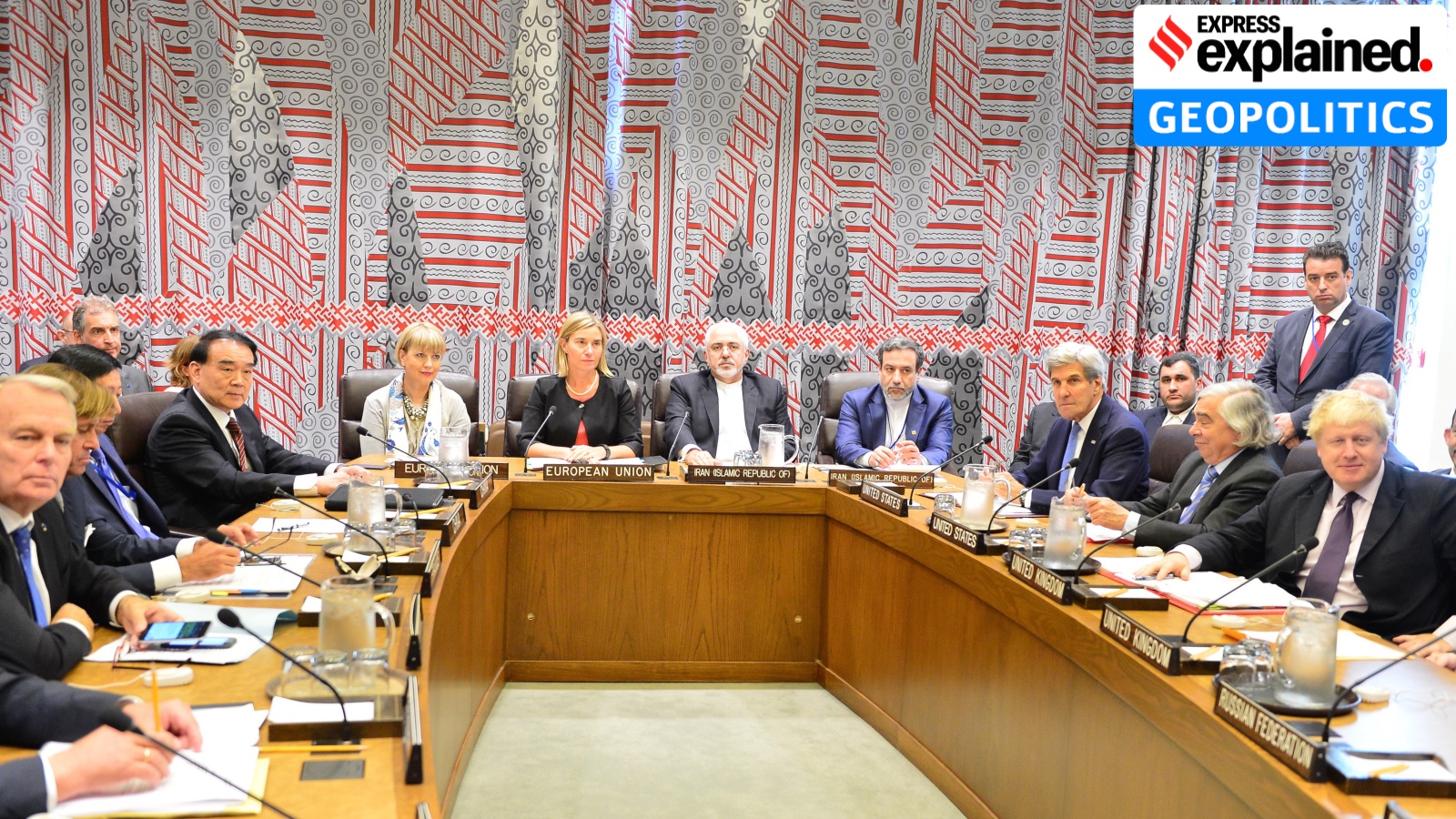
US Secretary of State, John Kerry alongside US Energy Secretary Ernest Moniz participating in the JCPOA in New York (Wikimedia Commons)
Monday’s framework for a peace deal between the United States and Iran has invited comparisons with the 2015 Iran nuclear agreement, which, although signed under different circumstances, tested the limits of cooperation between the countries.
The Joint Comprehensive Plan of Action (JCPOA) was signed between Iran and major global powers in July 2015. It went into effect in January 2016 and put restrictions on Iran’s civilian nuclear enrichment programme.
The nuclear option
Five permanent members of the UN Security Council (the US, UK, France, China and Russia) and Germany — collectively “the P5+1” — conducted negotiations with Iran, along with the EU.
An initiative led by then US President Barack Obama, the deal took two years of back-and-forth. It had the approval of the late Iranian Supreme Leader Ayatollah Ali Khamenei and President Hassan Rouhani, considered reformist and moderate in Iranian politics.
Essentially, Iran was to dismantle its nuclear programme and allow international inspections and verification of its commitments. In exchange, it would receive some relief from crippling economic sanctions.
The Obama administration said that Iran needed two key elements to construct a bomb: “Enough highly enriched uranium to produce enough material to construct a uranium bomb and tens of thousands of centrifuges.” Iran agreed not to produce highly enriched uranium and plutonium. The deal also mandated that its Fordow, Natanz, and Arak facilities pursue only medical and industrial research.
At that time, Iran had a uranium stockpile capable of creating 8 to 10 nuclear bombs. As per JCPOA, Iran was to reduce its stockpile of uranium by 98%, and keep its level of enrichment at 3.67% — significantly below the level needed for a bomb. Iran also had nearly 20,000 centrifuges between the Natanz and Fordow uranium enrichment facilities. This was to be reduced to 6,104 for the next 10 years.
Story continues below this ad
The third way Iran could build a nuclear weapon was by using weapons-grade plutonium. “The only site where Iran could accomplish this is the Arak reactor, a heavy-water nuclear reactor… under this deal, the Arak reactor will be redesigned so it cannot produce any weapons-grade plutonium,” the Obama administration had said.
Mutual benefit
Iran agreed to implement a protocol that would allow inspectors from the International Atomic Energy Agency (IAEA), the UN’s nuclear watchdog, unfettered access to its facilities and potentially to undeclared sites. The IAEA issued quarterly reports to its board of governors and the UNSC on Iran’s implementation.
A body known as the Joint Commission, which included representatives of all the negotiating parties, monitored implementation and resolved disputes.
“The previous three pathways occur at facilities that Iran has declared, but what if they try to build a nuclear program in secret? That’s why this deal is so important… Iran has committed to extraordinary and robust monitoring, verification, and inspection… (IAEA) will also be verifying that no fissile material is covertly carted off to a secret location to build a bomb. And if IAEA inspectors become aware of a suspicious location, Iran has agreed to implement the Additional Protocol to their IAEA Safeguards Agreement, which will allow inspectors to access and inspect any site they deem suspicious,” the Obama administration had said.
Story continues below this ad
Citing experts, the US think tank Council on Foreign Relations (CFR), noted that the deal could have prevented Iran from getting nuclear weapons for over a decade. “Many of the JCPOA’s restrictions on Iran’s nuclear program have expiration dates. For example, after ten years (from January 2016), centrifuge restrictions would be lifted… Some of the deal’s opponents faulted these so-called sunset provisions, saying they would only delay Iran building a bomb while sanctions relief would allow it to underwrite terrorism in the region.”
In exchange, the EU, UN, and US all committed to lifting their nuclear-related sanctions on Iran. They also agreed to lift the UN ban on Iran’s transfer of conventional weapons and ballistic missiles if the IAEA certified that Iran only engaged in civilian nuclear activity.
The P5+1 wanted to cap Iran’s nuclear programme to the point that if Iran decided to pursue a nuclear weapon, it would take at least one year, giving them time to respond. CFR said, “U.S. intelligence officials had estimated that, in the absence of an agreement, Iran could produce enough nuclear material for a weapon in a few months.”
In early 2016, the IAEA certified that Iran had met its initial pledges. The US and European nations also unfroze about $100 billion worth of Iranian assets. However, Trump withdrew the US from the deal in 2018, calling it “one of the most incompetently drawn deals I’ve ever seen”, effectively ending the agreement.
Shubhajit Roy, Diplomatic Editor at The Indian Express, has been a journalist for more than 25 years now. Roy joined The Indian Express in October 2003 and has been reporting on foreign affairs for more than 17 years now. Based in Delhi, he has also led the National government and political bureau at The Indian Express in Delhi — a team of reporters who cover the national government and politics for the newspaper. He has got the Ramnath Goenka Journalism award for Excellence in Journalism ‘2016. He got this award for his coverage of the Holey Bakery attack in Dhaka and its aftermath. He also got the IIMCAA Award for the Journalist of the Year, 2022, (Jury’s special mention) for his coverage of the fall of Kabul in August 2021 — he was one of the few Indian journalists in Kabul and the only mainstream newspaper to have covered the Taliban’s capture of power in mid-August, 2021. ... Read More
Tags:
Explained Geopolitics
Express Explained
Iran War
View original source — Indian Express ↗
Related stories

Portugal Resident
TechnologyJun 15, 2026 · 1 min
BE wants to ban AI-driven dismissals in Portugal
Portugal Resident

ZDNet
TechnologyJun 15, 2026 · 1 min
RefreshOS is a top contender for new Linux users - here's why
ZDNet
Indian Express
TechnologyJun 15, 2026 · 1 min
Maharashtra targets July rollout for unified MMR bus plan
Indian Express
TechRadar
TechnologyJun 15, 2026 · 1 min
This Dell laptop deal is a steal for work and study — and I'm impressed with the specs for this price
TechRadar