
Hacker Noon
The More Companies I Build, the More It Feels Like Medicine
When I was grinding through medical school, entrepreneurship wasn't even on my radar. Doctors diagnosed patients; founders built companies. They were separate planets. Medicine was grounded in biochemistry, clinical pathology, and patient care, while entrepreneurship seemed like a chaotic mix of product-market fit, sales pipelines, and raw growth. \ I never imagined that years later, after navigating tech projects, international student initiatives, and startups, I’d realize these two worlds share the exact same DNA. Most startup advice fixates on the highly visible mechanics: fundraising decks, growth hacks, and product launches. While those matter, they are rarely the root cause of why a company thrives or collapses. Just like in a clinical setting, the most obvious symptom is usually a distraction hiding a deeper pathology. \ Treating the Symptom One of the first things you learn in triage is to never take a symptom at face value. When a patient walks into a clinic with a blinding headache, throwing painkillers at them provides temporary relief but solves nothing if they are actually suffering from a deeper, systemic issue. Yet, businesses make this exact diagnostic error every single day. When sales drop, leadership assumes they have a marketing problem and spins up a new campaign. When user adoption stalls, product teams rush to ship shiny new features. If student enrollment slows at an educational institution, the knee-jerk reaction is to redesign the website. Sometimes these band-aids work, but more often, they fail because the visible crisis is just the surface layer. The real friction is buried deeper—trapped in misaligned incentives, broken internal communications, or toxic organizational habits. I’ve watched startups burn through months of runway treating surface-level symptoms while the underlying illness quietly metastasizes in the background. \ A Diagnostic Lesson From Higher Education A few years ago, I pitched an AI initiative to the International Medical University in Bishkek. The thesis was straightforward: artificial intelligence is fundamentally restructuring diagnostics, research, and patient administration. The next generation of physicians will inevitably practice alongside AI systems, so we needed to prepare them for that reality today. The leadership team was engaged, and the initial brainstorms were promising. But during one of our alignment meetings, the conversation took a telling turn. The immediate pivot wasn’t about pedagogical value, student outcomes, or how this would elevate future patient care. Instead, the overriding question became: "How do we make money out of it?" There’s nothing wrong with financial viability; sustainable programs require solid unit economics. But the instinct to prioritize immediate cash flow over long-term strategic positioning was a classic business misdiagnosis. They were staring at an immediate metric while completely missing the broader landscape shift. \ The Founder’s Blind Spot Founders are uniquely vulnerable to this kind of tunnel vision. We are builders by nature, which means we fall in love with solutions long before we genuinely understand the problem. I’ve fallen into this trap myself, and almost every founder I advise has done the same. Building feels productive. Shipping code feels like progress. Conversely, pausing to interrogate your own assumptions feels painfully slow. Admitting that you don’t actually understand why your product is failing feels uncomfortable. But moving fast in the wrong direction is just a highly efficient way to go broke. A fast answer to the wrong problem is still a failure. This brings us to the current AI gold rush. Right now, every enterprise is desperate to inject AI into their workflow. Consultants are making fortunes selling automation, and executives are panicking about being left behind. But throwing a sophisticated LLM at a broken internal process doesn't magically create efficiency—it just allows your company to make mistakes at terminal velocity. Technology is an amplifier, not a cure. It makes healthy systems hyper-efficient and chaotic systems catastrophic. The organizations that win the AI shift won't be the ones with the largest compute budgets; they'll be the ones with the diagnostic discipline to know exactly where that intelligence belongs. \ The Clinical Boardroom The best physicians I’ve ever worked with share a defining trait with the best founders I’ve met: an obsessive refusal to rush to conclusions. They sit with the discomfort of an unsolved problem. They ask the friction-inducing questions, audit the baseline assumptions, and resist the temptation to write an immediate prescription. From the outside, this diagnostic phase looks slow, even passive. In reality, it’s the shortest path to a cure. I no longer view my medical background and my entrepreneurial career as distinct chapters. One taught me how to analyze complex biological systems; the other taught me how to engineer organizational ones. The vocabulary is different, but the clinical reasoning is identical. If there’s one diagnostic truth I’ve carried from the clinic into the boardroom, it’s this: the first problem you see is almost never the real one.
View original source — Hacker Noon ↗
Related stories
The Next Web
TechnologyJun 15, 2026 · 1 min
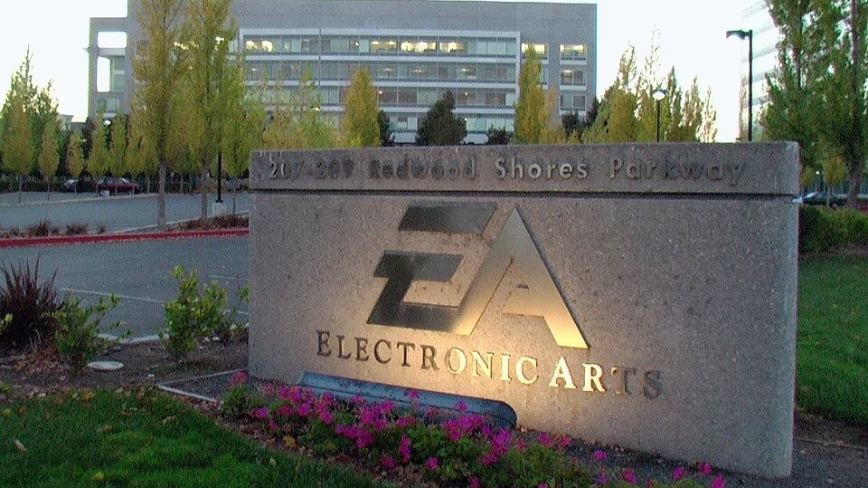
EA just built a full advertising platform inside its games, and 120 million players are the audience
The Next Web

ZDNet
TechnologyJun 15, 2026 · 1 min
How much RAM does your PC need in 2026? My advice after using Windows and Mac for years
ZDNet

Indian Express
TechnologyJun 15, 2026 · 1 min
After two failed bids, ISRO to attempt another PSLV launch by June-end, early July
Indian Express

VentureBeat
TechnologyJun 15, 2026 · 1 min
85% of IT teams claim every AI agent is under control. Only 42% actually know who owns them.
VentureBeat