Times of Israel
US-Iran deal met with despair in Israel, joy in Lebanon and hope in Iran
The deal between the United States and Iran to end their war, negotiated in secret and still not revealed in detail, was greeted Monday with despair in northern Israel, joy in Lebanon, and a measure of relief among other people across the Middle East.
In Israel, some northern community officials lamented the deal and how it did not appear to provide them with the security against attacks from Lebanon that they had hoped for.
Eitan Davidi, chair of the Moshav Margaliot community council, said “the miserable ceasefire that has been forced [on us]” has left the north “with a continuous threat from Hezbollah,” the Israel Hayom newspaper reported.
He said that Prime Minister Benjamin Netanyahu would have been better off not entering into the recent round of fighting “and leaving the situation the way it was before.”
The deal, he said, “takes us to a place of uncertainty… because security has not been restored. The complete opposite is true — the security situation here has deteriorated with the unfortunate agreement that President Trump is bringing upon us and with the prime minister’s consent and silence.”
Get The Times of Israel's Daily Edition
by email and never miss our top stories
By signing up, you agree to the terms
Israel and the US launched a campaign against Iran on February 28 in a bid to destabilize the regime and destroy its nuclear and ballistic missile capacities. Iran responded with missile and drone strikes across the region — including at Israel — as did Hezbollah, which began to attack northern Israel with rocket and drone barrages. Israel responded with massive airstrikes and a ground invasion that displaced hundreds of thousands of southern Lebanese.
Though Iran has tied Lebanon to its negotiations with the US, Israel insists it is a separate issue, as Hezbollah remains able to strike Israel at will. Both Iran and Hezbollah are avowed to wipe out Israel, which was not involved in the negotiations for a truce. Direct negotiations with Lebanon’s government for a separate ceasefire, hosted by the US, have so far been unsuccessful.
Iran and mediator Pakistan say the agreement with the US provides for an end to the fighting in Lebanon, but Israeli ministers said forces will not be withdrawn from the country. Netanyahu did not immediately comment on the deal, which was lashed by opposition leaders.
Asaf Langleben, head of the Upper Galilee Regional Council, said in a statement that what mattered for residents was “not declarations of agreements, but actions.”
“The residents of the Upper Galilee are tired of assurances and demand one thing: real security that will enable them to return to a sane life,” he said.
According to Israel Hayom, some northern residents also feel despair.
Sima Peler, a resident of the northern border city of Kiryat Shmona, wrote in a residents’ WhatsApp group, “Last one out, turn off the lights. They sold us out.”
Koby Heller, a 40-year-old Jerusalem resident and owner of a chain of orthopedic clinics, told AFP that “the general feeling within Israel, I can’t even say if it’s a feeling within, but everyone I talk to tells me: ‘We lost.'”
“President Trump went to war, with Israel, to achieve goals. The goals were — as he stated — to dismantle the missiles and to remove the uranium stockpile from Iran. Neither was achieved,” he said, referring to the reported terms of the memorandum of understanding between the US and Iran to halt the fighting.
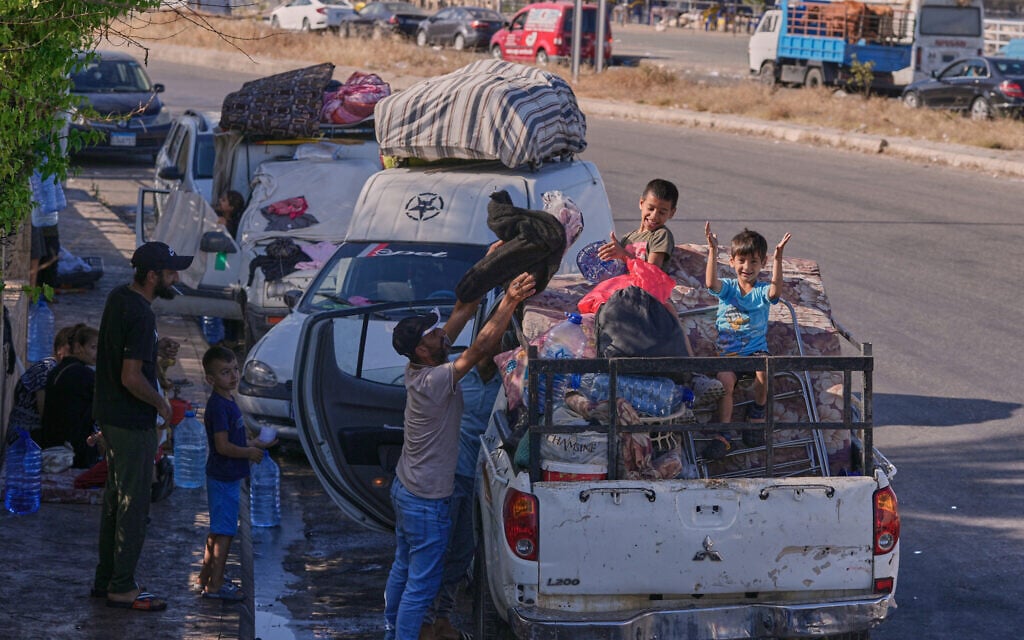
In Lebanon, AFP saw displaced people preparing to return to homes they fled in the south of the country, despite Israeli ministers declaring that they are not bound by the agreement, which reportedly also calls for a halt to fighting against Iran-backed terror group Hezbollah.
At the Qasmiyeh bridge, gateway to the Tyre area that Israel has pounded in recent weeks, dozens of cars packed with mattresses and suitcases were passing through a Lebanese army checkpoint, passengers flashing victory signs.
Alaa Merahi, who was driving with his wife and children, told AFP: “We’re returning to our south, to the free land… we can’t do without the southern land.”
Many expressed hope this would be a “final return” after hundreds of thousands of residents were repeatedly forced to flee Israeli bombings and evacuation orders.
At a crowded school-turned-shelter in the coastal city of Sidon, displaced people sat in classrooms drinking coffee, waiting for official authorization to return.
‘We’ll set up a tent’
“Our joy is greater than the whole world,” said Haifa Sherri, who was displaced from the town of Khirbet Selm near the border.
She said, however, she would hold off on returning until the situation became clearer.
Lebanon’s army urged displaced residents to delay their return to southern border villages, while several municipalities told people to await instructions.
But in Sidon, Hanaa Jaffal said she planned to return on Monday to Ansar, close to Nabatieh and the Israeli advance.
“There’s nothing like returning to your land, even if the houses are no longer there,” she said.
“We’ll set up a tent and stay in it,” she said, paying tribute to Iran, which backs Hezbollah and which insisted Lebanon must be included in any peace deal.
‘May not be pleasant’
In Iran, where the government brutally suppressed anti-government protests a month before the war began, most optimism was economic rather than political.
Tehran salesman Efran, 18, told AFP he hoped an end to sanctions would put the Iranian economy back in gear.
“Of course, if the Americans keep their word and do not break their promises, as usual,” he added.
Nastaran, a 29-year-old software engineer, said she would be very happy “once the war is over and the sanctions we had are lifted.”
Sadegh, a 52-year-old government worker, said Washington should be ready to make concessions.
“It may not be pleasant for both sides but nations need peace and tranquility, and I hope that the other side will adhere to this agreement,” he said.
In the monarchies of the Gulf, whose economies were battered by Iranian strikes and a shipping blockade imposed by Tehran on the vital Strait of Hormuz after the war started, but which Trump said would be removed by the deal, there was also cautious optimism.
“I’m relieved,” said 40-year-old Bahraini Hessa Mahmoud. “No one wants to live through war again.”
View original source — Times of Israel ↗
Related stories

ESPN
SportsJun 15, 2026 · 1 min
Source: Pickens reports ahead of Cowboys' camp
ESPN
CNA
SportsJun 15, 2026 · 1 min
Moroccan Ammouta named Al Ahly coach following Thorup departure
CNA

CNA
SportsJun 15, 2026 · 1 min
Hydration breaks heat up World Cup debate with players, coaches split on new rule
CNA

BBC Sport
SportsJun 15, 2026 · 1 min
Bale forms new sports fund with club investment eyed
BBC Sport