Times of Israel
Visiting Somaliland president opens embassy in Jerusalem
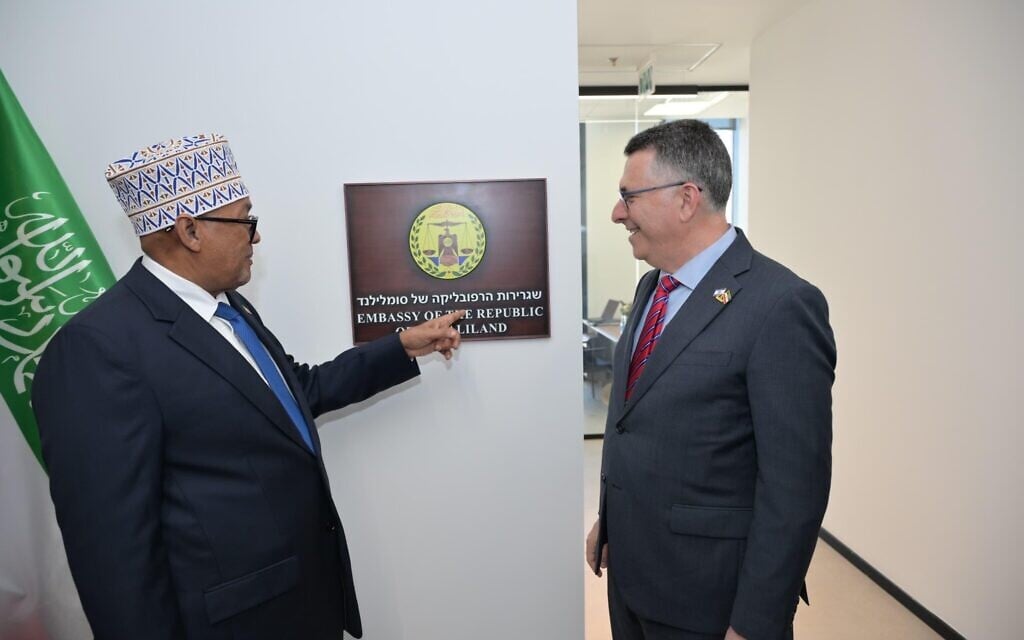
Somaliland President Abdirahman Mohamed Abdullahi and Israeli Foreign Minister Gideon Sa’ar opened Somaliland’s embassy in Jerusalem on Monday, the eighth top-level diplomatic mission in the capital.
Abdullahi is making his first state visit abroad since becoming president. In December, Israel became the first country in the world to recognize Somaliland, which broke away from Somalia in 1991.
The Muslim nation’s embassy is in Jerusalem’s Har Hotzvim hi-tech park.
Somaliland’s first ambassador to a foreign country presented his diplomatic credentials to President Isaac Herzog in March.
Dr. Mohamed Hagi, appointed in February, had been serving as an adviser to Abdullahi, and was an architect of Israel-Somaliland relations.
Get The Times of Israel's Daily Edition
by email and never miss our top stories
By signing up, you agree to the terms
The United States, Guatemala, Honduras, Kosovo, Papua New Guinea, Paraguay, and Fiji also have embassies in Jerusalem, while other countries — including Hungary, the Czech Republic, and Slovakia — have embassy branches in the capital. Other countries refuse to move their embassies to the city so long as Palestinian claims to its eastern neighborhoods have not been addressed in a peace agreement.
Sa’ar met with Abdullahi earlier at the Foreign Ministry in Jerusalem, revealing in a readout from his office that the two had also met at the ministry in October, in secret, two months before Israel’s recognition.
“I will always be proud of the privilege I had to write, with you and your people, the first pages in the story of the Israel-Somaliland relationship. I am certain this partnership will continue to grow stronger for the benefit of both our nations,” Sa’ar said, thanking Abdillahi for his “historic” decision to open an embassy in Jerusalem.
Sa’ar acknowledged that “there are indeed challenges in building the relationship between Israel and Somaliland.”
Jerusalem’s unilateral recognition of the country was condemned internationally, including by the African Union and over a dozen Muslim-majority nations, which also issued a joint statement condemning Somaliland’s decision to open its embassy in Jerusalem.
“Unfortunately, there are many trying to undermine [bilateral ties]. They will not be successful,” Sa’ar vowed, adding, “I am certain this partnership will continue to grow stronger for the benefit of both our nations.”
On Sunday, Abdillahi met with Herzog at the President’s Residence in Jerusalem, where he said that Somaliland will remember Israel’s recognition of his country and its willingness to host the first-ever state visit by its leader.
“Israel has taken part in a moment that will be remembered in the diplomatic history of our nation, and we do not take that gesture lightly,” said Abdillahi.
“Somaliland has been talking, has been reaching out to the world leaders for the last 35 years,” he continued. “They were asking only one question: to see us. Only one country desired to see us and recognize Somaliland, and that’s the government of Israel and its people.”
Herzog said the bilateral relationships must move “from declarations to people-to-people cooperation in a range of fields — and we had a very interesting discussion on that — of so many topics of common interest, and we both also face strategic challenges, which are important to both nations.”
“We both face the threat of radical extremism,” added Herzog. “We both seek security and stability in the region and in the Horn of Africa. We both see the importance of protecting maritime freedom.”
Sa’ar also previously met Abdillahi during an official visit to the Somaliland capital in January.
When Israel recognized Somaliland in December, Prime Minister Benjamin Netanyahu invited Abdillahi to visit.
At the time, Abdullahi said that Somaliland would join the Abraham Accords, calling it a step toward regional and global peace.
The 2020 accords were brokered by Trump’s first administration and included Israel formalizing diplomatic relations with the United Arab Emirates and Bahrain, with other countries, including Morocco, joining later.
The agreement with Morocco was followed by Israel recognizing Rabat’s sovereignty over the contested Western Sahara region.
Aside from Israel, no other United Nations member states have recognized Somaliland.
View original source — Times of Israel ↗
Related stories

The Punch
PoliticsJun 15, 2026 · 1 min
Insecurity: Reps move to review defence laws
The Punch
The Punch
PoliticsJun 15, 2026 · 1 min
Dangote meets Aiyedatiwa, plans biggest free trade zone in Ondo
The Punch

Rio Times
PoliticsJun 15, 2026 · 1 min
US Sells Brazil Stinger Missiles, but the Mission Is Murky
Rio Times

France 24
PoliticsJun 15, 2026 · 1 min
Interim US-Iran peace deal sparks anger among Israelis, who lash out at Netanyahu
France 24