Times of Israel
US says Trump, Vance and Iran’s Ghalibaf ‘digitally’ signed Iran deal on Sunday
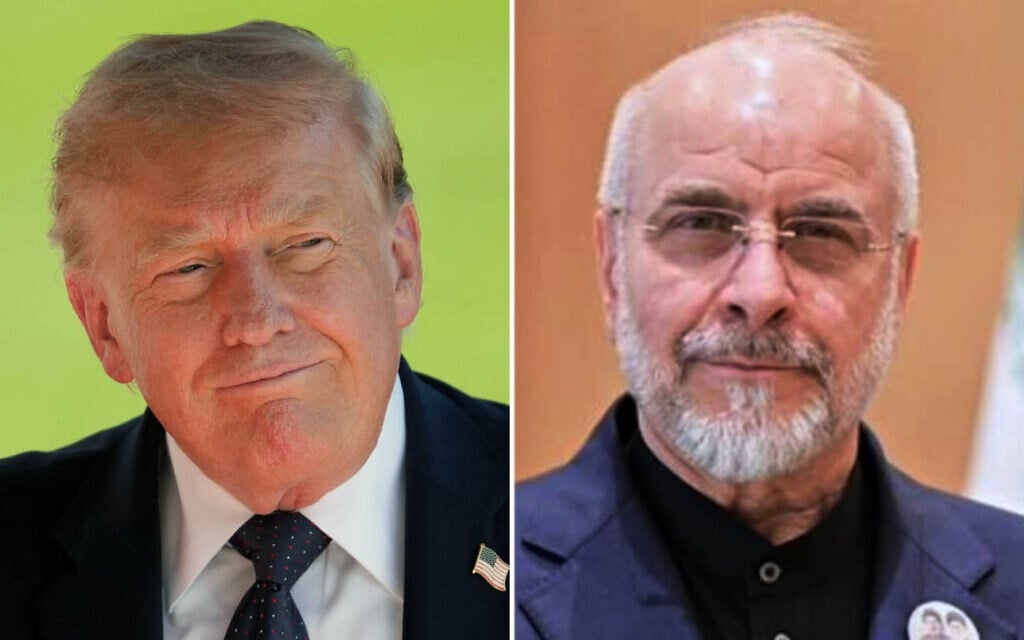
US Vice President JD Vance said on Monday that the memorandum of understanding between the US and Iran was signed “digitally” the previous day, ahead of an in-person signing ceremony apparently set for Friday in Switzerland with high-ranking American and Iranian officials in attendance.
The text of the agreement between the two countries — said to halt the US blockade of Iran, reopen the Strait of Hormuz, and begin 60 days of negotiations on Tehran’s nuclear program — has not been released to the public. Senior US officials, including Vance and US President Donald Trump, offered contradictory hints as to its contents in various interviews and briefings throughout Monday.
“We already signed the deal digitally yesterday,” Vance told ABC’s “Good Morning America.”
A senior US official subsequently confirmed that both Vance and Trump digitally signed the MOU on Sunday, with Iranian parliament speaker Mohammad Bagher Ghalibaf signing on behalf of Tehran, putting a decisive end to the war launched by the US and Israel on February 28.
It was unclear when the full text of the deal would be released, with Trump initially saying it would be made public “pretty soon,” before later specifying that it would likely be “some time after Friday.”
Get The Times of Israel's Daily Edition
by email and never miss our top stories
By signing up, you agree to the terms
Moments before Trump’s remarks from France, where he was attending the G7 summit, two of his top aides held a briefing for reporters in which one of them said the text would likely be released in the next 24 to 48 hours.
A pair of top officials in Trump’s administration also held a background phone briefing with reporters on Monday, shedding some light on how the deal will be implemented and what it contains.
The MOU established the “structure” for how negotiations on Iran’s nuclear program will unfold over the coming 60 days, but one of the senior US officials said that Washington will know “over the next two or three weeks” whether a follow-on agreement can actually be reached.
Trump threatened on Sunday that attacks on Iran could resume if the sides fail to reach a nuclear accord.
Conditions around Hormuz still murky
Another top official briefing reporters said that while the deal provides for the “immediate” reopening of the Strait of Hormuz, it will still “take a little time” to operationalize, as mines allegedly need to be removed and ship operators have their own judgments regarding the risk of using the waterway.
“We probably won’t return to normal in two weeks, but we will see a significant increase in strait traffic,” the senior US official said.
Trump, earlier on Monday, declared that the Strait of Hormuz had already been “partially” reopened, and would be “completely open” by the time of Friday’s signing ceremony.
Further complicating the narrative surrounding the deal, Vance told CNBC that Washington “expects” that the Strait of Hormuz will be “opened in a toll-free way for the long term.”
“That’s the sort of thing that we’re going to figure out in these technical negotiations,” he said.
The vice president notably stopped short of saying that the MOU would ensure freedom of navigation through the waterway, and his comments appeared to leave open the possibility that Iran would be able to charge tolls on vessels traveling through the strait. A senior US official later said that the MOU would indeed ensure the Strait of Hormuz is operated “toll-free” for the next 60 days, but suggested that tolls could be reimposed after that.
Praise for Iran’s leadership from Washington
Vance also told CNBC that he would be attending the signing ceremony in Switzerland on Friday and would be joined by Ghalibaf and Iranian Foreign Minister Abbas Araghchi. A senior US official briefing reporters later said top Trump aides Steve Witkoff and Jared Kushner would also be in attendance.
Vance said the US had been “dealing with everybody in the Iranian system” — from military hardliners to political leaders — claiming that Washington was sometimes doing so directly and had built good relationships with counterparts in Tehran that would allow for a successful negotiation.
The direct relationships between Washington and Tehran were necessary for the US to understand Iran’s red lines and where they would be willing to compromise, a US official briefing reporters said.
Trump also spoke effusively about Iran’s leadership, saying at the G7 summit that Washington has “gotten along very well” with Iran’s “new set of leaders,” again claiming that he had enacted regime change, even though the regime is still intact.
The initial MOU is said to include a commitment from Iran not to obtain a nuclear weapon, although this has little weight behind it, as Tehran has long insisted it is not seeking nuclear armament.
It previously committed to not seeking a nuclear weapon in the 2015 JCPOA agreement that Trump vilified and withdrew from in 2018. Both of Trump’s administrations, along with Israel, have refused thus far to take Tehran at its word — something the president has now suggested he is prepared to do.
In an effort to sell the MOU to naysayers, Vance insisted to CNBC that the US maintains “all of the cards,” as it will not offer Iran sanctions relief unless Tehran makes concessions during the upcoming nuclear talks.
“Even if we just stopped here, what would be true? Their military is destroyed, the Straits of Hormuz are open, their nuclear program has been destroyed, and we have incredible economic leverage over them that we didn’t have a year and a half ago,” Vance said.
Despite his claims, though, Iran’s missile program remains intact, even if badly battered, and it still holds onto its stockpiles of highly enriched uranium for the time being, which can be used to create a nuclear weapon. And, notably, the Strait of Hormuz was only closed in direct response to the US-Israeli offensive.
‘A little talk’ with Hezbollah
Iranian and Pakistani sources have said the MOU also extends the ceasefire to Lebanon, preventing Israel from continuing its offensive against Hezbollah, although Jerusalem has insisted that it will not agree to do so.
The announcement of the deal on Sunday night came after intensive efforts by Washington to avoid new Iranian attacks on Israel in response to an airstrike in Beirut earlier in the day. Trump had suggested that Israel had “overreacted” to Hezbollah fire on northern Israel, and said the IDF should no longer operate anywhere in Lebanon.
Broaching the topic again on Monday, Trump said the US wanted “to see if we can straighten out the Lebanon thing.”
“It just never seems to end,” he told reporters in Versailles.
“Hezbollah, we have to have a little talk with them,” Trump added, notably not specifying that he wants to have a talk with Israel. Axios reported on Sunday that the US president spoke to Prime Minister Benjamin Netanyahu following the strike on Beirut, and told him he “has no fucking judgment.”
Further clarifying the situation, a US official told reporters that the MOU was not conditioned on Israel withdrawing from Lebanese territory, but nevertheless envisioned a ceasefire that covers both Iran and Lebanon.
“The deal is a ceasefire, but it will not be a one-way ceasefire. If Iran is not able to control Hezbollah, and if they attack Israeli positions or Israeli towns, Israel will have the right to defend themselves and respond,” the US official said.
The official touted the ongoing talks between the Israeli and Lebanese governments in Washington, which critics say can accomplish little given Hezbollah’s refusal to cooperate with them.
But the US official insisted those talks, as well as the MOU, present an opportunity.
“The first point in the MOU talks about how Iran and its allies and America and its allies seek to end hostilities and hopefully have a final peace that hopefully will include a lot of these proxy groups,” the US official said. “Hopefully, this will help us get the Israel-Lebanon normalization and peace done properly.”
The Lebanese presidency said in a statement on Monday evening that Lebanese President Joseph Aoun welcomed the announced US-Iran deal in a call from Iran’s foreign minister.
The Lebanese leader said he hoped the agreement would be a “positive step towards reducing tensions and opening the door to diplomatic solutions,” while Araghchi emphasized “the importance of respecting Lebanon’s sovereignty,” the statement said.
In a statement on Telegram, Araghchi said he also spoke to Lebanon’s parliament speaker Nabih Berri, a staunch ally of Hezbollah, about the clauses in the MOU pertaining to Lebanon.
Agencies and Times of Israel staff contributed to this report.
View original source — Times of Israel ↗
Related stories

The Punch
PoliticsJun 15, 2026 · 1 min
Iyabo Obasanjo returns to PDP days after dumping APC
The Punch
ABC News
PoliticsJun 15, 2026 · 1 min
Live: Shadow treasurer says CGT inquiry 'running roughshod over democracy'
ABC News
ABC News
PoliticsJun 15, 2026 · 1 min
NSW premier's $2 million promise to a murder victim's mother
ABC News
Mexico News Daily
PoliticsJun 15, 2026 · 1 min
World Cup windfall has yet to land, as hotel occupancy in CDMX, GDL and MTY falls short
Mexico News Daily