The Next Web
Rivian CEO says supervised point-to-point self-driving will arrive this year, and he’s comparing it directly to Tesla’s…
TL;DR
Rivian CEO RJ Scaringe says supervised point-to-point self-driving arrives this year on Gen 2 and R2 vehicles, with eyes-off driving in 2027.
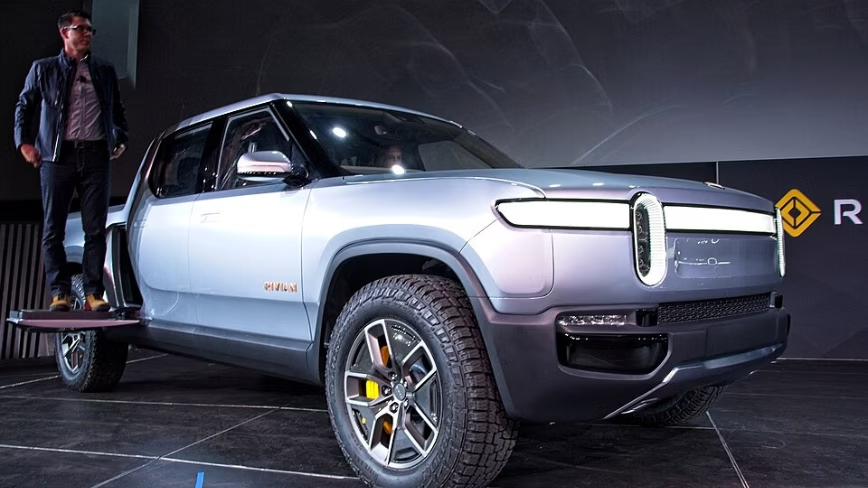
Rivian CEO RJ Scaringe said the company will ship supervised point-to-point self-driving on all of its second-generation vehicles and the R2 later this year, describing the capability as “very similar to Tesla’s FSD.” Speaking at the Masters of Scale event in Anaheim on Thursday, Scaringe laid out a three-stage autonomy roadmap: supervised point-to-point driving in 2026, eyes-off unsupervised driving in 2027, and a commercial robotaxi service with Uber beginning in 2028.
The announcement represents a significant jump from Rivian’s current driver-assistance system. Universal Hands-Free, which rolled out in late 2025, handles steering and speed on roughly 3.5 million miles of marked roads in the US and Canada. It does not navigate turns, traffic lights, roundabouts, or parking lots.
Point-to-point driving would extend the system’s capabilities to handle complete journeys from origin to destination, similar to what Tesla’s Full Self-Driving Supervised already attempts. The leap from highway lane-keeping to full urban navigation is the hardest problem in autonomous driving, and no company has solved it without significant constraints.
“Later this year, we’ll have full supervised point-to-point, which will be very similar to Tesla’s FSD,” Scaringe said. “And that’ll roll out to all of our Gen 2 vehicles and, of course, R2.” He did not specify a month or quarter for the rollout, and Rivian has not publicly demonstrated the point-to-point system in an uncontrolled environment.
The comparison to Tesla is deliberate but architecturally inexact. Tesla’s FSD relies exclusively on cameras, while Rivian’s platform integrates 10 external cameras, five radar units, 12 ultrasonic sensors, and a high-precision GPS receiver. Rivian began delivering R2 SUVs earlier this month, and future R2 models will add a roof-mounted LiDAR sensor and the company’s custom RAP1 processor, a 5nm chip delivering up to 1,600 trillion operations per second.
The pricing undercut is sharper than the technology comparison. Rivian’s Autonomy+ package costs $2,500 as a one-time purchase or $49.99 per month, compared with Tesla’s FSD at $8,000 or $99 per month. Whether the lower price reflects a competitive strategy or a difference in capability remains to be seen, given that Rivian’s point-to-point system does not yet exist as a shipping product.
Rivian’s autonomy software is built around what the company calls a Large Driving Model, a foundational AI system trained end-to-end through reinforcement learning. The LDM maps raw sensor input directly to vehicle trajectory, analysing multiple driving paths and selecting the optimal one using a technique called Group-Relative Policy Optimization. The approach mirrors the end-to-end neural network philosophy Tesla adopted with FSD v12, though Rivian’s multi-sensor hardware gives the model a wider range of input data to work with.
The 2027 eyes-off milestone is where the roadmap becomes commercially consequential. Supervised driving, regardless of how capable, still requires a human to watch the road. Tesla has been promising unsupervised FSD for years and has pushed the timeline repeatedly, most recently to Q4 2026 at the earliest. Scaringe has said Rivian targets Level 3 autonomy by 2028 and Level 4 by 2030, timelines that no autonomous driving company has consistently met.
The commercial centrepiece of the roadmap is the $1.25 billion deal with Uber announced in March. Uber committed an initial $300 million investment, with the remainder contingent on Rivian hitting autonomous performance milestones through 2031. The deal calls for Uber or its fleet partners to purchase 10,000 fully autonomous R2 robotaxis, with an option for up to 40,000 more beginning in 2030. Commercial deployment is planned for San Francisco and Miami in 2028, expanding to 25 cities by 2031.
Those targets depend on Rivian achieving something it has not yet demonstrated: a vehicle that can drive itself without human supervision. The company’s Gen 3 autonomy platform, which will power the robotaxi programme, is still undergoing validation. The initial R2 production run launched without the Gen 3 hardware, meaning the robotaxi-grade vehicles are at least one hardware generation away from production.
Scaringe framed the self-driving push as essential to Rivian’s long-term economics. The company posted a net loss of $3.63 billion in 2025 despite achieving its first full-year positive gross profit at $144 million. Autonomy, if it works, transforms the revenue model from selling cars to operating a transportation platform. But the gap between announcing a roadmap at a conference and shipping a reliable autonomous system is where most self-driving timelines have historically broken down.
View original source — The Next Web ↗
Related stories

Philippine Daily Inquirer
TechnologyJun 16, 2026 · 1 min
Ashley Rivera mourns mom's death from cancer
Philippine Daily Inquirer

The Hindu
TechnologyJun 16, 2026 · 1 min
The U.S. govt. policy is to systematically cut off any source of income to Cuba: Mitchell Valdes-Sosa
The Hindu

TASS
TechnologyJun 16, 2026 · 1 min
European lawmaker calls EU ‘party to Ukrainian conflict’
TASS
Indian Express
TechnologyJun 16, 2026 · 1 min
His BP, blood sugar and cholesterol were normal: Why did marathon runner have a heart attack?
Indian Express