Indian Express
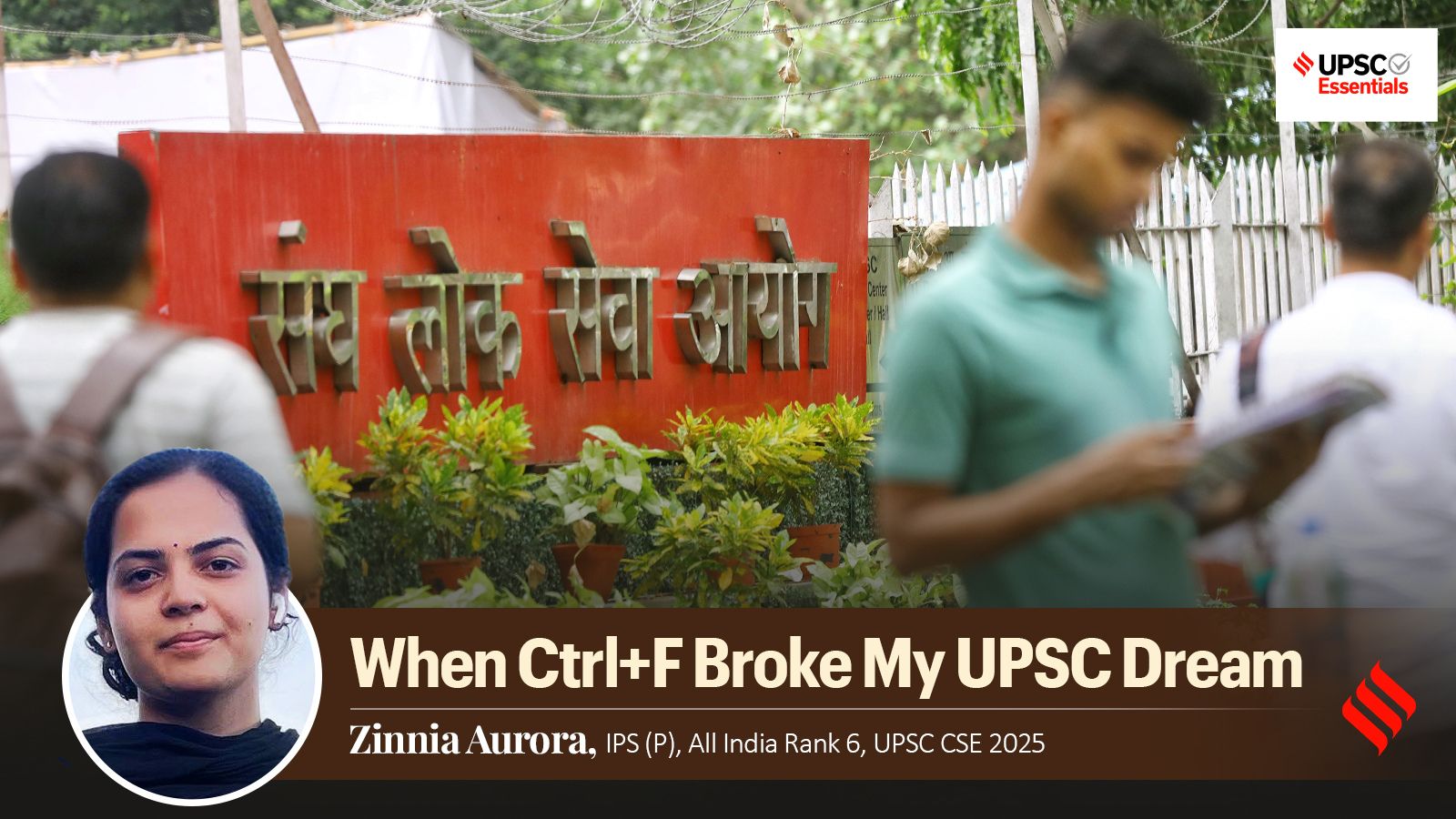
UPSC 2025 AIR 6 Zinnia Aurora writes: ‘How a failed attempt taught me to stand up again’
Ctrl+F. Ctrl+V. No results. Three keystrokes that shattered my UPSC dream on a grey June morning in 2023.
On June 12, I was travelling back home in a car when the Civil Services Preliminary Examination result PDF appeared on my mobile screen. I already knew that the examination had not gone well, but like every aspirant waiting for a result, I held on to a faint hope that somehow things would work out. With a thumping heart and trembling hands, I opened the Notes app where I had saved my roll number. I pasted it into the search bar and waited for the screen to respond. It did, just not in the way I had hoped. I remember that moment with unusual clarity. I was sitting beside my mother, and our car had stopped at the traffic signal near Gyarah Murti in Delhi. While the red light blinked ahead, my eyes drifted towards the iconic sculpture depicting the Dandi March.
In an instant, months of preparation, expectations, sacrifices and difficult decisions seemed to collapse into that single line on a PDF. Yet I did not allow any of it to show on my face. My mother’s smile was not something I was prepared to break.
We reached home, I told my parents that I had failed, and life appeared to move on. Internally, however, the weeks that followed were far more turbulent than the result itself. I had left a job, declined admission offers and invested heavily in a dream that had not materialised. More than disappointment, what I experienced was a profound questioning of self. The examination had exposed weaknesses I did not know existed and shattered assumptions I had quietly carried about my own abilities. Looking back, it was one of the most humbling experiences of my life.
The examination that forces you to meet yourself
The Civil Services Examination has a peculiar way of forcing individuals to confront themselves. While it is popularly viewed as a test of knowledge, serious aspirants know that knowledge is only one part of the equation.
The examination tests resilience, adaptability, emotional stability and discipline. It pushes candidates into situations where excuses stop working and honest introspection becomes unavoidable. In that sense, the examination often teaches lessons about self-governance long before it teaches governance.
Most aspirants do not undergo this transformation immediately. I certainly had not. Like many young people, I initially viewed failure as something that happened to me rather than something that could teach me.
Story continues below this ad
Zinnia shares a picture of her study table as she tells aspirants why it is important to stand up after failure.
It took time to realise that setbacks derive meaning not from the pain they inflict but from the lessons they leave behind. The challenge is not to sit with failure and repeatedly revisit it. The challenge is to stand up against it.
What Gyarah Murti taught me
That is where the imagery of Gyarah Murti unexpectedly returned to my thoughts. The sculpture commemorates the Dandi March and depicts individuals walking towards a goal far greater than themselves despite uncertainty, hardship and overwhelming odds.
As I reflected on that image, I began to appreciate a simple truth — none of those figures could have known exactly what lay ahead, yet they continued moving forward because the cause demanded perseverance.
Preparation for the Civil Services Examination evokes a wide spectrum of emotions. Over the years, aspirants experience hope, anxiety, excitement, frustration, admiration, self-doubt and pride, often within the span of a few months.
Story continues below this ad
The journey is rarely linear. Yet it is these fluctuations that give meaning to eventual success. Without setbacks, achievement would carry little significance.
Zinnia shares a picture of the traffic signal where she found an unexpected message about resilience and moving forward.
As Percy Bysshe Shelley famously observed, “Our sweetest songs are those that tell of saddest thought.” Many aspirants discover, often much later, that the moments they once viewed as failures were instrumental in shaping their future successes.
Pain has a peculiar way of sharpening perspective. Every setback leaves behind lessons that become visible only with time. More importantly, pain often becomes the driving force behind improvement. It forces us to confront uncomfortable realities and ensures that we do not repeat the same mistakes.
Turning failure into feedback
One of the most valuable lessons that preparation taught me was the importance of honest self-assessment. Every unsuccessful attempt contains information. The challenge is to identify it without allowing emotions to cloud judgement.
Story continues below this ad
For an aspirant, this means questioning academic assumptions, analysing strategy, identifying conceptual gaps and understanding the reasons behind poor performance. It means asking difficult questions about revision, test-taking ability, time management and temperament under pressure.
The objective is not self-criticism; it is self-improvement. Examinations come and go, but the ability to learn from setbacks remains relevant throughout life.
Zinnia writes about the importance of learning from the right quarters and looking beyond books to the broader world.
The lessons acquired while preparing for UPSC often extend far beyond the examination itself. The process teaches observation, analysis, patience and intellectual curiosity—qualities that remain valuable irrespective of whether one ultimately enters the Civil Services.
More than an examination
One of the biggest misconceptions surrounding UPSC preparation is that its value lies solely in the final result. While selection remains the goal, the preparation process itself creates enduring intellectual and personal benefits.
Story continues below this ad
My NCERT textbooks gradually stopped feeling like textbooks. History became a window into the evolution of governance and institutions. Political Science helped me understand democratic processes beyond textbook definitions. Current affairs started making sense because they could be connected with larger ideas and historical contexts. Learning became less about memorising facts and more about understanding how society functions.
This approach aligns closely with Sri Aurobindo’s conception of integrated learning, which emphasised intellectual, emotional, physical and moral development. In many ways, these are also the qualities that define an effective civil servant.
The examination, therefore, is not merely assessing knowledge; it is shaping individuals capable of handling complexity, responsibility and public service.
Read to learn, not merely to crack
Perhaps the most important lesson I learnt was to read for understanding rather than merely for selection. When preparation becomes entirely result-oriented, learning turns mechanical. Aspirants begin chasing information without truly engaging with it.
Story continues below this ad
Meaningful preparation emerges when curiosity replaces anxiety as the primary driver. Understanding concepts, connecting ideas and applying knowledge create a depth that rote learning can never achieve.
The irony is that candidates who focus on learning often perform better than those who focus exclusively on cracking the examination. The result is important, but genuine understanding is what sustains both performance and growth.
Turning the Red Light Green
We often hear that we live in a VUCA world: one characterised by volatility, uncertainty, complexity and ambiguity. The Civil Services Examination mirrors many of these realities.
No strategy can completely eliminate uncertainty, and no amount of hard work guarantees success on a particular day. That uncertainty, however, should not become an excuse for inaction. Instead, it should encourage adaptation and resilience.
Looking back today, I realise that my result day was not defined by the absence of my roll number in a PDF. It was defined by a choice. I could remain trapped at that red light near Gyarah Murti, endlessly replaying a disappointing moment, or I could move forward with greater clarity about what needed to change.
Story continues below this ad
Every aspirant eventually encounters such moments. A failed prelims, a disappointing mains result or an interview that does not go as expected can feel devastating in the moment. Yet these experiences often become the foundations upon which future success is built.
The task is not to avoid setbacks but to respond to them with honesty, analysis and determination. The red light at Gyarah Murti eventually turns green. To succeed in our own Dandi March, we too must learn to analyse, introspect and move forward with purpose.
(The writer is an Indian Police Service (IPS) probationer and secured All India Rank 6 in the UPSC Civil Services Examination (CSE) 2025.)
What moment helped you turn your UPSC failure into fuel for success? Share your story in the comments or write to us at [email protected].
Story continues below this ad
Subscribe to our UPSC newsletter. Stay updated with the latest UPSC articles by joining our Telegram channel – IndianExpress UPSC Hub, and follow us on Instagram and X.
🚨 Click Here to read the UPSC Essentials magazine for May 2026. Share your views and suggestions in the comment box or at [email protected]🚨
View original source — Indian Express ↗
Related stories

CNET
TechnologyJun 7, 2026 · 1 min
All the Trailers From Xbox Games Showcase 2026
CNET

Rio Times
BusinessJun 10, 2026 · 1 min
Global Economy Briefing — June 10, 2026
Rio Times

BBC Sport
SportsJun 5, 2026 · 1 min
Potter's Zlatan texts, overcoming failure & finding joy in Sweden
BBC Sport

TechRadar
TechnologyJun 6, 2026 · 1 min
'Resistance is futile': the 5 most revealing quotes from Computex 2026
TechRadar