Indian Express
Indian Express··3 min read
Indian contemporary artists debut at Russia’s Hermitage Museum
4 min readUpdated: Jun 16, 2026 01:46 PM IST
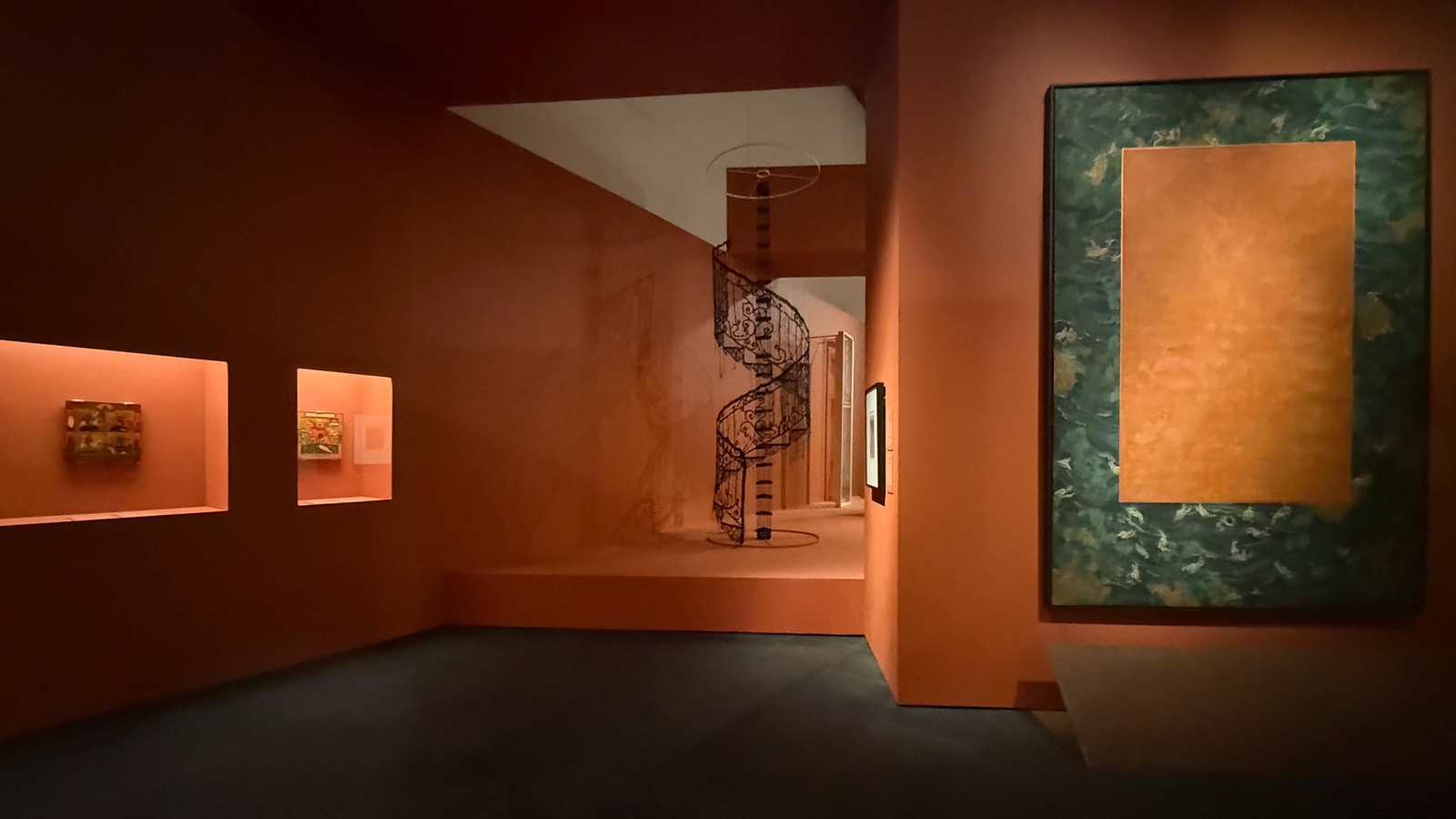
‘Sediments of Becoming’ at the State Hermitage Museum, St Petersburg.
Anindita Bhattacharya first went to Russia in 2001. The Russian collector Andrey Terebenin had acquired one of her works and she had travelled to supervise the intricate installation. It was during this visit that she encountered Russian icon paintings at the State Tretyakov Gallery in Moscow. The visit evidently left a deep mark on Bhattacharya. For her two exhibits at the landmark exhibition — Sediments of Becoming: Fossilised Present, Summoned Pasts — at the State Hermitage Museum, St Petersburg, which opened on June 4, she returned to her memories of the icon paintings.
‘As the Sea Forgets its Shore’ explores the cost of conflict – not in human but geographical terms. In the gouache on paper work, a rust coloured solid rectangle is surrounded by a lush green border that resembles a forest cover, as if to imply its slow erosion. “I am interested in how environments shift beyond recognition and how what once held begins to loosen,” she says.
The 2026 work with its rich border, echoes the kleimos or the panels in Russian icon paintings and the ornate borders of Mughal miniatures, both of which are part of the Hermitage Museum’s permanent collection.
‘As the Sea Forgets its Shore’ by Anindita Bhattacharjee.
As Bhattacharya’s work sits in dialogue with an 18th-century Russian icon of Saint Michael as the Horseman of the Apocalypse, both evoke the anxieties of a world on the brink of an apocalypse — ecological and theological respectively. This exchange between the present and the past is at the centre of ‘Sediments of Becoming’ that emphasises on “cultural continuity and deep civilisational layers.”
There’s also V Ramesh’s untitled piece that recreates the traditional game of snakes and ladders in gouache on paper, which interacts with a Russian lubok print with the imagery of ‘The Last Judgement’. Both share allegories of karma and damnation in the afterlife.
“I wanted to show India as a continuum. History and culture in India is recursive. Russian culture is equally rich. Both have a palimpsestic kind of a layering, which is deep, and embedded in our consciousness,” says Tunty Chauhan, the founder of Delhi’s Threshold Gallery, who has co-curated the exhibition with Marina Schulz, Head of the Contemporary Art Department, State Hermitage Museum, to pair the contemporary works “dialogically” with those in the museum collection.
Besides its conspicuous significance for being the first such show of contemporary Indian artists in the 260-year-old history of the museum. The exhibition assumes the status of a milestone moment in Indian art history for featuring mid-career contemporary names (Ravinder Reddy being an exception) on a global platform rather than the usual choice of modernists or contemporary masters.
Story continues below this ad
“I selected mid-career artists living in India, each with a distinct vocabulary and working across a full range of contemporary practice. I wanted to demonstrate their conceptual rigor and diversity. These are artists speaking in their own voice and they are the ones who are going to carry our depth into the present,” says Chauhan.
The participating artists include Afrah Shafiq, Debashish Mukherjee, Gargi Raina, Lakshmi Madhavan, Manjunath Kamath, Maya Krishna Rao, Pushpamala N and Sumakshi Singh.
Untitled by V Ramesh.
The conversational curation is also reflective of the way the exhibition came together — purely based on human connection forged over years, without any diplomatic or governmental channels. Chauhan first met the Terebenins – Andrey and his wife Ekaterina – nearly a decade ago, when they were travelling through India exploring and collecting Indian art. When they got stuck in Russia during the pandemic, they decided to showcase their collection there.
“There were enough Indian antiquities in museums there that had been interpreted by scholars and through a very ethnographic exoticised lens. But the Terebenins had lived in India and wanted to bring that experience to Russia,” recalls Chauhan, who also curated ‘India Reflections’ in Moscow in 2022.
Story continues below this ad
‘Sediments of Becoming’, which continues till October 4, became the natural progression to take the discourse on Indian art on the global stage forward. “These artists are not here to show the world what India looks like. They’re here to propose how history is made and remembered. They are at this moment, in this encounter, creating history,” says Chauhan.
View original source — Indian Express ↗
Related stories

Euronews
NewsJun 7, 2026 · 1 min
Qatari designers make North American runway debut in Toronto
Euronews

Japan Times
EntertainmentJun 8, 2026 · 1 min
Emerging Kansai artists to watch
Japan Times
Indian Express
EntertainmentJun 9, 2026 · 1 min
Hyderabad to Hollywood: Savdhaan India, Crime Patrol producer all set for Hollywood debut
Indian Express

Rolling Stone
EntertainmentJun 8, 2026 · 1 min
‘The Indigenous Setlist’ Podcast Will Spotlight Thriving Native and Indigenous Music Scene
Rolling Stone