Indian Express
What is Helium-3, the $2,000/litre rare gas sparking a race to mine the Moon?
4 min readJun 16, 2026 02:54 PM IST
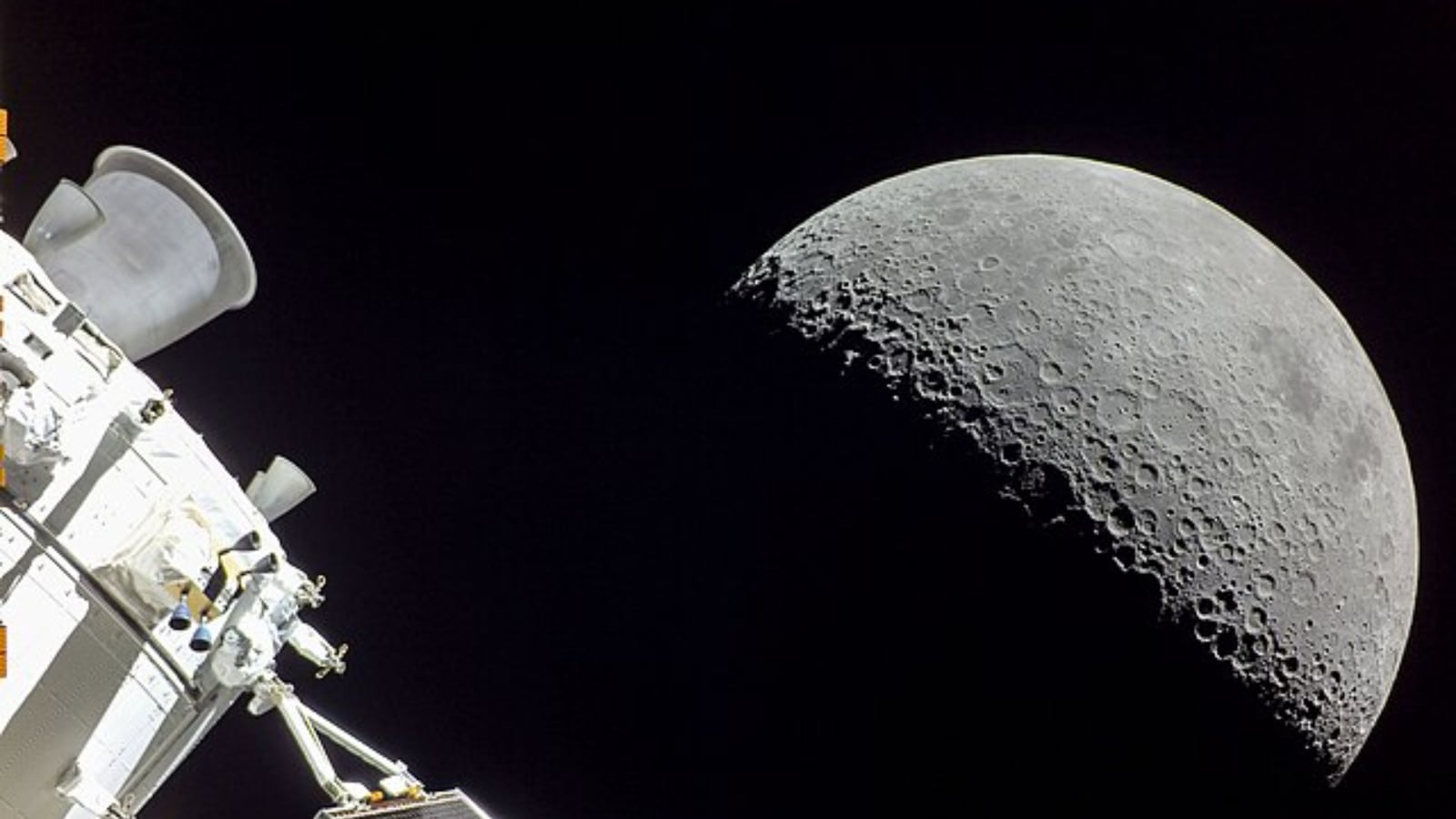
According to samples collected during Nasa's Apollo missions, helium-3 is found in greater quantities in the topmost layer of the Moon, called the regolith (Image: wikimedia commons)
Helium-3, a rare isotope of helium, is attracting growing attention from scientists, technology companies and space startups. Despite being virtually unknown to the general public, the element is said to be one of the most valuable substances found in nature, with prices for one litre exceeding $2,000.
The main reason for the interest in Helium-3 is that the material can play a crucial role in new technological achievements, such as quantum computing and supercooling, and, eventually, in future nuclear fusion plants. Given current shortages, several private companies are exploring innovative ways to procure materials, including extracting them from the Moon.
Contrary to popular belief, Helium-3 differs from it by having one less neutron in its atomic nuclei. Most Helium-3 in today’s world is obtained via the nuclear reaction of tritium decay in nuclear weapons stockpiles.
Helium-3 is widely utilised by scientists in their research due to its unique properties. First, it enables the achievement of low temperatures when cooling quantum computers. Second, it is used in particle physics experiments investigating dark matter and other enigmatic phenomena.
The future demand for Helium-3 could increase significantly as quantum computing becomes more widespread. Scientists believe that quantum computers would need thousands of litres of Helium-3 to operate, which exceeds existing production capabilities.
Increased demand has made the possibility of using a completely unexpected source very attractive: lunar soil.
According to samples collected during Nasa’s Apollo missions, helium-3 is found in greater quantities in the topmost layer of the Moon, called the regolith. Helium-3 was implanted into the Moon’s surface over billions of years by particles in the solar wind.
Story continues below this ad
Lunar mining
The promising possibilities have led some private companies to research lunar mining. Interlune from Seattle is one of the biggest players in the industry. It was founded by Harrison Schmitt, the former president of Blue Origin and Apollo 17 astronaut, and specialises in developing equipment to extract Helium-3 from lunar regolith.
Interlune plans to deploy autonomous excavators on the Moon that would collect and process large amounts of lunar soil. The material would be crushed and heated to release trapped gases, including Helium-3. The company says it could begin testing some of its technologies on lunar missions as early as 2027.
Another company, Astrotech Corporation, is pursuing similar goals and is exploring ways to extract Helium-3 by heating lunar regolith after transporting equipment aboard future SpaceX Starship missions.
Scientists still do not know exactly how much Helium-3 exists on the Moon or whether it is concentrated in accessible locations. Some estimates suggest concentrations may be only a few parts per billion, meaning hundreds of thousands of tonnes of lunar soil might need to be processed to obtain a single kilogram of Helium-3.
Story continues below this ad
Researchers also note that mining, processing and transporting material from the Moon would require enormous infrastructure and investment. Critics argue that extracting Helium-3 from Earth-based sources could prove more practical.
For example, Portugal-based Pulsar Helium is investigating Helium-3 deposits in Minnesota. Researchers studying the site say conventional drilling techniques could potentially recover useful quantities of the isotope without the need for lunar mining.
Others are working on alternative cooling technologies for quantum computers that would reduce dependence on Helium-3 altogether.
Still, interest in lunar Helium-3 continues to grow. Interlune has already signed a reported $300 million agreement to supply Helium-3 to a quantum computing company over the next decade.
Story continues below this ad
Whether the Moon becomes a major source of Helium-3 remains uncertain. But as demand for advanced computing and clean energy technologies increases, the rare gas is rapidly becoming one of the most sought-after resources in both the technology and space industries.
View original source — Indian Express ↗
Related stories
Times of India
NewsJun 5, 2026 · 1 min
Oil India strikes natural gas in third Andaman offshore well
Times of India

Times of India
NewsJun 5, 2026 · 1 min
Watch: Oil India discovers natural gas deposit in Andaman basin; Puri hails find
Times of India

Indian Express
TechnologyJun 8, 2026 · 1 min
Knowledge Nugget: Why is natural gas discovery in Andaman basin making headlines?
Indian Express

RNZ
NewsJun 9, 2026 · 1 min
Government earmarks $51m for new methane-busting technology
RNZ