Indian Express
Toxic pesticide in rice container leaves Mumbai toddler fighting for her life
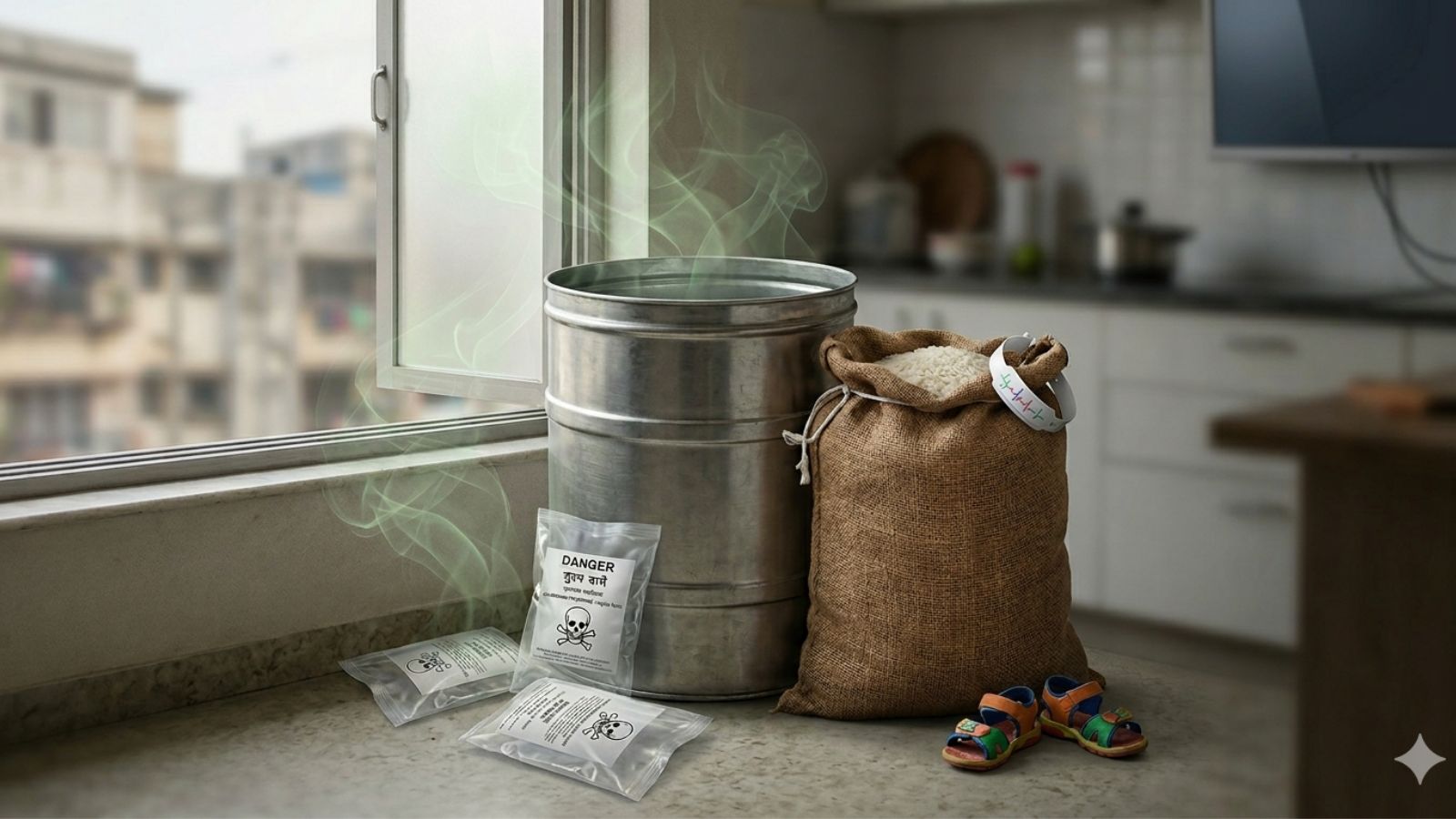
A two-year-old Mumbai toddler, weighing just 9 kg, is battling for life after inhaling fumes of aluminium phosphide, a highly toxic pesticide that her family had used to protect stored rice from pests and rats. The child is in a critical condition at Narayana Health SRCC Children’s Hospital, where doctors have placed her on advanced life-support systems after she suffered three cardiac arrests within a span of 15 hours.
The toddler was brought to the hospital on Saturday night after suffering from vomiting and diarrhoea for two days. She was severely dehydrated when admitted. According to doctors, the possibility of aluminium phosphide poisoning emerged only after the child suffered repeated cardiac arrests.
“Initially, she presented with severe dehydration, vomiting and diarrhoea. The diagnosis became clearer after a doctor in the child’s extended family mentioned that pouches of aluminium phosphide had recently been placed inside a large rice storage container at home and that a strong smell had persisted in the house since then,” Dr Soonu Udani, Medical Director, Paediatric Critical Care Medicine, Narayana Health SRCC Children’s Hospital, said.
“The child’s elder sister had also developed vomiting and diarrhoea around the same time but recovered within two days. That could be because the sister is older and has a better metabolism compared to the child who weighs just 9 kg,” Dr Udani added.
Doctors said the case has highlighted the dangers posed by a pesticide commonly used for grain storage that releases poisonous phosphine gas when in contact with moisture. The incident has also reignited concerns among medical experts and pesticide safety advocates about the continued availability of the chemical for household use.
The hospital released a statement on Tuesday advising families to be careful. “We strongly advise households not to store or use such products in homes or around stored food grains. Safer, approved pest-control methods should be used instead.
Public awareness is critical because prevention remains the most effective way to avoid these tragic and often fatal poisonings. We urge families to exercise caution and help spread awareness so that children and other vulnerable individuals are protected from unnecessary risk,” it said.
Story continues below this ad
No specific antidote
Considering that both children developed symptoms after the pesticide was placed in the household grain container, clinicians concluded that the presentation was consistent with a toxic exposure syndrome, or toxidrome, linked to aluminium phosphide poisoning.
“The conclusion is based on the clinical history and presentation. Both children became ill after the family introduced the chemical into the rice storage container. The elder sibling appears to have had a milder exposure and recovered, but the younger child, because of her age and small body weight, appears to have suffered far more severe effects,” Dr Udani said, adding that a medico-legal case has been registered.
With no specific antidote available for aluminium phosphide poisoning, doctors are relying on supportive treatment.
Following repeated cardiac arrests and rapidly deteriorating heart function, the child has been placed on extracorporeal membrane oxygenation (ECMO), an advanced form of life support that temporarily performs the functions of the heart and lungs by circulating and oxygenating blood outside the body. She has also been placed on mechanical ventilation and continuous renal replacement therapy (CRRT), a 24-hour form of dialysis used for critically ill patients with kidney dysfunction, Dr Udani said.
Story continues below this ad
The child is being monitored in the Paediatric Intensive Care Unit and has been covered with a specialised warming blanket to maintain body temperature.
“We initiated ECMO on Sunday afternoon, after which her heart function has shown some improvement. She remains critically ill, but we are continuing all supportive measures. Our hope is that the exposure dose was limited and that her heart, liver, and other organs recover with supportive care,” Dr Udani added.
Moisture exposure
Explaining the toxicity of the pesticide, Dr Udani said aluminium phosphide becomes particularly dangerous when exposed to moisture in the air. “When aluminium phosphide comes into contact with moisture, especially in humid conditions such as Mumbai, it releases phosphine gas, which is highly toxic. Phosphine is a rapidly acting poison that damages cellular metabolism throughout the body. It affects the heart very early, leading to cardiac failure, and can subsequently damage the liver, kidneys, brain and other organs. This poison kills the cells and prevents them from functioning. So when the cells die, any amount of support is not going to help. But we are hopeful,” she added.
It starts with symptoms such as vomiting but can rapidly progress to severe cardiac dysfunction and multi-organ failure. There is no specific antidote available. Treatment is entirely supportive, and the mortality rate is very high.
Story continues below this ad
According to doctors, phosphine gas acts by disrupting cellular energy production. Medical literature describes phosphine as a potent cellular toxin that inhibits mitochondrial respiration, preventing cells from producing energy and resulting in rapid organ damage and multi-organ failure.
Regulate aluminium phosphide: Doctors
The hospital has advised the family to discard the stored grain as a precautionary measure. “Aluminium phosphide, commonly used for grain storage, is an extremely toxic poison and should not be easily accessible for household use. Most countries have either banned or severely restricted it, but it continues to be available in India. It is also associated with a high number of suicide cases, particularly in agricultural regions where access is easier,” Dr Udani said.
“What I would particularly like to highlight is the need for much stricter regulation of this chemical. Existing warnings are clearly not enough. There should be stronger restrictions and prominent safety warnings to prevent such products from being used or stored in residential settings. Cases like this are preventable, and we need to ask why such a highly toxic substance continues to be so easily available,” she added.
Dr Narasimha Reddy Donthi, Senior Advisor at Pesticide Action Network (PAN) India, said the case reflects a wider lack of awareness regarding the hazards associated with such chemicals.
Story continues below this ad
“In rural North India, it is common for households to store grain inside their homes. Children are often exposed to these environments. Depending on the duration of exposure and concentration of fumes, inhalation of phosphine gas can be fatal, especially for children. There is no specific antidote for this poisoning,” Dr Donthi said.
“The fact that such a hazardous product is being used inside homes points to a complete lack of awareness about its dangers. When a hazardous product is sold over the counter, the minimum responsibility is to educate the buyer about the risks. This responsibility lies with both the manufacturer and the regulatory system. The product is simply too dangerous to be used casually in residential settings,” the doctor added.
Dr Donthi said warnings on packaging alone may not be sufficient to prevent accidental exposures, particularly in households where grain storage is common.
View original source — Indian Express ↗
Related stories

Daily Trust
EntertainmentJun 9, 2026 · 1 min
‘South Sudan children surviving on leaves’
Daily Trust

AllAfrica
BusinessJun 8, 2026 · 1 min
Kenya: Kagwe Pushes for Tougher Action Against Fake Farm Inputs
AllAfrica

Indian Express
NewsJun 10, 2026 · 1 min
Videos on ‘painless killing’, plant poison, alert neighbours
Indian Express

Antara News
NewsJun 9, 2026 · 1 min
Indonesia tightens food safety to curb toxic pesticides
Antara News