The Next Web
G7 leaders weigh a ‘trusted partners’ route to America’s top AI models
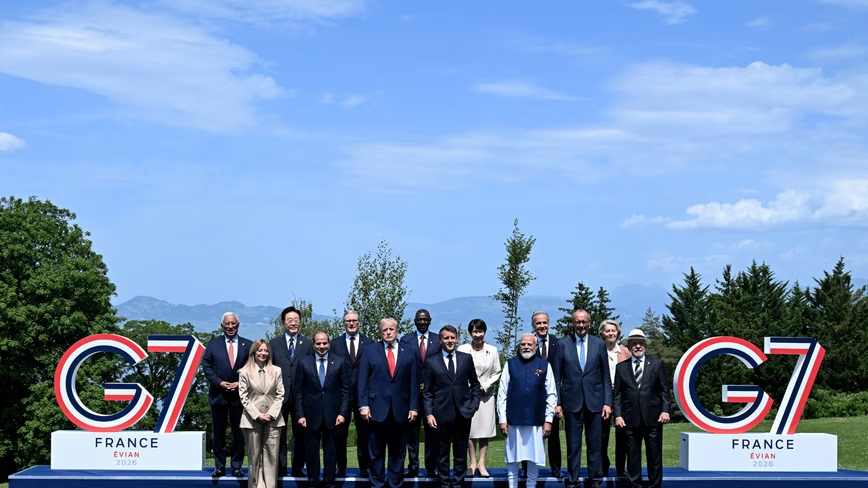
The conversation happened where these conversations usually happen, on the sidelines of a dinner. At the opening of the G7 summit in the French lakeside resort of Evian-les-Bains on Monday, representatives of several member countries raised with US Commerce Secretary Howard Lutnick the idea of a ‘trusted partners’ scheme that would let allied nations, or companies, reach the most advanced American AI models, according to people familiar with the discussions.
The proposal is a direct reaction to a decision taken in Washington four days earlier. On 12 June, acting on a US Commerce Department directive, Anthropic blocked foreign nationals from its two most capable systems, Mythos 5 and Fable 5.
Because the restriction could not be enforced selectively on a shared cloud service, the company switched the models off for everyone, worldwide. The order is believed to be the first export-control measure aimed at specific AI models rather than at the chips that run them.
That novelty is precisely what unsettled the allies. Chip controls are familiar terrain; America has spent years restricting what hardware can be sold and to whom.
Restricting access to the models themselves, including to nationals of close partners, is a newer and sharper instrument, and the G7 representatives spent Monday’s dinner trying to find a door that had just been shut. The ‘trusted partners’ under discussion could be countries or individual companies, the sources said.
The 💜 of EU tech
The latest rumblings from the EU tech scene, a story from our wise ol' founder Boris, and some questionable AI art. It's free, every week, in your inbox. Sign up now!
The stated rationale is defensive in the security sense rather than the commercial one. Broader access to frontier models, the argument runs, would let G7 countries build stronger cyber-defences against rivals, China foremost among them.
It is an appeal pitched in Washington’s own language: give your allies the best tools, and your allies will be better at the thing you also care about. If that framing moves the administration is another matter.
For Anthropic, the episode is one more turn in a fraught relationship with the US government. The company has been designated a supply-chain risk by the Pentagon, has had federal agencies ordered to stop using its technology, and has gone to court against Washington over the blacklisting, all while being told elsewhere in government that banks should use its models.
The June order to switch off its top systems is the most consequential intervention yet, and the one that has now pulled the G7 into the argument.
Nothing has been agreed. The discussions described were exploratory, conducted between country representatives and US officials rather than ratified by leaders, and a ‘trusted partners’ arrangement remains, for now, an idea floated over dinner.
What it signals is clearer than what it will produce. America’s closest allies have discovered that the most advanced AI they can buy is American, that access to it is now a lever in Washington’s hand, and that the only available response is to ask, politely, for it back.
View original source — The Next Web ↗
Related stories

The Hindu
PoliticsJun 16, 2026 · 1 min
G7 Summit Day 1 LIVE: G7 leaders open summit talks on Ukraine and West Asia as Zelenskyy joins in France
The Hindu

RFI
PoliticsJun 17, 2026 · 1 min
G7 leaders discuss AI risks before Macron hosts Trump at Versailles
RFI

CNA
NewsJun 9, 2026 · 1 min
North Korean and Chinese leaders agree to boost ties at Pyongyang summit
CNA

Straits Times
TechnologyJun 16, 2026 · 1 min
G7 leaders discuss 'trusted partners' access to cutting-edge US AI models, sources say
Straits Times