The Guardian
Does Ousmane Dembélé fit in a France attack led by Mbappé and Olise?
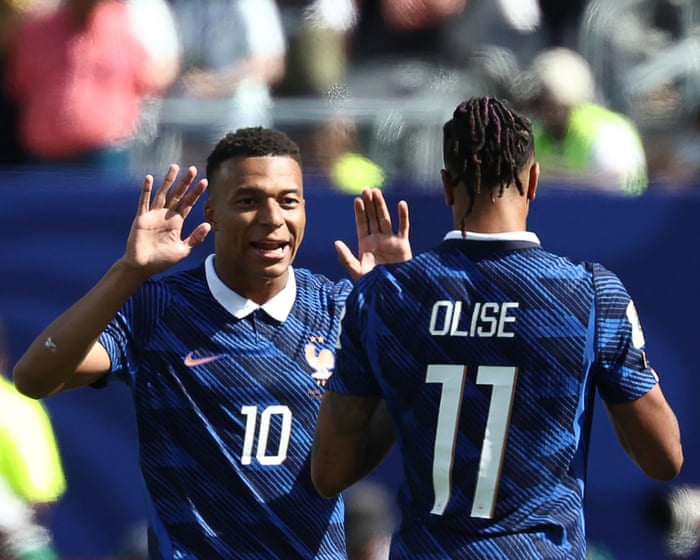
“If I start playing just to prove all of my critics wrong and to shut them up, I think I’d have to keep playing until I was 80,” said Kylian Mbappé as he wrote his name in the history books, surpassing Olivier Giroud as France’s all-time top scorer. He insists that his 57th and 58th goals for the national team – which secured a 3-1 win over Senegal in their World Cup opener – were not about “revenge”. But they were at least a response.
Mbappé is not someone who does all his talking on the pitch. Speaking before Euro 2024, he referred to himself in the third person as he announced his opposition to far-right politicians. “Kylian Mbappé is against extreme views and against ideas that divide people,” he said two years ago. I want to be proud to represent France. I don’t want to represent a country that doesn’t correspond to my values, or our values.”
The France captain made similar comments in the buildup to this World Cup. This time, his objection to the far right drew criticism from Michel Platini, who told Mbappé to remain politically neutral. “You are playing for all French people,” Platini said. “Once you take a stand, you fall out with half of the world.”
Deschamps says that when Mbappé speaks, he knows he does so “for all the players” and his viewpoint is shared by the dressing room. It doesn’t make him popular, however. Polling shows that Mbappé’s popularity is on the slide and has been since his exit from Paris Saint-Germain two years ago. He is acutely aware of public perception. “I am hated enough as it is,” he replied when asked about becoming the president of his country.
Before he even considers a political career, he has a World Cup to win. France’s dual-executive, semi-presidential system nicely encapsulates Mbappé’s predicament on the pitch: he needs a prime minister who will support rather than stymie him. An Mbappé-Ousmane Dembélé government would be an awkward cohabitation. Dembélé has excelled since moving into the No 9 position at PSG under Luis Enrique, winning the Champions League twice and the Ballon d’Or. At international level, though, that position is already taken.
Having previously been picked on the wing, Dembélé has been given a run through the middle in recent games, albeit in a No 10 role. He was ineffective in the position in France’s warm-up match against Northern Ireland and again against Senegal in their opener. Only Mbappé (37) had fewer touches than the PSG forward (40). The failure, granted, was a collective one; France failed to muster a single shot on target in the first half. Dembélé’s blocked long-range effort was their only shot at all.
At club level, Mbappé, Dembélé, Michael Olise and Désiré Doué scored 97 goals between them last season and, including assists, were involved in 157 goals. Given the attacking potential in the team, there was clearly a bug in the system against Senegal.
Deschamps identified it at half-time. Dembélé was moved out to the right and Olise brought into the middle. The manager explained his decision: “We were a lot better when Michael was positioned in the middle. I did it because I thought it would provide more of a link. Michael can play on both sides, but the more he gets on the ball, the better.”
Specifically, it is better for Mbappé. Olise would be the candidate of choice in Mbappé’s hypothetical government. To borrow an American perspective, Olise is the quarter-back and Mbappé is the runner, frequently found. As the Bayern Munich forward threaded the ball through for Mbappé to open the scoring, Dembélé could be seen advising a more conservative backwards pass. But Mbappé knew the pass would come and Olise knew the run would be made.
While different in profile, Olise is essentially the replacement for Antoine Griezmann. The former Atlético Madrid forward is the player with whom Mbappé has played most at international level (83 times). No player has provided Mbappé more assists than Griezmann. His retirement from international football left a void but it is now being filled.
Their combination was key to unlocking a game that, for more than an hour, provided plenty of cause for concern for Deschamps. France lacked creativity in midfield and variety in attack. Dembélé, Olise and Doué all wanted to occupy the same areas and there was a lack of forward runs from the wide players. Deschamps opted to start Doué, more technically gifted, rather than Bradley Barcola, a direct runner who stretches defences. Barcola’s goal from off the bench could provide Deschamps with food for thought before the Iraq game next Monday.
More conclusive, however, was the evidence that the Dembélé experiment should not be repeated. The forgiving nature of the group stage made starting Dembélé in the No 10 role, despite his struggles in the warm-up game, a worthwhile venture. France should use the Iraq game to build the Mbappé-Olise connection.
This is a team built around Mbappé and the win against Senegal justifies his stature as the centrepiece of a highly talented attacking armada. At 27, he has already made history. He is not only France’s all-time leading scorer but, with 14 goals at World Cups, he has also surpassed Just Fontaine’s record for goals at the tournament. As he prepares to win his 100th cap, he provides assurances that others simply do not, as talented as they may be.
“Even if he can’t have a great game, in one action he can make his team win,” said Deschamps after the Senegal win. Mbappé is the exclamation mark at the end of moves; his long-range finish to seal the game was just his fourth from outside the box in a France shirt. He is gradually becoming the traditional No 9 that France have lacked since Giroud’s retirement – a fox in the box.
As a result, he needs service and Olise is the one who provides it. It leaves difficult questions about Dembélé’s position and, perhaps, even his place in the team. The reality may be uncomfortable but the decision is being taken out of Deschamps’ hands. It is France’s dual-executives, Mbappé and Olise, who will be the difference between success and failure.
This is an article by Get French Football News
View original source — The Guardian ↗
Related stories
BBC Sport
SportsJun 6, 2026 · 1 min
Mr Irreplaceable and Ballon d'Or contender - is this Kane's time?
BBC Sport
Sky Sports
SportsJun 9, 2026 · 1 min
Dzeko: I did not think I would be playing at 40
Sky Sports
The Guardian
SportsJun 9, 2026 · 1 min
‘I didn’t think I’d be playing at 40’: Edin Dzeko on defying age to lead his country at the World Cup
The Guardian
Times of India
SportsJun 3, 2026 · 1 min
'Everyone would want to see Sooryavanshi in Test': Tendulkar's big claim
Times of India