
Hacker Noon
Inveniam and Docugami Are Solving the Bottleneck Between AI and $3.5T Private Credit Market
\ What is the actual constraint on private markets going on-chain at scale? It is not blockchain throughput. It is not custody. It is not regulatory clarity around stablecoins, which Japan, the EU, and now the United States have all addressed in the last eighteen months. The real bottleneck is older, less interesting, and considerably harder to fix: the data behind every private asset sits inside an unstructured document that no machine can independently verify line by line. \ Inveniam , the Detroit-based data infrastructure company that has credentialed more than $200 billion in private market assets on-chain , and Docugami , the Kirkland, Washington document intelligence company led by XML co-creator Jean Paoli, announced this morning a partnership that targets exactly that constraint. Docugami is opening its Document Graph Markup Language ( DGML ), and Inveniam will anchor the data elements that DGML extracts onto NVNM Chain , Inveniam's purpose-built Layer 2 attestation network. \ If the framing sounds dry, the implication is not. This is the kind of plumbing announcement that becomes load-bearing for the next phase of on-chain finance, even if it generates no token-price reaction on the day it is made. \ The news in one paragraph Docugami is opening DGML, a document data standard created by Jean Paoli, the same engineer who co-created the XML 1.0 standard at the W3C and built the docx, xlsx, and pptx formats during his time at Microsoft. DGML turns unstructured private-market documents, leases, loan agreements, operating statements, valuation reports, into precisely labeled data elements with semantic structure preserved. Inveniam will hash and anchor those individual data elements onto NVNM Chain, which launched on May 7, 2026 and went live on mainnet May 13. The result is a verification primitive that does not exist today: independent, granular, on-chain attestation of specific data points extracted from private-market documents, without exposing the documents themselves. \ The three forces converging right now Plumbing announcements only matter when the macro structure forces the question. Three forces are doing exactly that in mid-2026. \ The first is the size of the private credit market. The Alternative Credit Council, the AIMA-affiliated industry body, put global private credit AUM at $3.5 trillion at end-2024 , up 17% year-over-year. Moody's projects the figure to exceed $4 trillion by 2030 . For context, that is larger than the entire high-yield bond market and roughly comparable to the broadly syndicated loan market. \ The second is the August 2 2026 enforcement date for the EU AI Act. From that date forward, financial services firms operating high-risk AI systems in the EU face fines of up to €15 million or 3% of global annual turnover for high-risk system violations, and up to €35 million or 7% for prohibited practices . Article 86 also grants individuals harmed by high-risk AI decisions the right to an explanation. Translation: every AI-assisted credit decision, valuation, or trading action will need a verifiable audit trail to the underlying data. \ The third is the tokenization curve. The tokenized real-world asset market crossed $37.5 billion in May 2026 , up 100% year-over-year. Critically, private credit overtook tokenized treasuries as the largest non-stablecoin RWA segment in early 2026. \ Each of these forces alone would create a market opening. All three at once forces the question: how does an AI agent trading or valuing a private credit position prove to a regulator, a counterparty, or an auditor that the data behind its decision is real, complete, and unaltered? \ The honest answer, today, is that it cannot. That is the gap Inveniam and Docugami are aiming at. The architectural shift: from documents to data elements To understand why the partnership matters, you have to internalize a distinction the industry has been sloppy about. Until now, blockchain-based attestation of private-market documents has typically meant hashing the document as a whole, anchoring that hash on-chain, and claiming the document is verifiable. That works as a baseline integrity check. It does not work as a foundation for AI-driven finance. \ The reason is simple. An AI agent valuing a commercial real estate loan does not care that "a lease exists." It cares that the lease term is seven years, that the tenant is investment-grade, that the rent is $48,000 per month with a 3.5% annual escalator, that the renewal options are two five-year terms, and that net operating income comes in at $432,000. Each of those data elements is a separate fact, extracted from a different clause of a different document, with its own provenance and its own room for error or manipulation. \ Document-level hashing tells you the document is intact. Data-element-level attestation tells you the specific facts driving a decision are intact. The former is a notarization primitive. The latter is the substrate AI agents actually need. \ DGML is the format that makes data-element extraction precise and queryable. NVNM Chain is the rail that records those elements on-chain. \ Patrick O'Meara, Chairman and CEO of Inveniam, framed it directly in the announcement: "DGML is a foundational advance in how we read and structure the documents that drive private capital." That is the operative claim. Whether the market validates it over the next twelve months is a separate question. \ Why DGML matters as a standard, not just a product There is a category of strategic move that the industry routinely undervalues: opening a standard. \ When Paoli co-created XML at the W3C in the late 1990s, the value did not come from XML being a particularly novel piece of computer science. It came from the fact that XML was open. Every vendor, every government, every enterprise could implement against it without licensing fees and without dependency on a single platform. The same logic later applied to the Office Open XML formats Paoli helped drive at Microsoft. The reason every business document on Earth now lives in some flavor of docx, xlsx, or pptx is not because those formats are technically superior to alternatives. It is because they were standardized and adopted. \ Opening DGML is the same play. Docugami is not making DGML the property of one vendor or one set of customers. By inviting every participant in the private capital ecosystem to build on it, the company is positioning DGML to become the lingua franca for how private-market documents are translated into machine-readable data. If that succeeds, the value capture for Docugami shifts from selling a proprietary product to operating the canonical reference implementation of a standard the entire market depends on. \ This is a meaningfully different competitive posture from general-purpose LLMs offering document extraction as a side capability. Claude , GPT-5 , and the legacy IDP vendors like ABBYY, AWS Textract, and Google Document AI all process documents. None of them produce semantically labeled, provenance-aware data elements designed to be cryptographically anchored. That is a narrow niche, but it happens to be the niche where the regulated audit trail for AI-driven private finance gets built. \ What NVNM Chain actually does NVNM Chain is not a general-purpose blockchain. It is a Layer 2 designed for one specific job: anchoring attestations about private-market data so that AI agents, institutions, and regulators can independently verify what data drove what decision, without exposing the underlying data itself. \ The chain ships with three attestation primitives: Proof of Origin, Proof of State, and Proof of Process . Proof of Origin records where a data element came from, including the source document, the signer, and the timestamp. Proof of State records what the data looks like right now, including current values and version history. Proof of Process records how the data was transformed between origin and current state, including extraction methods and validation steps. \ These are not arbitrary primitives. They correspond directly to what a regulator under the EU AI Act, or a FINRA examiner under the 2026 Oversight Report's new AI auditability priority , or a federal contractor under OMB Memorandum M-26-04 , will need to evidence in order to demonstrate AI provenance. \ NVNM Chain was also production-tested before launch. The underlying TraceChain system handled compliance checks on GPU export controls at billion-event scale through a deployment with AIRev and OnDemand, under the G42 and Bank of International Settlements Regulated Technology Environment framework. That is not a sandbox demo. That is real institutional traffic. \ Where DGML and NVNM Chain sit in the stack When you map the full path from a private-market document to an AI-driven investment decision, you get five layers. The Inveniam and Docugami partnership lives in the middle two. \ At the bottom sit the source documents themselves: leases, loan agreements, financial statements, valuation reports, side letters. These are the raw material. Above them sits the data-element extraction layer, where DGML now plays. Above that sits the attestation layer, where NVNM Chain anchors hashes. Above that sit tokenization and RWA platforms. At the top sits the AI agent or institutional decision-maker. \ The historical problem is that the middle two layers were either missing or proprietary. Extraction was a black box, attestation was document-level, and tokenization platforms had to take both on faith. Opening DGML and anchoring its outputs on NVNM Chain is a deliberate move to make the middle two layers public, standardized, and independently verifiable. \ Why documents are the actual bottleneck A statistic that has been quietly true for decades is becoming load-bearing for crypto only now: roughly 85% of business data is unstructured or semi-structured , stuck in documents rather than databases. In public markets, this is manageable because most of the data the market needs has already been pulled out of documents and reformatted into structured feeds: Bloomberg, FactSet, exchange tapes. \ Private markets do not have that infrastructure. Every private credit fund agreement is a snowflake. Every lease has its own quirky escalator clause. Every operating statement is presented in a slightly different format. The unstructured-data problem is not 85% in private credit. It is closer to 100%. \ That is why the Inveniam plus Docugami partnership reads, on paper, as a niche infrastructure play, but matters out of proportion to its press coverage. The two companies are not solving for a new asset class or a new chain or a new tokenization standard. They are solving for the precondition that makes any of those things actually scalable at institutional volume. \ The Inveniam timeline reads like a setup If you look at Inveniam's product trajectory over the last eighteen months, the Docugami partnership is not a one-off. It is the last beat in a sequence that has been building toward exactly this moment. \ The company acquired Swarm in late 2025, picking up regulatory-compliant tokenization of public market assets and a lending infrastructure. It partnered with Armada ETF Advisors in December to modernize institutional access to private assets. It launched NVNM Chain on May 7, 2026 with mainnet going live on May 13. And now, six weeks later, it announces the Docugami partnership, just six weeks before EU AI Act enforcement begins on August 2. \ The sequencing is not accidental. NVNM Chain is the attestation rail. Docugami is the extraction layer that feeds it. The EU AI Act is the regulatory event that turns the combined system from a useful capability into compliance infrastructure. The Inveniam-Docugami announcement is the third piece of a three-piece arc, with the regulatory deadline acting as a forcing function for adoption. \ What could go wrong A few risks worth flagging plainly, since editorial pieces that don't name risks read as press releases: \ Standards adoption is slow. Opening DGML is the right move strategically, but standards take years to compound. Docugami is in a race against time, both with the AI Act enforcement window and with general-purpose LLMs that may move into structured extraction faster than expected. Standardization momentum is built one institutional customer at a time. \ NVNM Chain is a specialized Layer 2. Specialized chains historically have struggled to maintain network effects against general-purpose alternatives. Inveniam's argument is that general-purpose blockchains were built for token transfers, not for high-frequency institutional data anchoring. That argument is technically defensible, but the market has not always rewarded technical correctness over distribution. \ The trust gap may not be the bottleneck institutions actually feel. It is plausible that institutions in private credit are perfectly happy with proprietary data infrastructure operated by their service providers, and that the demand for independent, on-chain verification is overstated. The EU AI Act will force some movement, but how much movement, in what jurisdictions, and on what timeline is genuinely uncertain. \ Patent moats cut both ways. Inveniam holds more than 90 granted U.S. patents covering blockchain attestation of real-world asset data. That is a defensible moat. It is also a deterrent to the kind of ecosystem participation that would accelerate adoption. The patent strategy and the open-standard strategy have to be balanced carefully. \ None of these risks are dealbreakers. They are the cost of operating infrastructure that does not yet have a precedent in the market. \ The bottom line The Inveniam-Docugami announcement is not the kind of news that moves token prices. It is the kind of news that, in retrospect, gets cited as the moment a structural problem in on-chain private markets started getting solved. \ The problem itself is older than crypto. Private-market data has always been stuck in documents that machines cannot reliably parse, and institutions have historically managed around that constraint with armies of analysts, lawyers, and back-office staff. AI agents do not have that luxury. They need data they can act on at machine speed, with verifiable provenance, under regulatory regimes that are getting strict enough to make the alternative existentially expensive. \ DGML solves the extraction precision problem. NVNM Chain solves the attestation problem. Together, they target the specific layer of the stack where private-market AI most needs work, and they arrive just before the regulatory environment makes that work mandatory. \ Whether this becomes the standard that the next decade of on-chain private finance is built on, or whether a competing approach emerges from Anthropic, OpenAI, BlackRock, Securitize, or some combination of them, is a question of execution, distribution, and standards-body politics that will play out over the next eighteen months. \ But the architectural argument behind the partnership is sound. The trust gap in private-market data is real. The forcing functions are coming on a fixed timeline. And the team executing the response has both the patent stack and the standards pedigree to make a credible run at it. \ That is worth watching. \ Don’t forget to like and share the story! :::tip Vested Interest Disclosure: HackerNoon has reviewed the report for quality, but the claims herein belong to the author. #DYOR. ::: \ \
View original source — Hacker Noon ↗
Related stories

Hacker Noon
TechnologyJun 4, 2026 · 1 min
Fhenix and Monaco Research Are Trying to Build a Dark Pool That Actually Works: Behind DeFi
Hacker Noon
Bloomberg
BusinessJun 8, 2026 · 1 min
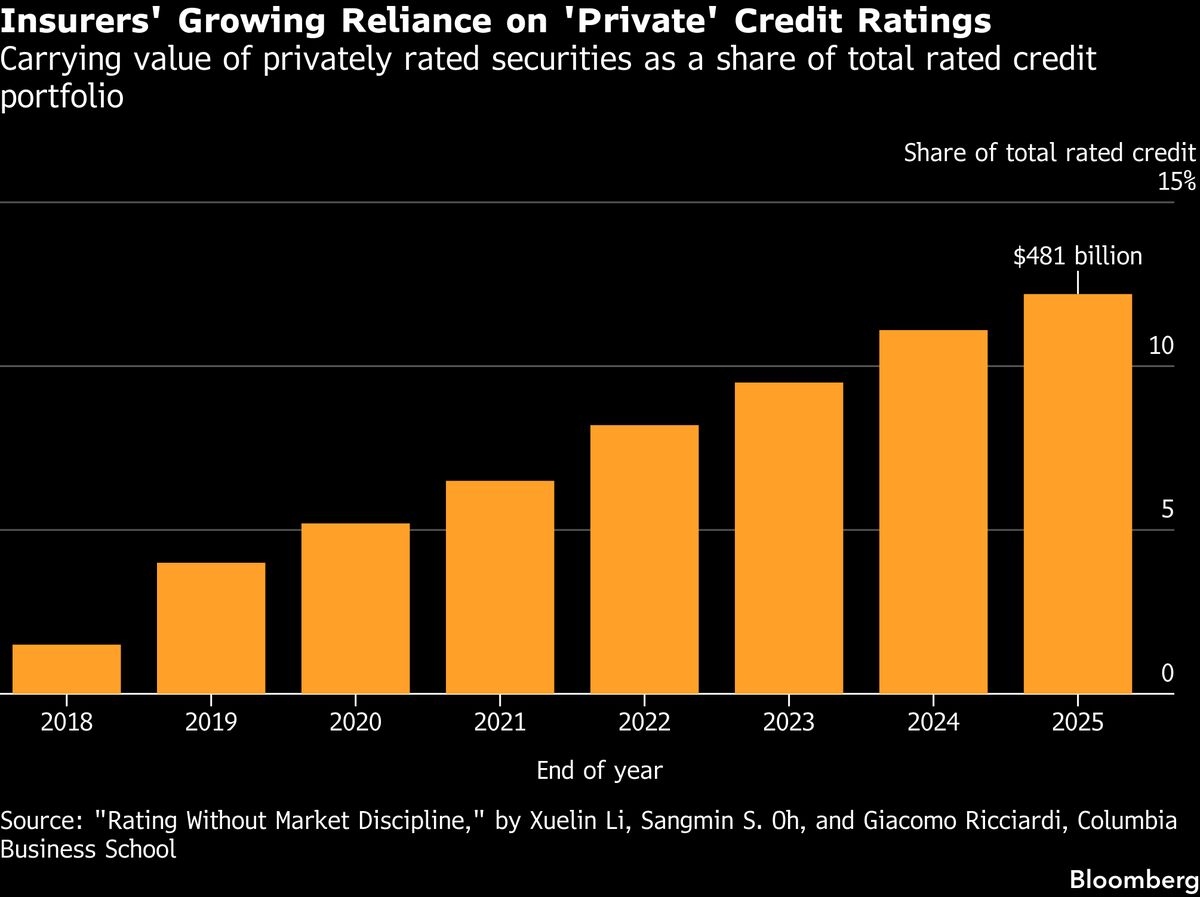
Inflated ‘Private’ Ratings Are Masking Credit Risk, Columbia Study Says
Bloomberg

CNBC
BusinessJun 9, 2026 · 1 min
SpaceX IPO explained: The price is set, but retail allocation still up in the air
CNBC

Bloomberg
BusinessJun 10, 2026 · 1 min
Expect Strong Second Half of Year for Private Equity: Carlyle's Steve Wise
Bloomberg