Indian Express
Amid West Asia conflict, bitumen woes hit India’s road infrastructure push
4 min readNew DelhiJun 18, 2026 01:34 AM IST
The Ministry of Road Transport and Highways has granted relief measures of force majeure and price adjustment to highway contractors in light of war-related disruptions.
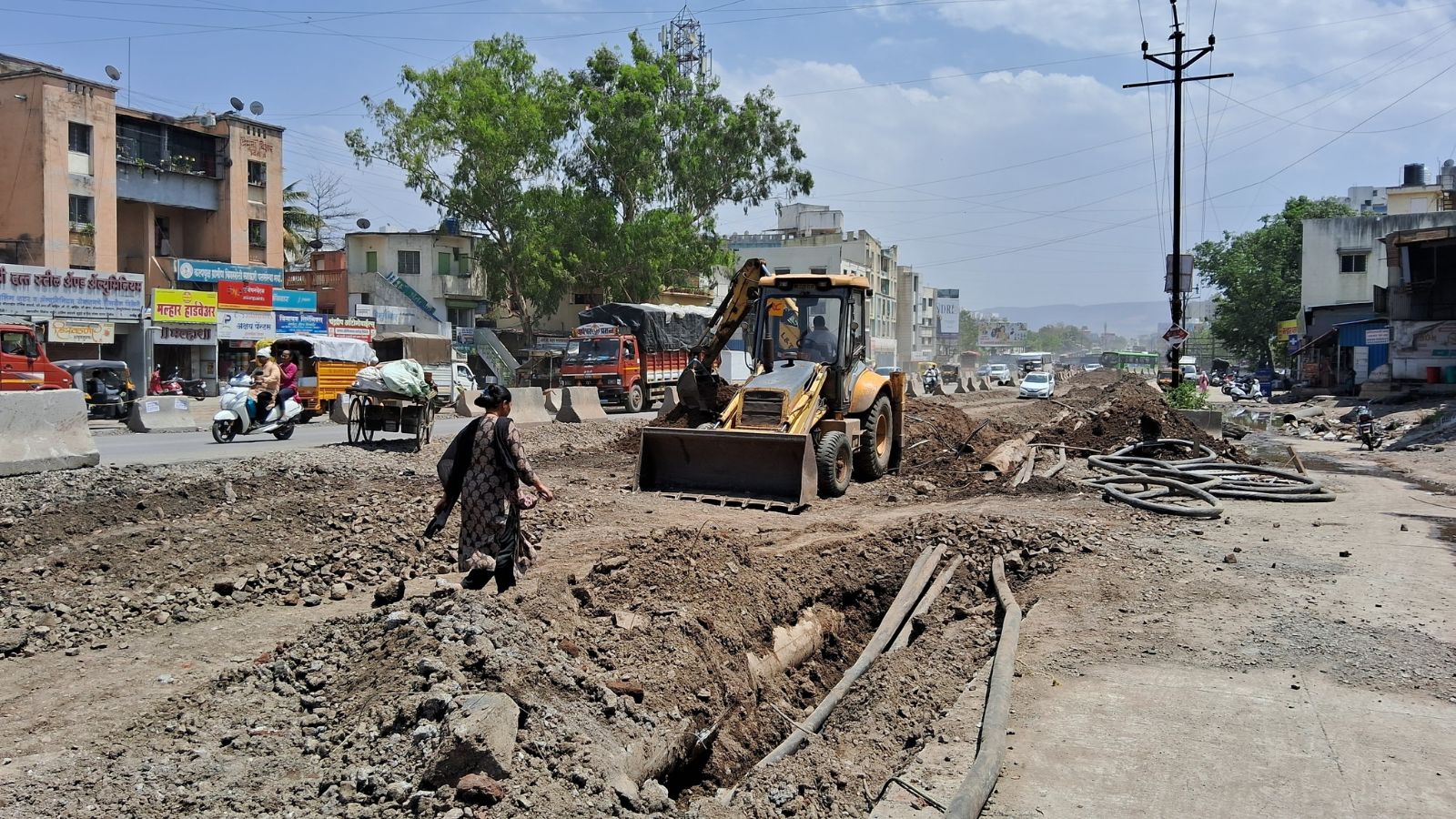
The ongoing conflict in West Asia has hit India’s push to expand road infrastructure. Bitumen, crucial for road construction, was also caught in the crossfire just like oil and gas, with an import dependency ranging between 30 to 40%.
The government has a target of building 10,000-km of highways in the ongoing financial year 2026-27. Additionally, 17,365 km of roads remain to be constructed under Pradhan Mantri Gram Sadak Yojana (PMGSY) Phase-III, a flagship scheme for rural infrastructure.
Bitumen imports have taken a hit after the war, with road construction companies and contractors raising concerns over low supplies and increasing prices with the National Highway Authority of India (NHAI) and state road agencies.
According to the Ministry of Petroleum and Natural Gas (MoPNG) data, India imported 2.36 lakh tonnes of bitumen in April 2026, compared to 2.97 lakh tonnes imported in April 2025 and 2.74 lakh tonnes imported in April 2024.
Similarly, domestic bitumen consumption has also declined. A total of 5.80 and 5.19 lakh tonnes was used in April and May 2026 — almost 33% lower than the 8.62 and 8.57 lakh tonnes consumed in April and May 2025. It was also lower than the same period in 2024. India requires almost 90 lakh tonnes of bitumen annually. Of this, around 54 lakh tonnes are produced domestically in the refineries of oil companies like IndianOil and Bharat Petroleum. The shortfall is met by imports from West Asia. Over 99% of India’s bitumen imports come from Iraq, UAE, Iran, Oman and Bahrain. Zafar Khan, President of the Highways Investor Association, said, “The Strait of Hormuz is critical for India’s road sector because a substantial portion of the crude oil processed by Indian refineries originates from the West Asia and transits through this route. Any disruption in the region can impact crude supplies, refinery operations, and consequently the availability and pricing of bitumen, a key input for road construction.”
The mismatch
India was not always as dependent on imports. The change has been driven by the mega road projects undertaken within the last decade, through schemes like Bharatmala (for enhancing road connectivity via expressways and economic corridors) and PMGSY.
National Highways have grown from 91,287 km in 2014 to 1.47 lakh km currently (a 61% increase), while the length of expressways increased from 93 km to 3,052 km. However, domestic bitumen production has not kept pace. Imports have more than doubled, and consumption increased by almost 50%. According to data available with the Petroleum Planning and Analysis Cell of MoPNG, bitumen imports began in 2001-02, at around 9,000 tonnes. A significant increase was recorded in 2013-14, when 2.46 lakh tonnes were imported — more than double the previous year’s import volume.
Story continues below this ad
This doubled again by 2014-15, reaching 5.17 lakh tonnes, and continued increasing.
Force majeure
The Ministry of Road Transport and Highways has granted relief measures of force majeure and price adjustment to highway contractors in light of war-related disruptions.
In its June 5 circular, the ministry said for project delays linked to the conflict, contractors can claim force majeure clauses to receive two to four months of relaxation without penalty. The ministry has also provided a cost-escalation compensation mechanism, or price adjustment, to account for a surge in fuel prices and construction material costs, as well as logistics expenses.
However, contractors availing relief under the price-adjustment circular will not be eligible for force majeure relief. Khan said that those constructing roads under PMGSY and small-Engineering, Procurement and Construction projects are facing the most difficulty.
Story continues below this ad
“While everybody is in distress, the larger highway contractors are better equipped to deal with the situation. The existing crude can be recycled for the bitumen. The government should try to protect smaller contractors from an increase in prices. The price of one tonne of bitumen had shot up to Rs 80,000 from Rs 40,000.”
Dheeraj Mishra is a Principal Correspondent with the Business Bureau of The Indian Express. He plays a critical role in covering India's massive infrastructure sectors, providing in-depth reporting on the connectivity lifelines of the nation.
Expertise & Focus Areas: Mishra’s journalism is focused on two of the country's most capital-intensive and public-facing ministries:
Ministry of Railways: Tracking the operations, safety, and development of India's vast railway network.
Ministry of Road Transport & Highways: Covering policy decisions, infrastructure projects, and highway development.
What sets Mishra apart is his rigorous use of the Right to Information (RTI) Actas a primary tool for news gathering. By relying on official data and government records, he ensures a high degree of accuracy and trustworthiness in his reporting. This data-driven approach has resulted in numerous impactful reports that hold public institutions accountable and bring transparency to government operations.
Find all stories by Dheeraj Mishra here ... Read More
View original source — Indian Express ↗
Related stories

Times of India
NewsJun 4, 2026 · 1 min
Government mulls cement roads amid bitumen price spike
Times of India

Indian Express
NewsJun 8, 2026 · 1 min
Israel and Iran trade strikes as conflict escalates; IDF hits petrochemical sites in Mahshahr
Indian Express

TASS
PoliticsJun 4, 2026 · 1 min
Global market facing shortage of tankers, rising freight costs — Novak
TASS

Times of India
PoliticsJun 16, 2026 · 1 min
US-Iran peace deal: What opening of Hormuz would mean for India’s crude oil supplies
Times of India