Indian Express
Indian Express··7 min read
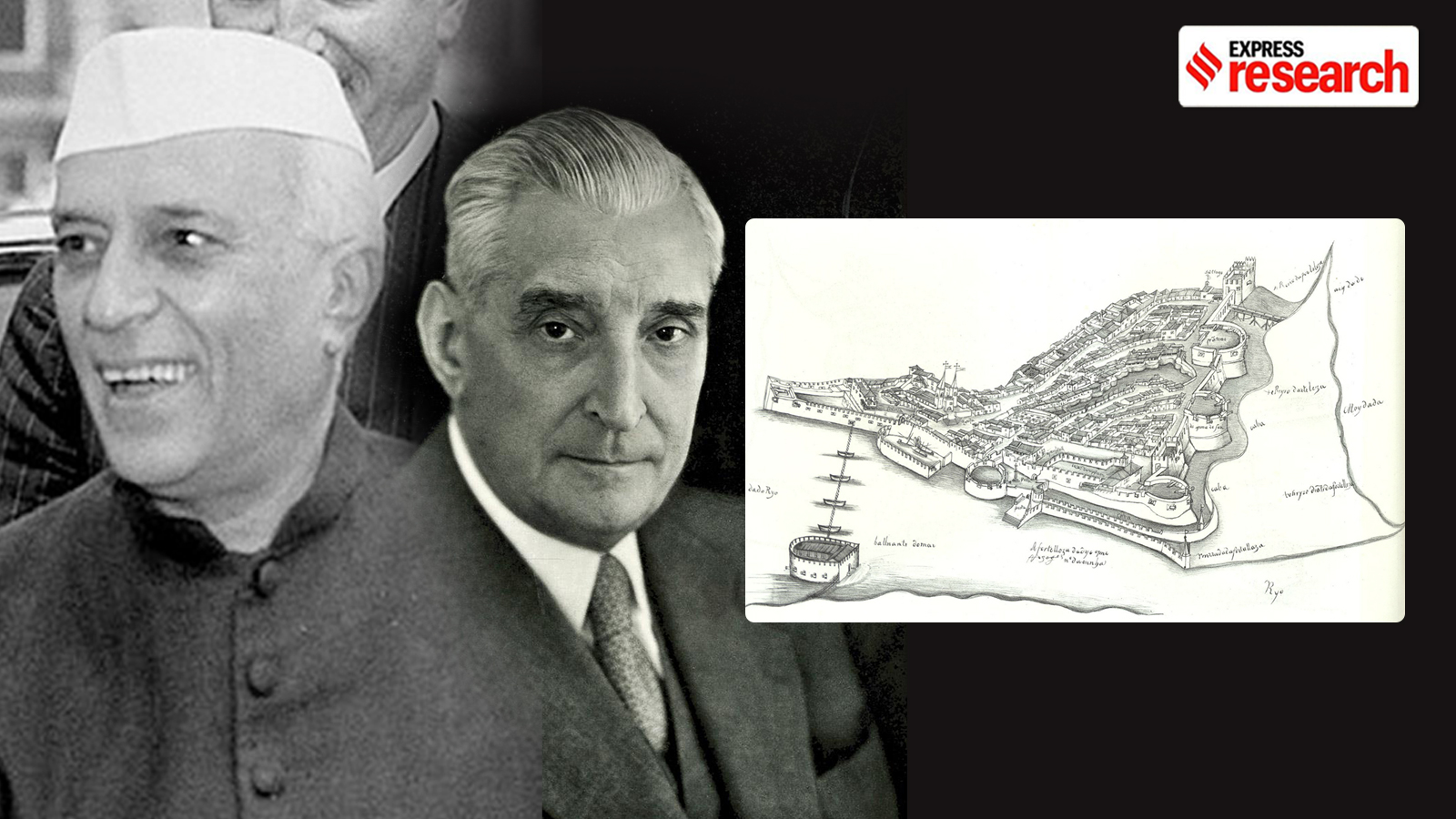
Why Nehru waited 14 years to end Portuguese rule in Goa
Eighty years ago, on June 18, 1946, socialist leader Ram Manohar Lohia and his associate Julião de Menezes led a civil disobedience movement against Portuguese rule in Goa. The protest, now commemorated as Goa Revolution Day, became a defining moment in the territory’s anti-colonial struggle against the Portuguese.
Yet, Goa did not become part of Independent India until 1961. Even after the British left the subcontinent in 1947, Portugal refused to relinquish its colonies of Goa, Daman, Diu, and Dadra and Nagar Haveli. For the next 14 years, Prime Minister Jawaharlal Nehru resisted calls for military action, preferring diplomacy and international pressure to secure their transfer.
Why did Nehru wait so long to act against one of the last colonial powers in India, and what finally led him to launch Operation Vijay in December 1961?
For Nehru, Goa presented a dilemma. While he regarded continued Portuguese rule as an anachronism, he feared that using force would undermine India’s commitment to peaceful conflict resolution and damage its standing among newly independent nations.
His government therefore pursued negotiations with the regime of António de Oliveira Salazar, even as anti-colonial protests intensified and pressure mounted at home for decisive action.
The imperialists who stayed
After India gained independence in 1947, Portugal refused to hand over its remaining colonies, which it had ruled since the 16th century. Salazar steadfastly refused to talk and refused to vacate the last vestige of European colonialism in India. At first, writer Valmiki Faleiro notes in his book, In Goa, 1961: The Complete Story of Nationalism and Integration, he condescendingly declared that Goa was the “… light of the West in the Orient.”
Opposition to colonial rule in Goa had been steadily mobilised by leaders such as Lohia, who championed non-violent Gandhian methods of resistance.
Story continues below this ad
Ram Manohar Lohia (left) with others (Wikipedia)
The major anti-colonial protest led by Lohia on June 18, 1946, was suppressed by the Portuguese authorities. Similar confrontations occurred in 1954, when Portuguese forces used violence to stop non-violent satyagrahis from entering Goa. A parallel movement in Dadra and Nagar Haveli, however, proved successful, and the territory was liberated from Portuguese control in 1954.
Alongside non-violent resistance, armed groups such as the Azad Gomantak Dal (Free Goa Party) and the United Front of Goans carried out guerrilla operations against the Portuguese. In The Portuguese Presence in India: Malabar and Goa, author Poulami Aich Mukherjee notes, “These organizations — along with Indian volunteers were also involved in the liberation of Dadra and Nagar Haveli from Portuguese rule in 1954”.
However, Nehru’s government remained committed to a diplomatic resolution, holding discussions with the regime of António de Oliveira Salazar and seeking the peaceful transfer of Portugal’s remaining Indian territories. “The Indian Government adopted a ‘wait and watch attitude’…with numerous representations to the Salazar regime and attempted to highlight the issue before the international community,” writes Mukherjee.
What perplexed Nehru most
For Nehru, Goa posed a unique dilemma. Historian and academic Judith M Brown explains in Nehru: A Political Life that he was reluctant to use military force not only for principle, but also because he feared it would damage India’s standing in world opinion and undermine its international influence.
Story continues below this ad
At the same time, he recognised the limits of non-violent resistance. Unlike the British, the Portuguese showed little inclination to respond to satyagraha, viewing themselves as custodians of a historic Christian civilisation.
Nehru famously described the tiny Portuguese enclave as a “pimple on the face of Mother India,” occupying barely 0.1 per cent of the country’s territory.
Yet many Indian nationalists saw the issue very differently. Faleiro notes that Lohia retorted, saying, “It was a pimple that disfigured the face of India more than that other pimple of Kashmir.”
Across the political spectrum, socialists such as Jayaprakash Narayan, Minoo Masani, Asoka Mehta, Ram Manohar Lohia and George Fernandes, along with public figures including Krishna Menon, regarded Portuguese-ruled Goa “not as a ‘pimple’ but as an anachronism that needed to be corrected,” writes Faleiro.
Story continues below this ad
Nehru nevertheless remained committed to diplomacy. As one of the principal architects of the Bandung Conference of April 1955, he sought to build Afro-Asian solidarity against colonialism and lay the foundations of what would later become the Non-Aligned Movement.
Delegations held during the Bandung Conference, April 1955 (Wikipedia)
Reflecting this approach, Nehru declared from the Red Fort on August 15, 1955: “I declare here and now that we shall not send our Army [into Goa]. We will solve this problem peacefully. Let everybody understand this clearly. India has decided not to use force.”
Days later, addressing the Uttar Pradesh Congress Committee at Sitapur, he reiterated: “To take Goa by force would be easy … (but) police action would be contrary to the policy of the Government as well as to the dignity of India.”
A year later, on July 26, 1955, he again told Parliament, “We have always been clear that we will not use force except for defence, that we will not provoke or wage war or adopt any aggressive tactics leading to war”
Story continues below this ad
Nehru, meanwhile, continued with diplomacy in 1956. He told Parliament before (referring to the Goa question), “We deal with national and international issues, and we often have to be very patient. It is this reputation we have built in the world … [that] we do not act in haste, we give mature consideration to problems. Because we try to function as a mature nation and have not taken hasty decisions or hasty actions. Therefore, the world pays attention to what we say.”
Portugal, however, refused either to negotiate or to relinquish its Indian territories, and the diplomatic deadlock between New Delhi and Lisbon continued.
Over time, international opinion increasingly shifted in India’s favour. Brown notes, “Gradually the tide of world opinion seemed to be flowing India’s way.” The United Nations’ 1960 declaration against colonialism, coupled with growing criticism of Portuguese rule in Africa, left Lisbon increasingly isolated. Leaders from several newly independent African nations also began pressing Nehru to take a firmer stand on Goa.
Domestic pressure was mounting as well. More than a decade after independence, many Indians viewed the continued existence of European colonial enclaves on the subcontinent as intolerable.
Story continues below this ad
By late 1961, the situation had reached a breaking point. Within the Indian government, support for a firmer response was growing. “The Ministry of Defence, now headed by Krishna Menon, seems to have had no qualms about direct action,” notes Brown.
Operation Vijay
By October 1961, Nehru’s diplomacy had run its course. Within India, the decision was taken to use military force to end Portuguese rule, and preparations began for what would become known as Operation Vijay.
Alarmed by signs that India was preparing for armed intervention, Portuguese Prime Minister António de Oliveira Salazar sought international support. He first appealed to the United Kingdom to mediate, then lodged protests through Brazil, and finally approached the United Nations Security Council (UNSC).
The governments of the United States and Britain, along with UN Secretary-General U Thant, urged Nehru to postpone any military action. Yet, as Brown writes, “[Nehru] explained forcibly to all three why India could no longer hold back from armed intervention.”
Story continues below this ad
Nehru’s public position hardened as the crisis reached its final stage. On December 10, just nine days before the operation began, he told the press, “Continuance of Goa under Portuguese rule is impossible.”
António de Salazar (Wikipedia)
Meanwhile, Salazar instructed Goa’s Governor-General, Manuel António Vassalo e Silva, to resist at all costs. As cited by Mukherjee, Salazar’s message declared, “Do not expect the possibility of truce or of Portuguese prisoners, as there will be no surrender rendered because I feel that our soldiers and sailors can be either victorious or dead.” In accordance with these orders, the Portuguese prepared for war.
On December 18, Indian forces launched coordinated operations by land, sea and air against Portuguese positions in Goa, Daman and Diu. Within little more than 36 hours, Portuguese resistance had collapsed.
As Mukherjee notes, “The armed action, involving air, sea and land strikes for over 36 hours, ended 451 years of Portuguese colonial rule in Goa. Fourteen Indians and thirty-one Portuguese were killed in the fighting.”
Story continues below this ad
International criticism
The operation, however, sparked considerable international criticism. Many Western governments accused India of abandoning its long-standing commitment to peaceful conflict resolution.
Even as Indian troops advanced into Goa, UNSC convened an emergency session at Portugal’s request. There, the US representative, Adlai Stevenson, condemned India’s military action and introduced a resolution calling for an immediate ceasefire, the withdrawal of Indian forces, and the resumption of negotiations. The resolution, co-sponsored by France, the United Kingdom and Turkey, failed after the Soviet Union exercised its veto.
The end came swiftly. On December 19, 1961, Governor-General Silva formally signed the instrument of surrender. More than a decade after Independence, Goa’s integration came not through diplomacy but through the military intervention Nehru had long resisted.
View original source — Indian Express ↗
Related stories
Indian Express
NewsJun 10, 2026 · 1 min
Akal Takht breaks deadlock, SGPC jatha heads to Pakistan after 14 years
Indian Express
Indian Express
PoliticsJun 10, 2026 · 1 min
Italy’s Giorgia Meloni congratulates Narendra Modi on becoming longest-serving PM of India
Indian Express
Indian Express
NewsJun 10, 2026 · 1 min
‘Priority to bring Tatas back’: BJP minister 18 years after Nano’s Bengal exit
Indian Express

Times of India
TechnologyJun 16, 2026 · 1 min
FIFA World Cup 2026 Recap: A Day of Only Draws after 68 years
Times of India