Indian Express
UPSC Mains Answer Practice — GS 1
UPSC Essentials brings to you its initiative for the practice of Mains answer writing. It covers essential topics from both the static and dynamic portions of the UPSC Civil Services syllabus across various GS papers. The questions are carefully selected on the basis of their relevance to the UPSC examination and current developments, helping aspirants focus on themes that matter most for Mains. This answer-writing practice is designed as a value addition to your UPSC CSE Mains preparation. Attempt today’s GS-1 questions and check your progress.
🚨 Click Here to read the UPSC Essentials magazine for June 2026. Share your views and suggestions in the comment box or at [email protected]🚨
QUESTION 1
Discuss the significance of the Goa Liberation Movement in the broader context of India’s decolonisation and nation-building after Independence.
QUESTION 2
Archaeological artefacts are not merely objects of artistic value but also important sources for reconstructing ancient societies. Examine this statement in the context of the Harappan ‘Dancing Girl’ figurine.
QUESTION 1: Discuss the significance of the Goa Liberation Movement in the broader context of India’s decolonisation and nation-building after Independence.
Relevance: The Goa Liberation Movement highlights the completion of India’s decolonisation process and the consolidation of national unity after Independence. The topic illustrates the role of diplomacy, military action, and foreign policy in integrating colonial enclaves into the Indian Union. The topic is relevant to GS Paper 1 under Modern Indian History and post-Independence consolidation.
Note: This is not a model UPSC answer. It only provides you with a thought process which you may incorporate into the answers.
Introduction:
Story continues below this ad
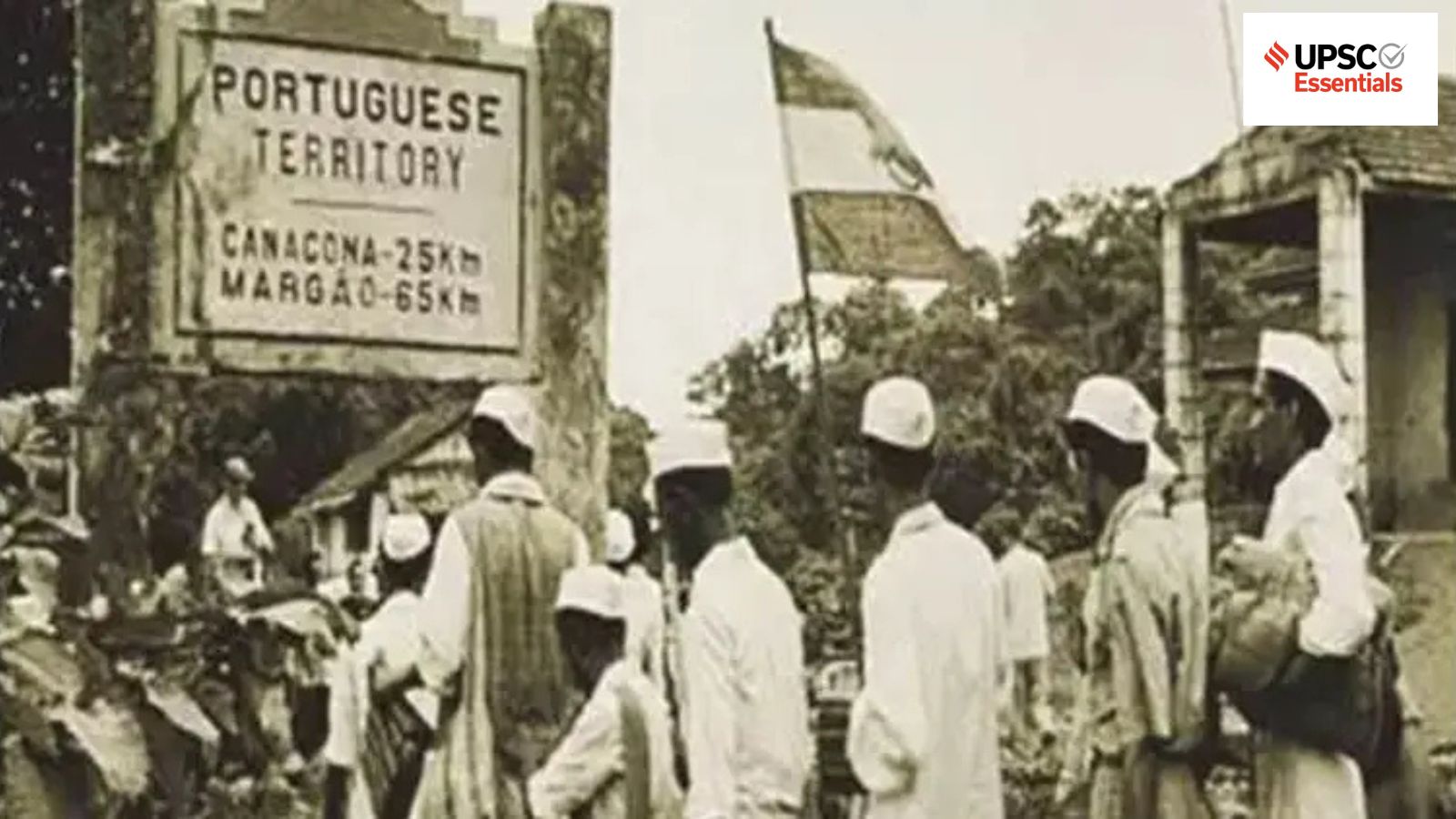
— Although India gained independence in 1947, Goa, Daman, and Diu remained under Portuguese sovereignty. The independence of Goa in December 1961, following years of diplomatic attempts and popular resistance, signified the conclusion of India’s struggle against colonial authority and was a watershed moment in post-Independence nation-building. By October 1961, within India, the decision was taken to use military force to end Portuguese rule, and preparations began for what would become known as Operation Vijay.
— A socialist leader Ram Manohar Lohia and his associate Julião de Menezes led a civil disobedience movement against Portuguese rule in Goa. The protest, now commemorated as Goa Revolution Day, became a defining moment in the territory’s anti-colonial struggle against the Portuguese.
Body:
You may incorporate some of the following points in your answer:
Significance of Goa Liberation in India’s decolonisation and nation-building
Story continues below this ad
— Prime Minister Jawaharlal Nehru initially tried diplomacy and discussions as India dealt with the consequences of Partition and the Kashmir issue. Military action was taken only after Portugal repeatedly refused to negotiate and continued to treat Goa as an important part of metropolitan Portugal.
— The liberation of Goa marked the end of the last significant European colonial colony in India. It demonstrated India’s determination to remove colonial rule from its area following independence.
— Portugal’s refusal to accept Goa as a colony, combined with its hope of international backing, compounded the situation. India’s subsequent participation confirmed its sovereign power over territories still under colonial control.
— The liberation brought Goa, Daman, and Diu into the Indian Union, strengthening independent India’s territorial unity.
Story continues below this ad
— The movement garnered support from Goan nationalists, satyagrahis, and freedom fighters striving to remove Portuguese control. The episode demonstrated India’s inclination for peaceful conflict resolution while also indicating that prolonged diplomatic failure may need dramatic action.
Conclusion:
— The Goa Liberation Movement represented the culmination of India’s decolonisation and strengthened the national unity goal. It emphasised that independent India preferred peaceful solutions whenever possible, but was willing to protect its sovereignty and territorial unity if diplomacy failed.
(Source: Why Nehru waited 14 years to end Portuguese rule in Goa, pib.gov.in)
Points to Ponder
Why did Goa remain under Portuguese rule even after India’s Independence in 1947?
Read about Operation Vijay
Related Previous Year Question
Story continues below this ad
Assess the main administrative issues and socio-cultural problems in the integration process of Indian Princely States. (2021)
QUESTION 2: Archaeological artefacts are not merely objects of artistic value but also important sources for reconstructing ancient societies. Examine this statement in the context of the Harappan ‘Dancing Girl’ figurine.
Relevance: The Harappan ‘Dancing Girl’ figurine demonstrates how archaeological evidence helps reconstruct the social, cultural, and technological aspects of ancient civilisations. It highlights the importance of material culture and historiography in interpreting India’s past. The topic is relevant to GS Paper 1 under Indian Culture and Ancient Indian History.
Note: This is not a model UPSC answer. It only provides you with a thought process which you may incorporate into the answers.
Introduction:
Story continues below this ad
— The Harappan ‘Dancing Girl’, a 10.8 cm bronze figurine discovered during the 1926-27 excavations at Mohenjo-daro, is one of the most famous relics from the Indus Valley Civilisation.
— Aside from its artistic value, it reveals important details about Harappan technology, society, and the difficulties of interpreting archaeological evidence.
Body:
You may incorporate some of the following points in your answer:
The figurine as a source for reconstructing ancient society
— The figurine was crafted using the lost-wax casting method, which demonstrates complex bronze-casting techniques and superb craftsmanship. It suggests that Harappans had excellent knowledge of metallurgy and were skilled craftspeople.
Story continues below this ad
— The confident posture, detailed ornamentation, and realistic proportions show a high level of artistic skill. The figurine demonstrates that artistic expression had a crucial role in Harappan civilisation.
— The necklace and multiple bangles demonstrate the use of personal jewellery. Such details demonstrate the civilisation’s adornment practices and craftsmanship.
— The figurine’s confident stance has sparked numerous interpretations of identity, status, and everyday life. Historians emphasise that these are interpretations rather than confirmed historical truths.
The retouched image of the ‘Dancing Girl’ appears in Class 9 Art textbook ‘Madhurima,’ which is part of NCERT’s first-ever arts education textbook series, introduced under the NEP and NCF.
Conclusion:
— The Harappan ‘Dancing Girl’ is not only a marvel of ancient art, but also an important archaeological source for understanding Harappan technology, craftsmanship, and material culture. At the same time, its history shows that archaeological findings should be read with caution, based on context and facts rather than current perceptions.
(Source: Story behind the Harappan ‘Dancing Girl’ featured in NCERT’s new textbook, Why are we afraid of the Dancing Girl of Mohenjo-daro?)
Points to Ponder
What are the strengths and limitations of interpreting ancient societies through archaeological evidence?
Related Previous Year Questions
Discuss the salient features of the Harappan architecture. (2025)
To what extent has the urban planning and culture of the Indus Valley Civilization provided inputs to the present day urbanization? Discuss. (2014)
Previous Mains Answer Practice
UPSC Essentials: Mains answer practice — GS 3 (Week 158)
UPSC Essentials: Mains answer practice — GS 3 (Week 159)
UPSC Essentials: Mains answer practice — GS 2 (Week 158)
UPSC Essentials: Mains answer practice — GS 2 (Week 159)
UPSC Essentials: Mains answer practice — GS 1 (Week 158)
UPSC Essentials: Mains answer practice — GS 1 (Week 157)
Subscribe to our UPSC newsletter and stay updated with the news cues from the past week.
Stay updated with the latest UPSC articles by joining our Telegram channel – IndianExpress UPSC Hub, and follow us on Instagram and X.
View original source — Indian Express ↗
Related stories
Indian Express
PoliticsJun 5, 2026 · 1 min
Cockroach Janata Party Protest Live Updates
Indian Express

Bloomberg
BusinessJun 10, 2026 · 1 min
Steady UK Assets Dodge Global Volatility
Bloomberg

Bloomberg
BusinessJun 10, 2026 · 1 min
US Inflation Matches Expectations While Core CPI Softens
Bloomberg
Bloomberg
BusinessJun 8, 2026 · 1 min
Updates From Apple WWDC Keynote
Bloomberg