CNA
CNA··4 min read
Macron deploys Versailles’ gold, mirrors and history in a high-stakes courtship of Trump
World
“Versailles is a diplomatic tool and an instrument of influence,” says French President Emmanuel Macron, likening diplomacy to football.
18 Jun 2026 06:14PM
(Updated: 18 Jun 2026 06:29PM)
PARIS: Donald Trump explained the appeal in one sentence: “Versailles is not gold leaf — Versailles is the real deal.”
For Emmanuel Macron, that was precisely the point.
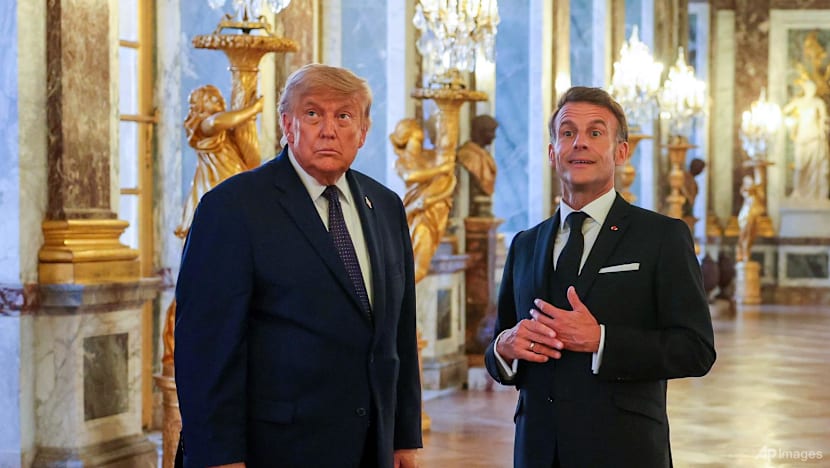
On Wednesday (Jun 17) night, the French president threw open Louis XIV’s palace to his US counterpart for a private reception, show and dinner marking America’s 250th birthday. At a turbulent moment for the trans-Atlantic alliance, it could help Macron keep a personal channel open as the two navigate differences over Iran, Ukraine and tariffs.
It already kept Trump from leaving a Group of Seven summit early, as he did last year in Canada.
“I’m a fan of beautiful places,” he told reporters, saying he had planned to leave earlier until “a very nice man” invited him to dinner.
After posing in front of Versailles' golden doors, Trump enjoyed a private tour of the chateau's glittering interior. And in a surprise move over a dinner of lobster, caviar and vanilla ice cream, he signed a memorandum on ending the war in Iran at a venue steeped in historical symbolism.
Versailles is perhaps the biggest soft-power flex available to a French president: The Hall of Mirrors, the gardens of the Sun King and several centuries of carefully polished national grandeur.
“Versailles is a diplomatic tool and an instrument of influence,” Macron said Wednesday, likening diplomacy to football. “Whether I’m playing at home or away, my goal is to score goals. And when I host other teams, I try to give them a nice welcome.”
France holds little economic or military sway over Washington, so pageantry is one of its few levers — even as its use elsewhere has brought mixed results at best.
SOFT POWER BUILT FROM STONE
Macron and Trump have often clashed over policy.
Their relationship has endured partly because Macron understands the power of personal attention, dramatic settings and a well-timed invitation.
Their first meeting in 2017 produced a white-knuckled handshake that instantly became a symbol of their competitive rapport.
Months later came dinner inside the Eiffel Tower and a place of honour at France’s Bastille Day parade.
Versailles raises the stakes, allowing a French president to wrap a modern political encounter in the scale and authority of national history.
“It is soft-power flex based on hard buildings,” said Denis Lacorne, professor of American studies at Sciences Po.
Macron has used the palace before, receiving Russian President Vladimir Putin there in 2017 and later hosting King Charles III and Queen Camilla for a state dinner.
Versailles has been a favoured setting for French leaders to honour foreign guests for over three centuries, the palace told The Associated Press. It remains “a place in the service of French diplomacy”.
With Trump, the setting carries added resonance.
The former real estate developer has long treated architecture as a statement of status, success and power. In his second term, he has sought to erect a legacy in stone — with plans for a new White House ballroom and a 76m triumphal arch resembling Paris’ Arc de Triomphe.
THE REAL DEAL - AND 357 MIRRORS
The evening included a Hall of Mirrors visit and fountain display.
The Hall of Mirrors was once a feat of technology: 357 mirrors set in 17 arches along a 73m gallery, showing French manufacturers could rival Venice’s celebrated glassmakers.
They were also built to multiply a king. Every royal entrance ricocheted across the glass, and a modern guest gets the same treatment.
“You will be reflected many, many times, from one mirror to another,” Lacorne said.
For a president who has spent his second term turning the Oval Office gold, the appeal is clear, he added.
Trump arrives, in a sense, at a building he has quoted for years: He has said he modelled Mar-a-Lago’s ballroom after Versailles.
OTHERS HAVE SOUGHT TO FLATTER A VISITING TRUMP
Trump remembers spectacle, and often brings it home.
The 2017 Bastille Day parade saw tanks, horses and marching bands fill the Champs-Élysées as fighter jets trailing red, white and blue smoke soared overhead.
Trump called it “one of the greatest parades I’ve ever seen”.
“We’re going to have to try and top it,” he said back in Washington, where he began pressing for a military parade. In 2025, he finally presided over a large Army anniversary parade through the capital.
China employed dazzle diplomacy when it hosted Trump for a “state visit plus” in 2017, including a rare tour of its Forbidden City, an experience once reserved for emperors.
Britain offered its own version last September, greeting Trump’s second state visit with mounted troops, a carriage procession and a Windsor Castle banquet.
THE GLEAM IS THE EASY PART
The diplomatic pomp has clearly flattered Trump, who called the Windsor banquet one of the highest honours of his life.
But it seems to have won few concessions.
The early Macron-Trump “bromance” has hardened into something rougher and more transactional.
Trump has threatened tariffs of up to 100 per cent on French wine and Champagne amid a broader trade fight. France opposed the US war against Iran, even as Macron pressed Washington to keep backing Ukraine.
At home, the dinner has drawn criticism.
“We must learn once and for all to live without Trump,” said Jean-Luc Mélenchon, the veteran far-left leader.
Versailles hands Macron some advantages, experts say: centuries of diplomatic history, a setting built for Trump’s taste for ceremony, and a palace already familiar to the hundreds of thousands of Americans who visit each year.
History counsels caution. Ronald Reagan dined beneath the same mirrors on the sidelines of the 1982 G7, and central disagreements outlasted the splendour.
Source: AP/fh
Related stories

E! Online
EntertainmentJun 4, 2026 · 1 min
Gigi Hadid's Necklace Has Bradley Cooper Written All Over It
E! Online
Times of India
SportsJun 17, 2026 · 1 min
Meet Antonela Roccuzzo, Lionel Messi’s childhood love
Times of India

Philippine Daily Inquirer
NewsJun 16, 2026 · 1 min
How ‘The Notebook’ influenced how we see romance
Philippine Daily Inquirer
Times of India
EntertainmentJun 16, 2026 · 1 min
Taylor Swift reportedly found 'real' love with Travis Kelce after dating struggles
Times of India