Times of India
TMC implosion, NCP split and Congress question: Why 'ghar wapsi' may not be the answer
Has the time come for Congress's breakaway parties to return to the fold?
NEW DELHI: Mamata Banerjee's Trinamool Congress is not merging with the Congress. That’s final for now. Both the parties have firmly rejected speculations about a merger, dismissing them as "baseless rumours" and "fake news".
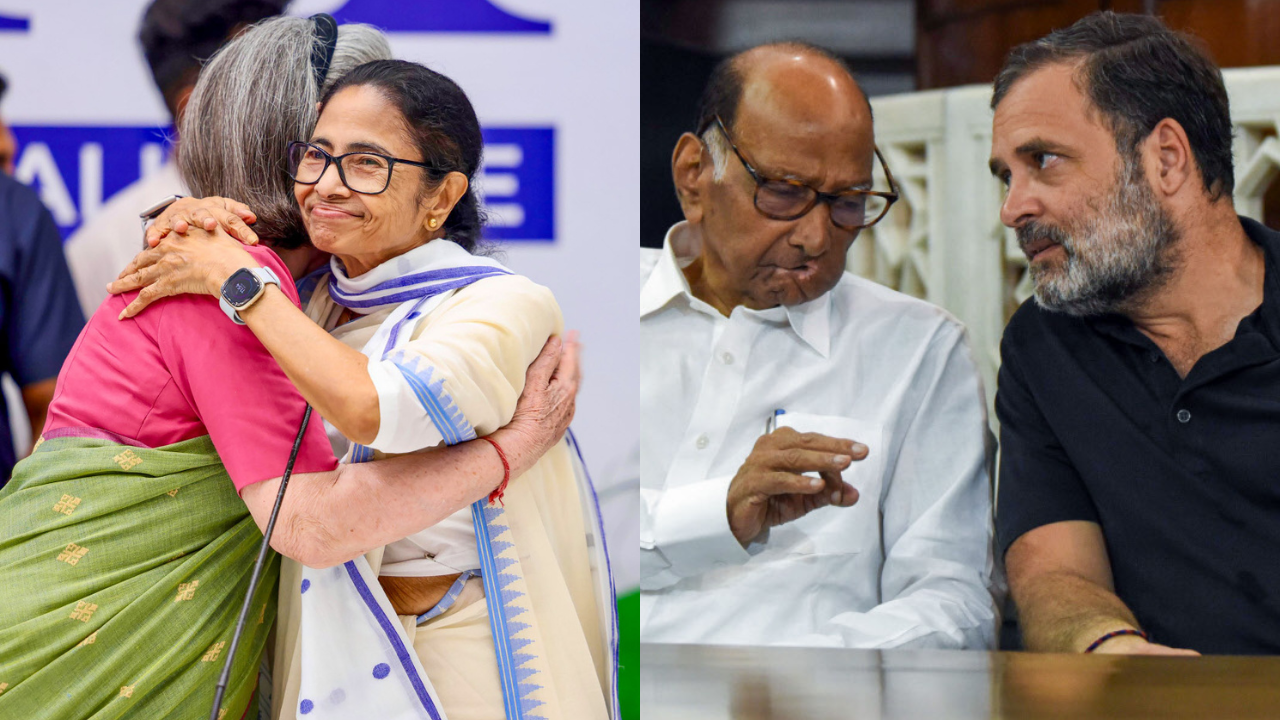
But not before the speculations triggered a larger and far more interesting political debate: should leaders like Mamata Banerjee and Sharad Pawar, who broke away from the Congress decades ago to chart their own political course, consider returning to the grand-old-party's fold to strengthen the opposition fight against the BJP?The merger buzz gained traction after Mamata Banerjee met Sonia Gandhi and later her nephew and political heir Abhishek Banerjee held a lengthy meeting with Rahul Gandhi.
The meetings came against the backdrop of an unprecedented crisis within the Trinamool Congress following its crushing defeat in the 2026 West Bengal assembly elections.
Sonia Gandhi meets Mamata Banerjee during INDIA bloc meeting in New Delhi
For the first time, the once-impenetrable fortress of the TMC showed deep cracks. Mamata Banerjee, who ruled Bengal for 15 years and appeared invincible until recently, was reduced to just 80 seats in the assembly as the BJP formed its first-ever government in the state.
But her setback did not end with the election results. Several newly-elected MLAs and some of the closest aides of Mamata Banerjee rebelled against the party and reached out to the BJP. Much of the anger within the TMC was directed at Abhishek Banerjee, with sections of the old guard accusing the leadership of sidelining those who spent years building the party. Such rapid was the unravelling of the Trinamool Congress that the once-invincible Mamata Banerjee, who had been dismissive about the Congress for the last 15 years, was forced to rush to the grand-old-party for help.It is this plight of Mamata Banerjee which prompted suggestions from some quarters that the Trinamool chief, who had formed the party in 1998 after breaking away from the Congress, should consider “Ghar-wapasi.” And this suggestion was not just for Mamata, but also for leaders like Sharad Pawar. Pawar, who formed the Nationalist Congress Party (NCP) in 1999, and faced a similar challenge after his party split. Pawar eventually lost control of the NCP name and its iconic clock symbol to the faction led by his nephew Late Ajit Pawar.Another leader who faces challenges similar to Mamata is Uddhav Thackeray. Udhhav, who lost control of Shiv Sena after rebellion by his party MLAs, is now battling fresh speculations of further defections amid reports of "Operation Tiger". There are reports that 6 of his 9 MPs are in touch with Eknath Shinde, who had led the rebellion against Uddhav, and is now deputy chief minister in the BJP-led government in Maharashtra.Together these stories point to a broader reality: several regional parties that once appeared dominant in their respective states are confronting an increasingly assertive BJP that has not just defeated them but is also benefitting from their implosion.It is this backdrop that has revived an idea that would have seemed improbable just a few years ago.
The 'ghar-wapsi' debate
The homecoming debate was triggered by Shiv Sena (UBT) leader Sanjay Raut, who argued that parties born out of the Congress should reunite with the parent organisation to strengthen the opposition against the BJP.
Sanjay Raut floated the idea of merger
The Sena (UBT) leader went a step further, urging Sharad Pawar to take the lead in bringing together parties that emerged after splitting from the Congress.Former Rajasthan chief minister Ashok Gehlot backed the idea, saying "the time has come", while Maharashtra Congress leader Nana Patole argued that leaders such as Mamata Banerjee and Sharad Pawar increasingly recognise the need for a stronger Congress to counter the BJP.
Congress leader Nana Patole backed the idea
At first glance, the argument appears compelling. The BJP has emerged as the dominant force in the country. When Prime Minister Narendra Modi first came to power in 2014, the BJP was in power in just seven states.
With victories in West Bengal and Assam, the BJP-led NDA now governs 22 states and Union Territories. Opposition unity remains a work in progress. Several regional parties are weaker today than they were some years ago.But before asking whether Congress's former children should return home, it is worth asking why they left in the first place.
Why Congress's children walked away
Mamata Banerjee did not leave the Congress because of ideological differences.
She walked out in 1998 because she believed the party had become incapable of defeating the Left Front in West Bengal. Frustrated with the Congress high command and convinced that Bengal required a more aggressive opposition, she founded the Trinamool Congress.
Congress splinters that survived, built independent regional identities
The move paid off. In 2011, Mamata accomplished what the Congress had failed to do for decades, ending the Left Front's 34-year rule in West Bengal.Sharad Pawar's exit came under different circumstances. In 1999, Pawar, PA Sangma and Tariq Anwar challenged Sonia Gandhi's foreign origin and subsequently formed the Nationalist Congress Party.
While the NCP remained ideologically close to the Congress and frequently governed alongside it, Pawar succeeded in building an independent political identity rooted in Maharashtra.YS Jagan Mohan Reddy's departure was driven by succession politics. Following the death of his father, former Andhra Pradesh chief minister YS Rajasekhara Reddy, Jagan felt sidelined by the Congress leadership and eventually floated the YSR Congress Party.
Within a few years, the YSRCP had virtually replaced the Congress in Andhra Pradesh.Their exits were driven by different factors, but each believed they stood a better chance outside the Congress than inside it.In most cases, they were right.
What has changed now
What has changed is not the Congress. It is the exponential rise of the BJP.When Mamata Banerjee left the Congress in 1998 and Sharad Pawar followed in 1999, the BJP was nowhere near as dominant as it is today.
Regional parties grew by occupying political space vacated by a declining Congress.Today many of those same parties are confronting a very different challenge.Over the last decade, the BJP has expanded beyond its traditional Hindi heartland, ending the BJD's 24-year rule in Odisha, conquering West Bengal and making steady inroads into regions where it was once considered weak.
The result is that regional parties which once competed primarily with the Congress increasingly find themselves battling the BJP for voters, leaders, organisational networks and political relevance.Political scientist and Fellow at New Delhi-based think-tank Centre for Policy Research (CPR), Rahul Verma notes that Congress reunification is not without precedent. Leaders who broke away from the party in the past, including Pranab Mukherjee and those associated with formations such as the Tamil Maanila Congress and Tiwari Congress, eventually returned to the parent organisation.However, Verma argues that the political context today is fundamentally different.
"In those times, the Congress was still a formidable force and was in a position to form governments at the national level. Some of these leaders could be accommodated in the party and in the government. The problem today is that when you are talking about parties like the TMC, YSRCP and NCP, Congress itself is a very small player in states such as West Bengal and Andhra Pradesh, and even in Maharashtra it is not particularly strong," he told TOI.While a merger could potentially benefit both sides in the medium term, given that all three parties are facing electoral headwinds, Verma questioned how practical such an arrangement would be. "Congress does not have much to offer beyond party positions. Leaders like Mamata Banerjee and Jagan Mohan Reddy have built successful independent political careers outside the Congress. The practicality and feasibility of how that accommodation would work remains a question," he said.
Why merger may not be practical
While the idea of homecoming sounds grand, its actual implementation on the ground may neither be easy nor practical.Consider this: If Mamata Banerjee and Sharad Pawar were to return to the Congress fold, would they be willing to function under the leadership structure of Rahul Gandhi or Mallikarjun Kharge after running independent parties for decades?Would their supporters accept such a transition?Would party workers who spent years fighting each other suddenly become colleagues overnight?In West Bengal, for example, it would be literally impossible to visualise Congress’s Adhir Ranjan Choudhary working in tandem with Mamata Banerjee and Abhishek Banerjee.
Those who have followed Adhir’s politics would know that the entire politics of the former West Bengal Congress president has centred around opposing Mamata Banerjee and her Trinamool Congress.Many of these parties built their identity by positioning themselves as alternatives to the Congress. Returning to the fold risks diluting the very identity that helped them grow.Doesn't the INDIA bloc already serve that purpose?
Lok Sabha LoP Rahul Gandhi, Congress President Mallikarjun Kharge, party MP Sonia Gandhi, Samajwadi Party MP Akhilesh Yadav, TMC supremo Mamata Banerjee and others during the INDIA bloc meeting, in New Delhi.
If opposition parties are already working together under the INDIA bloc umbrella, what additional advantage does a formal merger provide?Congress, TMC, Shiv Sena (UBT), NCP (SP) and several other parties already coordinate on national issues and parliamentary strategy while retaining their individual identities.If countering the BJP is the objective, the 2024 Lok Sabha elections is proof that opposition unity does not necessarily require a merger.The Congress, TMC, DMK, Shiv Sena (UBT), NCP (SP), Samajwadi Party and several other parties fought under the INDIA bloc banner while retaining their separate identities. Together, they significantly reduced the BJP's tally from its 2019 peak and denied it a standalone majority.
The coalition came under pressure only when the electoral battle entered the states where political rivalry between the opposition ranks rocked the boat. That problem is unlikely to disappear simply because party headquarters decide to merge.
Does merger help the Congress?
The merger experiment may make for good optics and also catchy headlines, but does it help the Congress to revive electorally? Perhaps not.
Neither Mamata Banerjee in West Bengal nor Sharad Pawar in Maharashtra commands the political influence they once did.
Both leaders are grappling with challenges that would have been difficult to imagine at the peak of their careers.The last assembly elections in Maharashtra showed that Sharad Pawar’s influence in the state is on the wane. The veteran leader struggled to even make an impact in his stronghold of Baramati. Similarly, in West Bengal, Mamata is dealing with the fallout of a major electoral defeat and a growing internal crisis within the TMC.The Congress, meanwhile, requires more than high-profile leaders. It needs robust state-level organisations, local leadership and grassroots workers.
Anti-BJP coalition better than merger
Mamata Banerjee, Sharad Pawar, and Jagan Mohan Reddy became political heavyweights because they proved they could survive and thrive outside the Congress system. They didn't need Congress. They built their empires on strong regional pride and their own distinct leadership styles.There is little doubt that the BJP's rise has made opposition unity more important than ever before. But unity does not necessarily mean merger.In fact, the experience of the INDIA bloc suggests that opposition parties can work together against the BJP while retaining their separate identities and leadership structures.That is perhaps the more practical path forward. Congress and its former leaders may find themselves cooperating more closely in the years ahead, but a formal return to the parent fold appears far less likely.For leaders like Mamata Banerjee and Sharad Pawar, revival may depend less on returning to the Congress and more on returning to the streets, rebuilding their organisations and reconnecting with voters.That, after all, is how they became powerful in the first place.
View original source — Times of India ↗
Related stories

Daily Trust
BusinessJun 4, 2026 · 1 min
In the dusty lexicon of Nigerian street parlance, a JAMB question is not merely a difficult riddle
Daily Trust

Philippine Daily Inquirer
PoliticsJun 4, 2026 · 1 min
Luistro: No reply, just manifestation to Duterte’s impeach raps answer
Philippine Daily Inquirer

Times of India
SportsJun 18, 2026 · 1 min
Portugal needs to put 'GOAT' Ronaldo out to pasture
Times of India
Indian Express
NewsJun 17, 2026 · 1 min
TMC split: LS Speaker invites Abhishek Banerjee to present his case on Friday
Indian Express