Times of Israel
Times of Israel··9 min read
NYC primary elections test anti-Israel congressional candidates’ aspirations
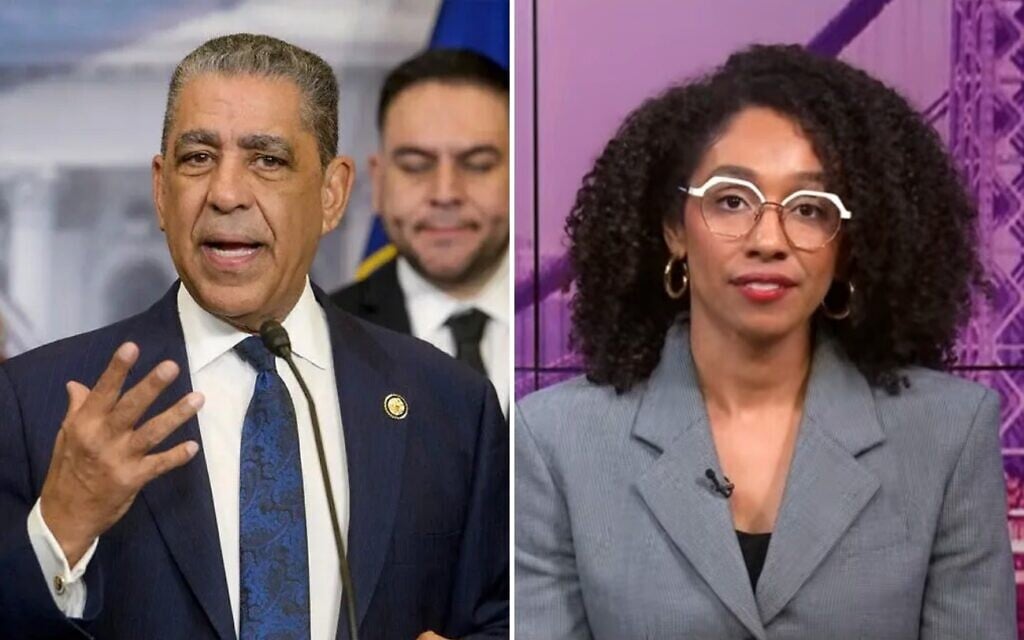
NEW YORK — On October 8, 2023, the day after the Hamas onslaught in southern Israel, US Rep. Adriano Espaillat, a New York City Democrat, attended a vigil in his district.
“We stand here in solidarity with the State of Israel and to denounce terrorism,” he said. Soon after, he plastered the window of his Manhattan office with images of the hostages held in Gaza.
The same day, a little-known activist, Darializa Avila Chevalier, attended a Times Square rally that celebrated the Hamas attack, standing at its barricade, wearing a keffiyeh.
The two are now facing off in a heated Democratic primary for the city’s 13th Congressional District. The race, alongside two other primaries in New York City, will test the far-left Democratic Socialists of America (DSA) organization’s anti-Israel platform and Congressional aspirations in New York City.
Espaillat represents establishment, centrist Democrats and their views on Israel, while Chevalier is a flag-bearer for the far-left movement that has made antagonism toward Israel central to its politics. If Chevalier and the other leftist candidates win, it will boost the far left and provide the movement with lessons related to political fundraising, anti-Israel campaigning and candidates’ histories. Losses will be a setback for the movement and New York City Mayor Zohran Mamdani.
Get The Times of Israel's Daily Edition
by email and never miss our top stories
By signing up, you agree to the terms
Espaillat, 71, is a longtime political operative in the city with deep ties in the neighborhood. He has represented the area in the state legislature since 1997 and in Congress since 2017. The district, in Upper Manhattan and part of the Bronx, includes Harlem, Washington Heights, Inwood, and Morningside Heights, home to Columbia University.
Mamdani, whose home base is the DSA, won most of the area by a comfortable margin in last year’s mayoral race. The district’s demographics are usually more of a stretch for the far left, which performs best in the so-called “Commie Corridor” in parts of Brooklyn and Queens. Those areas are more gentrified, while District 13 is more working-class.
The district is racially mixed and Jews make up around six percent of residents, according to a 2024 estimate.
Like most of New York City, the area is solidly Democratic, which means next week’s primary will almost certainly decide who wins the general election.
Mamdani and the far left have lined up behind Chevalier, while the Democratic Party establishment supports Espaillat, setting up a showdown between the two camps.
Like Mamdani, but more so
Chevalier is part of a cadre of far-left hopefuls riding on the momentum of Mamdani’s upset election win last year, and is like Mamdani, but more so.
Both entered politics with activism against Israel, have made the issue central to their identities and campaigns, are fueled by the DSA and its energetic base and focus on issues like affordability. Both are young people of color and Muslims, Chevalier by conversion.
Mamdani and Chevalier have often connected domestic problems in the US to Israel. During the campaign, Chevalier has linked Israel to US food, law enforcement, racism, immigration, and housing, saying the same “corporate interests” displace Palestinians and minority Americans.
“I see our tax dollars going towards a war, towards a genocide, towards things that are not helping our community,” Chevalier said in a Tuesday debate.
When discussing immigration enforcement in the district, she has attacked Espaillat for not giving enough support to Columbia protest leader Mahmoud Khalil, who was arrested in the district for deportation. Chevalier joined Columbia’s protest encampment during the Gaza war.
Chevalier attributes her political awakening to two months of volunteering in the West Bank in 2014.
“I saw so many connections to what was happening to Palestinians there in Palestine and what was happening to so many communities across the US, particularly black and Latino communities,” she said in the debate. “It showed me that connection, not only that it is like, but it is the very same system.”
Alongside Mamdani’s political rise, a Chevalier victory would further signal that focusing on Israel can be a winning campaign platform.
There is little polling in the Espaillat-Chevalier race; a poll by a pro-Espaillat group put him slightly ahead, while a survey by a group favoring Chevalier put her in the lead.
A history of extreme statements
There are significant differences between Chevalier and the mayor. Mamdani ran against the centrist Andrew Cuomo while holding elected office — even if his legislative record was scant — in the New York State Assembly, while Chevalier, a doctoral student, has not held office and did not have a public profile before entering the race.
Chevalier lacks Mamdani’s cheerful charisma, social media virality and massive network of on-the-ground volunteers.
Chevalier has also taken more extreme positions than Mamdani. While Mamdani’s statement on October 8, 2023, focused its criticism on Israel, he did not attend the Times Square rally, which was widely criticized by New York’s Democratic party leadership. The city’s branch of the DSA initially endorsed the rally, then walked back its support.
Mamdani later condemned Hamas and its attack on Israel. The progressive group Broadway Democrats said in a message to members that, during an endorsement meeting with Chevalier, “she point-blank refused” to condemn Hamas and the October 7 attack, and instead turned the question “into yet another attack on Israel.”
During Mamdani’s campaign, some of his old, hardline statements resurfaced, such as calling the NYPD “racist” and blaming the Israeli military for police violence in the US.
Those comments seem tame compared to Chevalier’s social media history.
Chevalier’s past comments, from a deleted Twitter account, included linking US “bullying” Russia to the invasion of Ukraine, calling the US a “fucking disgrace,” labeling former US president Joe Biden a “rapist,” calling the US worse than Hamas, saying “Israel doesn’t exist,” a joke about wiping her dirty hands on an American flag, supporting Palestinian terrorist Rasmea Odeh, mocking interracial relationships, and calling to abolish police, prisons and borders.
Espaillat’s campaign has seized on the comments, but if Chevalier wins, after saying “fuck Kamala Harris” in a district where nearly 80% of voters backed Harris, it will signal that past hardline rhetoric is not a deal-breaker.
New @EspaillatNY ad today, hitting heavily at @DarializaforNY’s controversial since-deleted tweets, airing on TV and online pic.twitter.com/XYOJwUOfDK
— claudia irizarry aponte (@clauirizarry) June 6, 2026
Chevalier apologized for the Harris comment on Tuesday and said she “regrets” her “word choice” in other statements.
Israel is a central issue
Espaillat should be a solid candidate for the left. He is the first member of Congress to arrive in the US as an undocumented immigrant, the first Dominican member of Congress, the head of the House’s Hispanic Caucus, and a longtime supporter of unions.
His support for Israel is a sticking point, though, as Democratic voters have become increasingly hostile to the Jewish state.
Chevalier has hammered Espaillat over Israel and his past funding from the American Israel Public Affairs Committee (AIPAC). Espaillat has evaded questions on his ties to AIPAC and whether he considers the war in Gaza a genocide, while calling the war “horrific,” condemning settlements, and accusing Prime Minister Benjamin Netanyahu of war crimes.
After the Gaza war began, Espaillat spoke out in support of Israeli hostages, security funding for Jewish institutions, and Jewish students at Columbia University. His office was vandalized with anti-Israel graffiti in 2024.
“I believe in a two-state solution and she doesn’t believe in the existence of Israel,” he said during Tuesday’s debate. “She went to celebrate the death of innocent people in Israel right after the attack.”
“I am just shocked by the dehumanizing language that was just used,” Chevalier said, claiming her participation in the celebratory rally was a protest against Israel’s expected response.
“My opponent continues to dehumanize Palestinian life,” she said.
The New York Editorial Board asked Chevalier in a Wednesday interview whether she had engaged with any pro-Israel residents of the district. She responded by saying she had organized with the anti-Zionist Jewish Voice for Peace.
She defined Zionism as an “ideology that is looking to create a political system where one group of people has more standing before the law,” a definition that is not shared by any Zionist groups.
‘Our team. Our year’
Progressive candidates are running in other Congressional races in the city, all featuring Israel as a major issue, but none offer such a clear-cut example of an upstart far-left candidate challenging the establishment.
In the 7th Congressional District, in Brooklyn and Queens, the DSA’s Claire Valdez is a leading candidate. Both she and her main opponent, Brooklyn Borough President Antonio Reynoso, are critical of Israel, but Israel is still an issue in the race. Valdez has attacked Reynoso for not accusing Israel of genocide soon enough and falsely suggested he had support from AIPAC.
Valdez and Reynoso are running for a seat vacated by US Rep. Nydia Velázquez, meaning Valdez does not have an establishment incumbent to campaign against. Valdez also has a legislative track record in the New York State Assembly, unlike Chevalier.
If Chevalier and Valdez both win, the victories will signal the DSA’s continued upward trajectory in the Mamdani era and send a message to a Democratic party split between its moderate center and radical left. Losses will chasten the DSA, and Mamdani.
There are currently only two DSA members in Congress — New York’s Alexandria Ocasio-Cortez and Michigan’s Rashida Tlaib.
The DSA’s National Political Committee this month issued a new platform calling for radical measures such as abolishing the Senate and declaring Jerusalem the capital of a Palestinian state, according to a Wednesday report in City Journal.
In the 10th Congressional District, in Lower Manhattan and Brooklyn, Brad Lander is challenging incumbent Dan Goldman from the left. Both Lander and Goldman are Jewish with histories of engaging with Jewish community groups.
Lander is not a DSA candidate, though, and has a long record in New York City politics. Lander is harshly critical of Israel, accusing the Jewish state of genocide and attacking AIPAC, even though he identifies as a liberal Zionist. Last week, he said that the anti-AIPAC attack line made him “queasy” due to antisemitic tropes about Jews, money and power, but that he had to do it anyway.
Lander and Valdez also do not have the history of incendiary statements that Chevalier does. Lander criticized the October 8 anti-Israel rally and cut ties with the DSA over its endorsement of the protest.
The Espaillat-Chevalier race also tests the movement’s political and fundraising maneuvers.
Espaillat endorsed Mamdani in the general mayoral election — but not in the primary — and Mamdani reportedly committed to endorsing Espaillat’s reelection campaign, but reneged on that commitment to back Chevalier. The endorsement is a risk for Mamdani as he spends political capital backing the DSA candidate, going against the Democratic Party leadership.
And while Chevalier has attacked Espaillat for his funding from AIPAC, a pro-Palestinian super PAC, American Priorities, has spent hundreds of thousands of dollars backing her campaign. American Priorities acts as a counterweight to AIPAC and is also backing Valdez and Lander.
The three progressive candidates — Chevalier, Valdez and Lander — have allied during the race, appearing in a basketball-themed campaign video, alongside Mamdani, earlier this month.
The candidates will rally with Mamdani and US Sen. Bernie Sanders, the godfather of the US progressive movement, in Brooklyn on Thursday.
“Our team. Our year,” advertisements for the rally said.
View original source — Times of Israel ↗
Related stories

BBC
NewsJun 10, 2026 · 1 min
Platner wins Maine primary to challenge Collins
BBC

Times of Israel
PoliticsJun 16, 2026 · 1 min
Trump-backed congressional candidate supports Israel, says Antichrist will be Jewish
Times of Israel

The Hill
PoliticsJun 4, 2026 · 1 min
South Carolina draws attention with competitive GOP primary for governor
The Hill
The Guardian
PoliticsJun 16, 2026 · 1 min
Oklahoma begins choosing a new US senator and governor in crowded primary – US politics live
The Guardian