Indian Express
US-Iran MoU: An expert gives a point-by-point breakdown, from nuclear issue to Strait of Hormuz
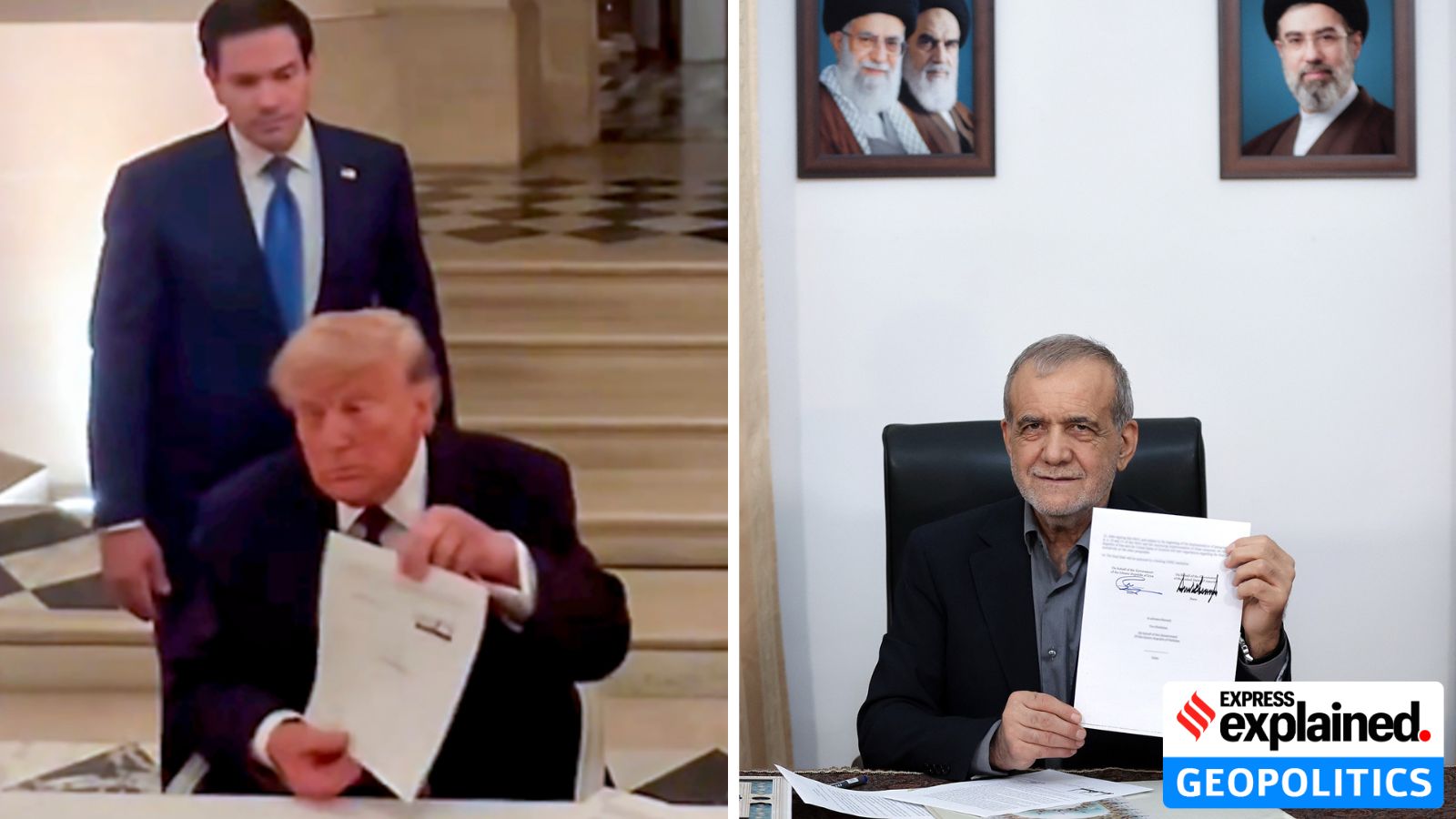
The US and Iran signed a 14-clause Memorandum of Understanding (MoU) to begin 60 days of negotiations for a final deal on June 17 and 18, respectively.
Unlike the 2015 Barack Obama-era nuclear agreement, the 2026 MoU indicates that the final agreement would both address the Iranian nuclear programme and set the terms of the US-Iran political relationship. These terms potentially make the Islamic Republic stronger than it has ever been since 1979, allowing it greater economic relief and the necessary geopolitical consent to build-up conventional military capabilities that can re-shape West Asia’s balance of power.
Here is a breakdown of the key points, what each side has promised, and what it says about their respective positions after months of conflict.
Clause 1: End to hostilities on all fronts — including Lebanon
This is the principal war termination clause. Compared to the April 8 ceasefire, the MoU signed by US President Donald Trump and Iranian President Masoud Pezeshkian cements Lebanon’s integration with the US-Iran cessation of hostilities.
The 60-day interim period naturally bears the risk of resumed Israeli bombardment of Lebanon. How Iran navigates any violations might be informed by its behaviour on June 14. Iran accepted US incentives (immediate removal of naval blockade in the Strait of Hormuz) to refrain from resuming hostilities against Israel/US targets, despite having committed to respond to Israel’s bombing of Beirut. This arguably set a new precedent in terms of what Iran is willing to accept.
Clause 2: No interference in internal affairs
The immediate import of this clause is the removal of Trump’s rationale for resuming attacks on Iran. Between January 13 (when Trump stated that “help is on its way” in support of Iranian anti-government protestors) and February 28 (war initiation), Washington’s rationale oscillated between “regime change” and de-nuclearisation. The clause is, thus, imperative in Tehran’s view, beyond Iran’s historic concerns regarding US interventions in Iran.
Clause 3 contains a crucial provision allowing both sides to extend the 60-day period before a final agreement, with mutual consent.
Clause 4: Removal of US blockade
Story continues below this ad
By June 16, the US Navy had already effectively withdrawn its blockade. In functional terms, withdrawal would refer to the remaining US Carrier Strike Groups deployed to the Strait of Hormuz.
Clause 5: Passage through Hormuz
Iran will allow unconditional transit passage to shipping in the Strait of Hormuz. However, it is the provision allowing Iran (and Oman) to define the future administration of the Strait that meets Iran’s consistent demand that the Strait cannot return to its pre-war status.
Oman and Iran can reach a joint framework that can potentially mimic Turkish fee arrangements for the Dardanelles and Bosphorus Straits under the Montreux Convention. Since about 20-25% of oil and 20% of gas shipping globally relies on the Strait of Hormuz, estimated annual revenue could exceed $11-13 billion.
Clause 6: $300-billion plan for reconstruction of Iran
The reconstruction initiative is a core component of the MoU, and the key distinguishing element from past US-Iran negotiations for the 2015 Joint Comprehensive Plan of Action (JCPOA) for limiting Iran’s nuclear program.
Story continues below this ad
The fund will act as Iran’s avenue to re-access the international economy. It also contains incentives for businesses linked to both Trump and Steve Witkoff, the real estate investor and US Special Envoy to the Middle East.
Clause 7: Sanctions relief in final deal
This clause will have to address several categories of US unilateral sanctions on Iran, including those on the energy and shipping sectors. A Wall Street Journal estimate suggests that Iranian oil and fuel sales could generate around $60 billion in annual revenue.
Washington will also have to address the interlinkage of three types of sanctions – on Iran’s nuclear activities, counter-terrorism related sanctions and designations.
Clause 8: Iran to not procure or develop nuclear weapons
This clause’s reaffirmation of Iran’s commitment not to pursue a nuclear programme reflects continuity in Iran’s position since 2003.
Story continues below this ad
A lot of the US need to degrade Iran’s existing nuclear capabilities is now moot, given the US bombardment of Natanz, Fordow, Arak, and Isfahan in June 2025.
The core distinguishing factor from the JCPOA negotiation timeline (roughly 2013-15) is Iran’s stockpile of 60% enriched uranium, which Iran did not possess at the time. Now, the MoU evidently does not mandate Iran to transfer its enriched nuclear material to any third country; a significant divergence from the original US position.
With fundamental changes to Iran’s nuclear programme having been forced through US diplomatic and military action (reduced future enrichment capabilities but increased stockpile of highly enriched uranium), it is Iran’s other shifts since 2018 which will now have to be addressed.
Trump withdrew the US from the JCPOA back in 2018. Tehran formally terminated its remaining commitments after its October 2025 expiry and has, over time, withdrawn from other international monitoring protocols. By late 2025, the International Atomic Energy Agency officially declared that it had suffered a “loss of continuity of knowledge” vis-à-vis Iran’s nuclear programme.
Clause 9: Status quo until final deal
Story continues below this ad
While this is meant to secure the gains of the MoU, none of the 14 clauses contains any reference to negotiations over ballistic missiles or Iran’s relationships with regional non-state actors. On July 17, Trump also implied his willingness to let Iran retain ballistic missile capabilities, arguing that similar capabilities possessed by Iran’s “neighbours” warrant it. Here, too, the US President has moved significantly from his rationale for his 2018 withdrawal from the JCPOA.
Clause 10 (sanctions waivers) acts as an interim arrangement before Clause 7 (sanctions removal) is operationalised.
Clause 11: US unfreezes Iranian assets
Iran’s frozen funds in foreign banks and holdings amount to over $100 billion. Around $12 billion has reportedly already been unfrozen and made available to Iran, which President Pezeshkian said would be used to pay pending salaries, with banks in Qatar and the UAE being the principal facilitating institutions.
Clause 12 provides for creating a mechanism to monitor the implementation of the MoU. This matters for the operationalisation of Clause 3, which allows mutually decided extensions to the 60-day window.
Story continues below this ad
Monitoring implementation is crucial for the operationalisation of Clause 3, which allows mutually decided extensions to the 60-day window. While negotiations over the nuclear file might necessitate an extension, this would also theoretically extend the period in which Iran leaves the Strait of Hormuz unconditionally open, as well as the timeline for American military drawdown, which may increase domestic pressures on Tehran. The executive mechanism, then, will likely ensure the retention of good faith over 60 days.
Clause 13 sets a hierarchy of mutual priorities during the 60 days.
Finally, Clause 14’s provision for a UN Security Council Resolution for endorsing the deal is notable – despite the Trump administration’s oft-stated disdain for the UN’s mechanisms and the so-called limitations they impose on American decision-making.
The JCPOA was endorsed by UNSCR 2231, whose binding nature was affirmed in the text through Article 25 of the UN Charter. While the new UNSC Resolution will have to be similar, the limited power of the Council to prevent unilateral withdrawal by Washington was proven in 2018. This time, Iran could potentially seek fail-safe arrangements.
View original source — Indian Express ↗
Related stories

The New York Times
PoliticsJun 17, 2026 · 1 min
U.S. Official Releases Text of Agreement With Iran
The New York Times

Straits Times
PoliticsJun 17, 2026 · 1 min
Verification is key in US-Iran nuclear talks, Saudi foreign minister says
Straits Times
South China Morning Post
PoliticsJun 7, 2026 · 1 min
China’s nuclear weapons scientist Du Xiangwan clarifies role in nation’s war on waste
South China Morning Post

Al Jazeera
NewsJun 8, 2026 · 1 min
IAEA chief says Iran-US nuclear talks in ‘complicated phase’
Al Jazeera