The Next Web
Immigrant-focused VC Geek Ventures returns with larger checks
Immigrant founders have long played a significant role in U.S. technology, but access to early-stage capital often still depends on local networks, customer introductions and proximity to established investors. That gap has created room for a small number of venture firms focused on immigrant, diaspora and cross-border founders, a category that has grown in recent years.
Geek Ventures is part of that category. The firm, which invests across the U.S., Europe and Israel, is raising its second fund and preparing to write larger checks at the pre-seed and seed stages. Its first fund closed at $23 million in 2023. Fund II is targeting $25 million to $30 million, with room to reach $40 million, and has already secured around $20 million in commitments.
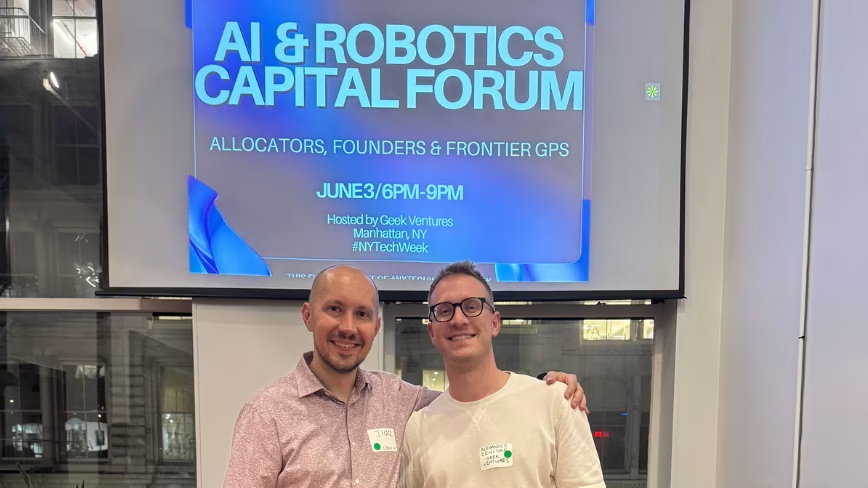
Geek Ventures was founded by Ihar Mahaniok, who now leads it alongside partner Alexander Zemlyak, both with roots in the former Soviet Union. Mahaniok made more than 60 angel investments before launching the firm, while Zemlyak joined in 2023 after working across Israel, London and Eastern Europe, including four years at LETA Capital.
Fund I was built around a conviction that immigrant founders, particularly technical ones, are often overlooked by investors despite having the technical backgrounds and cross-market experience that early-stage investors often look for. Over time, that thesis became more specific. The firm was not just looking for immigrant founders, but for founders who had already crossed markets, networks and technical barriers, and were building companies where early access to U.S. capital and networks can make a material difference.
But the size of the fund is not the main change. With Fund II, Geek Ventures is shifting toward a lead investor role, writing larger checks, building larger ownership positions and getting into rounds earlier.
From instinct to process
Geek Ventures’ first fund was built around Mahaniok’s network and the angel investments he had made before launching the firm. He spent two decades as an engineer at Google, Meta and WeWork, and his approach focused on companies outside the networks where most venture capital flows.
The fund closed at $23 million and backed more than 35 companies. With first checks of $100,000 to $300,000, Geek Ventures could get into rounds early, but rarely had enough capital to lead them, build larger ownership positions or take board seats.
When Zemlyak joined in 2023, Geek Ventures began moving from a founder-led network into a more structured venture firm. He brought experience from Israel, London and Eastern Europe, including four years at LETA Capital, where he was Principal and Head of Israel. There, he worked on sourcing and early-stage investments across the region.
At Geek Ventures, Zemlyak helped turn the existing network and approach into a more formalized investment process. The firm now has a system for reviewing hundreds of inbound companies each month, a clearer framework for writing larger checks and defined criteria for deciding when to lead or co-lead a round rather than follow. Zemlyak was promoted to Partner in May 2025.
“Talent may be equally distributed globally,” Zemlyak says, “but access to capital and networks is not. Founders who have already navigated that gap tend to show a kind of adaptability that is hard to find elsewhere and harder to teach.”
Writing larger checks earlier
Fund II gives Geek Ventures more flexibility at the initial investment stage. The firm plans to write first checks of $500,000 to $800,000, with up to $2 million reserved for follow-on investments. With larger checks, the firm can lead or co-lead rounds, take board seats and build larger stakes in the companies it backs.
Backers include AppLovin founder Adam Foroughi and the founders of PandaDoc, along with other operators and investors connected to immigrant-led technology companies. The team is spread across New York, Austin, Kyiv and Tel Aviv.
Writing larger checks does not mean stepping back from early-stage risk, it means going into deals better resourced.
“At pre-seed, investing is not really about data,” Zemlyak says. “There is never enough of it. What you are evaluating is how a team handles not knowing things: whether they test assumptions quickly, update their thinking when something fails and move from uncertainty toward something they can actually act on.”
What new portfolio shows
Fund II’s early investments are focused on AI infrastructure, vertical AI applications, robotics, deep tech and data-heavy software. Cytronic and Spacer Robotics are on the hard-tech side. Spike aggregates health data from more than 600 IoT devices, while Caremaze closed a $3 million pre-seed round in March 2025 with Geek Ventures alongside early Palantir investors.
Across the portfolio, the common thread is immigrant founders building technically difficult companies in markets where access to U.S. capital, early customers and the right networks can materially change the trajectory of the business.
The firm is also preparing to launch an accelerator for founders who are close but not quite ready for a fund check, ones who need more customer validation, sharper positioning or a clearer path to their first institutional round.
Next steps
The company plans to establish a West Coast office in the United States, reflecting the fact that much of its portfolio, investor base, and co-investor network is already concentrated around the Bay Area. Across Fund I and commitments to Fund II, Geek Ventures now manages roughly $50 million and has seen continued interest from investors.
“Venture capital has historically underestimated how large and strong the immigrant founder pool really is,” Mahaniok says. “With Fund II, our goal is simple: back those founders, write larger checks and earn a place in the best rounds before they become obvious.“
View original source — The Next Web ↗
Related stories

Japan Times
BusinessJun 17, 2026 · 1 min
SoftBank finds fewer tech bets for venture capital in Latin America
Japan Times
Bloomberg
BusinessJun 16, 2026 · 1 min
SoftBank Scales Back Latin America Tech Bets as Venture Capital Boom Fades
Bloomberg

Times of India
NewsJun 5, 2026 · 1 min
India leads among immigrant founders of US billion-dollar startups
Times of India

Times of India
NewsJun 4, 2026 · 1 min
How Indian immigrants have fueled billion-dollar startups in America over the years
Times of India