Indian Express
Indian Express··11 min read
Ranga, Billa, and a reporter: How a photograph sealed India’s best-known manhunt
It was in a police officer’s smoke-filled room at Crawford Market in then Bombay that I first heard of Billa, a young drifter from the Sion Koliwada area who had become a terror in parts of Dharavi. Billa, the officer said, would rob homes, accost young couples in the secluded Powai Lake area, and had become a scourge in parts of the city.
Growing up in the late 1970s at The Indian Express office at Nariman Point, one of Mumbai’s earliest skyscrapers, we lived from one story to the next. It was like feeding a beast that was never satisfied. The battleground for professional rivalry was the crime beat that I handled.
The press room at the Police Commissioner’s office was where handouts were circulated, and the “official” line to every story was given. Other eager beavers like me were always waiting for a Deep Throat to land a story in our laps; after all, we were operating in the Watergate era.
The officer — a regular contact who will remain anonymous — would often invite me for a cup of tea and fill me in on the gossip and intelligence doing the rounds. He was also the source who persuaded Haji Mastan, the legendary smuggler, to give me an interview for The Indian Express.
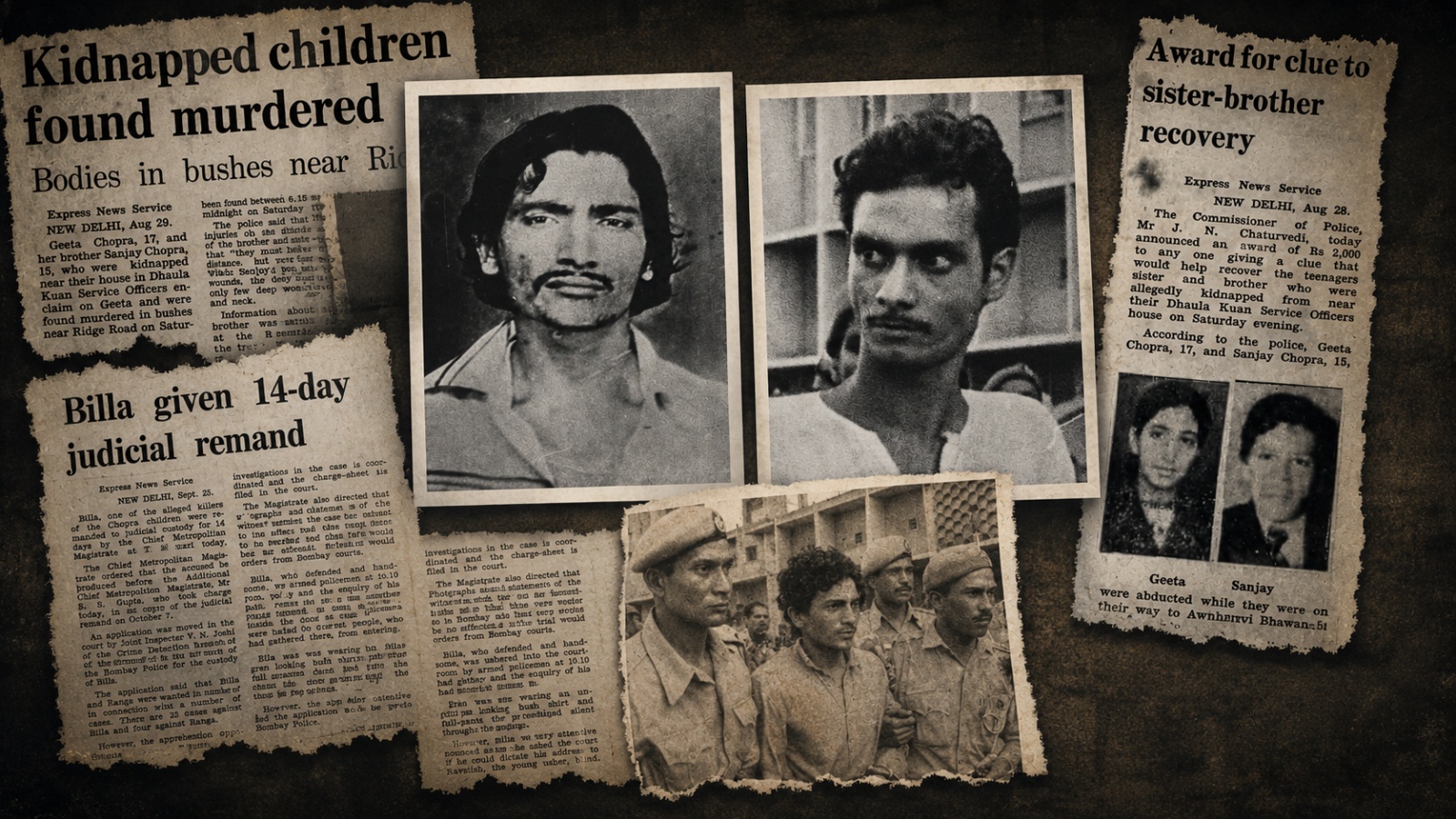
This photograph of Billa (Jasbir Singh) that was published in all editions of The Indian Express and finally led to his arrest. Express Photo
On one of those visits, the officer had news: Billa, who had been arrested in a burglary case in April 1978, had escaped from a Crime Branch cell. It was a dramatic escape. Every floor of the Crime Branch building was built like a cage, with iron bars, where undertrials were usually kept chained. Yet, Billa had vanished. He seemed to have chosen the day: May 1, 1978, Maharashtra Day and Labour Day, when most senior officers were occupied with bandobast duties and were busy making arrangements for public rallies.
I broke the story about Billa’s escape and it became big news, much to the embarrassment of the police. The Police Commissioner’s office was barely a few metres away.
The thrill of the story, however, lasted only a while; soon, I was preparing to leave for Bhopal to take up my new assignment as The Statesman’s Special Representative.
Story continues below this ad
Meanwhile in Delhi, a different story was building up. Geeta (16) and Sanjay Chopra (14), children of Madan Mohan Chopra, a Captain in the Navy, had been kidnapped — dragged into a moving car — and killed, a crime that shocked the nation.
My two years on the crime beat hadn’t prepared me for the twist that was to follow, one that would warrant a follow-up story. Four months later, Billa, along with his associate Ranga, would be arrested for the Geeta and Sanjay Chopra murders.
Long queues at a liquor shop in Connaught Place, Delhi. Express Archive photo by RK Sharma
On August 26, 1978, the children, Geeta and Sanjay, were on their way to the All India Radio office at Sansad Marg to participate in a radio programme. They were to reach the office by 7 pm and their father was to have picked them up at 9 pm. But they never reached the AIR office.
Their bodies were found two days later in the Ridge area. On August 31, 1978, police found a mustard Fiat car, though they were unconvinced that it was linked to the crime. Contrary to some accounts, the car was recovered in the Majlis Park area, not in the Buddha Jayanti Ridge area where the bodies were found.
Story continues below this ad
The horrific nature of the case had made it a national story. As expected, The Indian Express team covered the case and its developments closely.
The Indian Express front page the day the bodies of Sanjay and Geeta Chopra were found
Looking back now, the timing was extraordinary. The year-old Morarji Desai-led government looked increasingly fragile as it battled coalition stressors and internal rivalries. Although Mrs Gandhi had been voted out of office the previous year, the Congress was snapping at the heels of the ruling Janata Party, waiting for an opportunity to come back. Officials were nervous, and the police administration was under intense pressure. The Shah Commission was probing excesses committed during the Emergency years.
The kidnapping and murder of the siblings couldn’t have come at a worse time for the government that was already firefighting on other fronts. A few days earlier, Suresh Ram, the son of Defence Minister Jagjivan Ram, was allegedly implicated in a sex scandal. Also, the alleged encounter killing of the dacoit Sunder had brought several police officers under scrutiny.
Geeta and Sanjay’s photos were published in The Indian Express on August 28, 1978
When the Sanjay-Geeta case broke, the Delhi Police was divided. While some believed the kidnap theory, others tried to link it to the controversy surrounding Suresh Ram. Some even saw a Congress conspiracy behind it, especially since the party’s student wing had been organising rallies demanding answers. When Atal Bihari Vajpayee, who was then the Minister for External Affairs, arrived at one such rally, a stone hurled at him struck his nose. The crowd was eventually dispersed with tear gas.
Story continues below this ad
A police officer controls traffic at Nariman Point in Mumbai. Express Archive Photo
Back in Bombay, the police were on the lookout for Billa, who had found a new associate in Ranga. Police and court documents say it was Shyam Singh, one of Billa’s associates, who had introduced him to Ranga. Shyam Singh had grown weary of Billa’s violent temper and unpredictable mood swings. He had earlier witnessed firsthand the murder of two Arab tourists and knew that Billa was becoming increasingly dangerous.
Believing that Billa needed someone younger to work with, Shyam introduced him to Ranga. Tall, powerfully built, and nearly six feet tall, Ranga immediately impressed Billa. The two quickly formed a partnership.
One of their first crimes together was the kidnapping of a child for ransom. The plan, however, fell apart and the child was eventually returned unharmed. The failed operation led to the two men blaming each other for the fiasco.
Billa outside the Chief Metropolitan Magistrate’s Court in Delhi (left) and Ranga
By then, the Bombay Police were already closing in. Besides the murder of the Arab tourists, Billa was wanted in a string of robberies. There were also reports around Bombay of young couples being accosted by Billa in secluded areas around Powai. He would also reportedly offer women lifts and ensure that the rear door handles were broken, making escape almost impossible.
Story continues below this ad
With the police on their heels, Billa and Ranga decided to leave the city and head north to Delhi. This was the duo’s first trip to Delhi. They did not know the city and hoped to slip in unnoticed.
Meanwhile, the Bombay Police, convinced that Billa and Ranga were in Delhi, had already made two trips to the Capital, even before the Sanjay-Geeta Chopra murders. But the Delhi Police was not entirely convinced. In Delhi, officers of the Bombay Police were provided a jeep and a handful of constables to assist in the search, but little progress was made.
The breakthrough came when Jugal, a former associate of Billa and Ranga, broke ranks and approached the police. He revealed that the duo were indeed in Delhi, moving around in stolen cars and frequently changing number plates to avoid detection. Acting on this information, the Bombay Police made yet another trip to Delhi. They tracked down the painter who had fabricated the fake number plates, and his description of the two men matched what Bombay investigators already knew — Billa and Ranga were in Delhi.
The reporter, Raju Santhanam, then and now
Then, one day, I got a call from my officer source. I met him reluctantly, having no interest in the story now, eager to find my bearings in Bhopal.
Story continues below this ad
The officer said the Bombay Police wanted a wider manhunt, more personnel, and, most importantly, the circulation of Billa and Ranga’s photographs. He gave me Billa’s photograph, asking if it could be published in The Indian Express.
The Express published the photograph in all its editions. Days later, a group of Army jawans travelling on the Kalka Mail spotted the two men. They had recognised Billa from his photograph that a local paper, Navyug, had picked up from the Express. They alerted the authorities, leading to the arrest of Billa and Ranga at the New Delhi railway station on September 8, 1978. With that, one of India’s most notorious manhunts had come to an end.
The publication of the photo was a pivotal moment that led to their arrest. A congratulatory telex from the editor was what every reporter dreamed about. I got one — Kuldip Nayyar, then Editor, Express News Service, was always the first to acknowledge a great story.
Billa being taken away in a police van after he was sentenced to death in Delhi on 7.4.1979. Express Photo by RL Chopra
The case would go on to taint Delhi as crime capital, a reputation the city hasn’t been able to shake off to this day, and traumatise an entire generation of children and their parents about getting dragged into a moving car. The Billa-Ranga case is now the subject of a series on an OTT platform, highlighting the “heroic” role played by the Delhi Police. But truth should come in the way of a good story.
Let’s look at the timeline and the role played by the Delhi Police. The children were kidnapped on a rainy day at about 6.30 pm outside Gol Dak Khana on August 26, 1978. A passer-by, Bhagwan Das, who was on a scooter, saw the children fighting Ranga and Billa in a mustard Fiat. He saw the girl pulling the hair of the driver and the boy quarrelling with the other passenger. He informed the Police Control Room with the number of the Fiat — HRK 8390. This was at 6.44 pm.
Story continues below this ad
Minutes later, another passerby, Inderjit Singh, saw the scuffle. He chased the vehicle up to Shankar Road, but it disappeared after the red lights. The Police Control Room was alerted at 7.40 pm.
By then, Billa-Ranga and the children were already in the Buddha Jayanti Park in Delhi’s Ridge area. That was not all. The hapless father of the children, Captain Chopra, complained to the police about his missing children at 10.15 pm and again at 11.30 pm. No one had the imagination to tie it all together.
Those were not the only lapses.
Following repeated complaints by Chopra, a posse of about 240 policemen combed the Buddha Jayanti Park. They found nothing. It was a cowherd who found the bodies in the morning, barely 200 yards from where the police organised a manhunt.
The lapses seemed endless.
In his confessional statement, Ranga said Geeta Chopra had given Billa a blow to his head, leading to a cut on his forehead. Hours after the murders, Ranga-Billa went to Willingdon Hospital (now Dr Ram Manohar Lohia or RML Hospital) and told a police inspector on duty at the hospital that they were attacked by some men. They used the same Fiat car, in which they had committed the crime, to drive the police to the spot where they were ostensibly attacked and dropped them back. The sub-inspector in his wisdom asked them to leave and come the following day. They, of course, never did.
Story continues below this ad
Sanjay Chopra, who was kidnapped and killed by Ranga and Billa. Express Photo
It was only after they were arrested and the fingerprints in the Fiat car matched with Billa-Ranga’s that the Delhi Police acknowledged that they were indeed the two suspects their Bombay counterparts were going after.
The trial took approximately four years to conclude, at the end of which Billa and Ranga were sentenced to death, a ruling that was challenged in the higher courts.
While upholding the death sentence, the Delhi High Court made a significant observation regarding the conduct of the Delhi Police, noting that the lives of the children might have been saved had the police acted promptly on the information available to them.
Court documents show that although the PCR received the report at 6.44 pm, the local police station deputed an officer for investigation only at 7.05 pm. “Surely the police did not expect the offenders to stay put in their car at Gol Dak Khana and wait for the police. Had flying squad cars been put into operation immediately, there was a good chance for preventing the murders. A general alarm should have been sounded to apprehend the culprits,” the court said.
On April 21, 1981, the Supreme Court upheld the death penalty. On January 31, 1982, both men were hanged in Delhi’s Tihar Jail.
With that, a sordid chapter in the country’s criminal history had finally come to an end.
The bodies of Geeta and Sanjay Chopra were found at Delhi’s Buddha Jayanti Park in New Delhi on 31.8.1978. Express Archive Photo
The journalism of the late Seventies was very different from what it is today. We had fewer resources, no mobile phones, no internet and certainly no social media. What we did have was an obsession with getting the facts right. Stories were built slowly, source by source, document by document.
ALSO READ | Notorious child murderers Ranga and Billa kidnapped Bobby Deol’s friend, cops warned Dharmendra he could be next
Over the years, I watched the Billa-Ranga case acquire a life of its own. Each retelling added a new layer. Some facts were forgotten, others exaggerated. More recently, OTT adaptations have introduced an entirely new generation to the case. They have also, in some instances, blurred the line between fact and fiction.
There is nothing wrong with dramatisation. But when fiction becomes accepted as history, someone eventually has to go back and ask what really happened.
That was the reason Sanjay Singh, my former colleague at NDTV, and I decided to write a book on the subject.
I realised that I had witnessed a small but important part of the story. I had known about Billa before the Delhi murders. I had broken the story of his escape. I had received the photograph that was eventually published across The Indian Express network. Most importantly, I still had access to diaries, notes and contacts that could help reconstruct events as they actually unfolded.
What began as a casual conversation with Sanjay Singh eventually became a year-long effort to separate myth from fact. The deeper we dug, the clearer it became that the story most people think they know is only part of the truth.
And I have to thank the Bombay Police’s ‘Mark Felt’ for it.
The writer’s forthcoming book, Billa-Ranga: A Nation Ambushed, co-authored by Sanjay Singh, is being published by HarperCollins
View original source — Indian Express ↗
Related stories

Al Jazeera
NewsJun 10, 2026 · 1 min
Twelve killed in Johannesburg mass shooting, manhunt under way
Al Jazeera
Times of India
PoliticsJun 6, 2026 · 1 min
Sandeshkhali arms bust: West Bengal STF recovers weapons from TMC leader's pond
Times of India

The Hill
PoliticsJun 7, 2026 · 1 min
Manhunt underway after at least 12 people were shot near Toledo festival: Police
The Hill

Philippine Daily Inquirer
NewsJun 16, 2026 · 1 min
Suspect in deadly Leyte ambush arrested; cops hunt other gunman
Philippine Daily Inquirer