Indian Express
When Juhi Chawla’s in-laws loaned money to Gujarat government amid financial crisis
Actor-entrepreneur Juhi Chawla is often named amongst one of the wealthiest actors in Bollywood. According to Hurun Rich List, she has an estimated net worth of Rs 7,790 crore, while her husband, businessman Jay Mehta, is associated with a business empire valued at nearly Rs 17,500 crore. While much of the public conversation around their wealth often circles around their stake in the IPL franchise Kolkata Knight Riders (KKR), which they have now sold, the roots of the Mehta family’s fortune go back more than a century—and include a remarkable chapter in Gujarat’s history. Few people know that there was a time when the Gujarat government reportedly turned to Jay Mehta’s grandfather, industrialist Nanji Kalidas Mehta, for financial assistance during a severe financial crisis.
When Gujarat government borrowed money from Juhi Chawla’s in-laws
In 1960, the erstwhile bilingual Bombay State was officially divided into two separate states—Maharashtra and Gujarat. While the political reorganisation was historic, the newly formed Gujarat faced significant economic and administrative challenges. Many major industrial and financial centres remained in Maharashtra, leaving Gujarat to build its economic foundations from scratch.
According to businessman and community leader Shree Satishbhai Vithalani, Chairman of the Lohana International Business Forum, the state government faced a serious financial crisis during its early years and reportedly struggled to pay government employees.
Speaking on Sagar Kathrotiya’s podcast, Vithalani recalled, “Nanji Kalidas Mehta was originally from Porbandar. He went through tremendous hardships before reaching Uganda and eventually built a vast business empire there, including sugar factories and several other ventures. After the Gujarat-Maharashtra separation, the Gujarat government faced initial financial difficulties. There was a payment crisis, and as far as we know, the government took a loan from Nanji Kalidas Mehta to meet its obligations. It is a huge thing.”
Today, the business founded by Nanji Kalidas Mehta is overseen by subsequent generations of the family, including Jay Mehta, and spans industries ranging from sugar and cement to hospitality, real estate, sports and infrastructure.
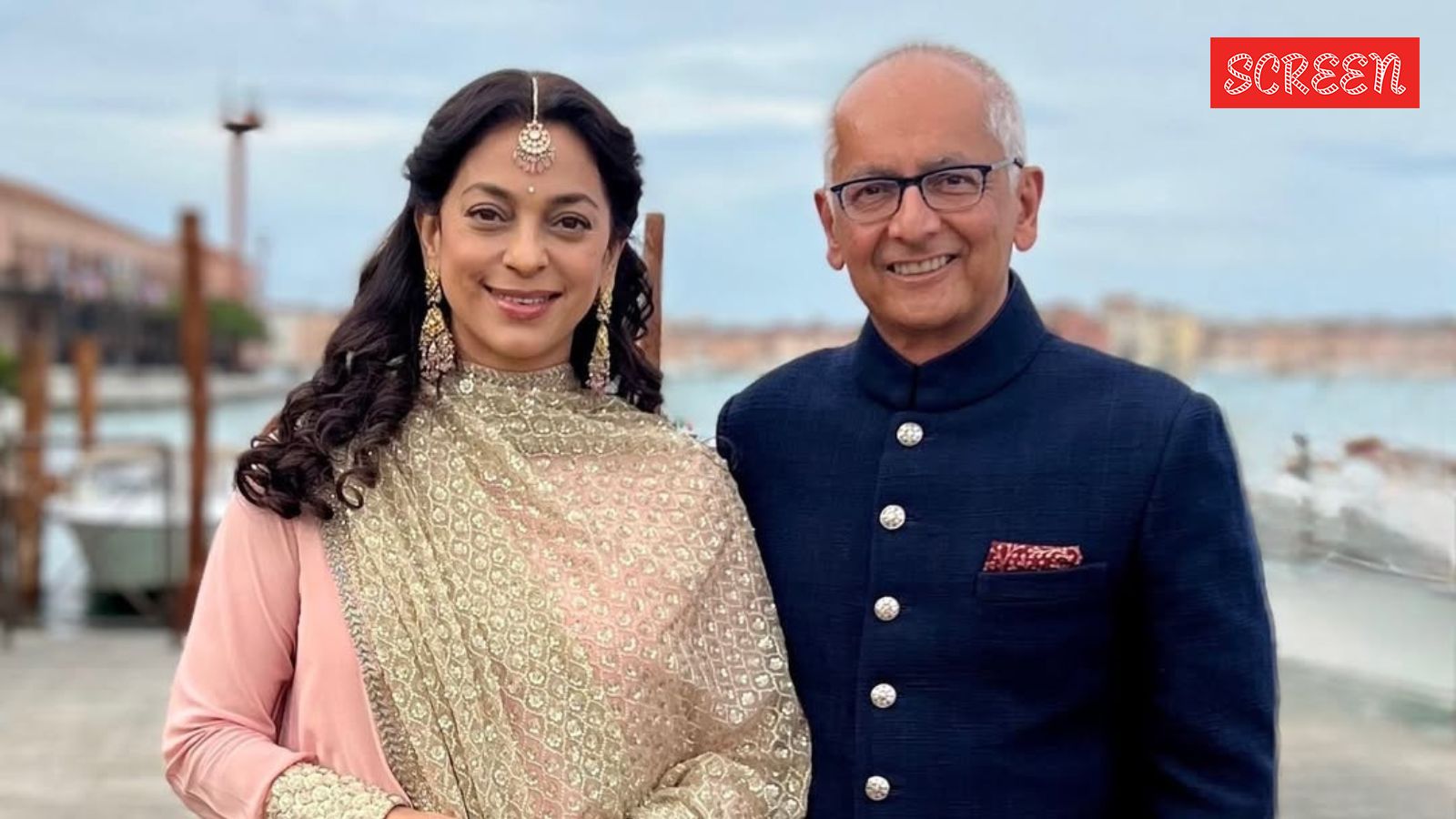
Juhi Chawla with husband Jay Mehta. (Photo: Juhi Chawla/Instagram)
The 13-year-old who sailed to Africa
Juhi’s grandfather-in-law Nanji Kalidas Mehta was born in Porbandar, and at the age of 13, he sailed to East Africa in the early 1900s. Arriving in Mombasa, Kenya, with little more than ambition and determination, he began by doing odd jobs in shops, running errands and learning the basics of trade. Over time, he ventured into business, trading textiles, grains and everyday commodities. His entrepreneurial instincts soon led him deeper into East Africa, particularly Uganda, then known as the “Pearl of Africa.”
By the 1920s, he had begun investing in agriculture. In a bold move, he acquired land in Lugazi, Uganda—a region that was then largely swampy and undeveloped—and started cultivating sugarcane. It was a risky bet. Infrastructure had to be built from the ground up, and the land required extensive development.
Story continues below this ad
But Nanji’s vision extended beyond trading. He wanted to control the entire value chain—from cultivation to processing and distribution. In 1930, he established the Uganda Sugar Factory Limited, laying the foundation for what would become one of East Africa’s largest industrial groups.
Over the following decades, the business expanded rapidly into multiple sectors, including agriculture, sugar manufacturing, cement, packaging, textiles, finance, insurance, real estate, energy and infrastructure. As his success grew overseas, Nanji also invested heavily in India. In the late 1920s, he began building textile mills in Porbandar even as his export interests stretched across Africa and Asia. His growing success also found expression in an architectural masterpiece back home.
ALSO READ | ‘Salman Khan isn’t god’: Kala Hiran director defends film as court hearing gets deferred
The grand legacy of Swastik Bhavan
In 1936, Nanji Kalidas Mehta completed the construction of Swastik Bhavan, a magnificent sea-facing residence in Porbandar built for his extended family. Named after the auspicious symbol, the home reflected both traditional Indian values and modern global influences.
Story continues below this ad
Spread across landscaped gardens, the double-storeyed mansion was built using limestone sourced from nearby quarries and featured Italian marble flooring, Japanese tiles, European Art Deco glass chandeliers and furniture imported from Africa.
Indian Prime Ministers were regulars at Swastik Bhavan
In an interview with Architectural Digest, Nanji’s granddaughter Kamal Mehta revealed that the residence has hosted some of India’s most prominent personalities over the decades. The Maharaja and Maharani of Porbandar were frequent guests, while former Prime Ministers Indira Gandhi and Morarji Desai, as well as Prime Minister Narendra Modi, have visited the historic home. She also recalled hosting Field Marshal Sam Manekshaw and several renowned writers, poets and thought leaders. Even today, nearly 90 years after it was built, Swastik Bhavan remains a symbol of the family’s legacy.
Losing everything overnight
Yet, the Mehta story is not just one of wealth and success. Nanji Kalidas Mehta devoted considerable resources to community welfare across East Africa. His businesses provided employees with housing, clean water, healthcare facilities and educational opportunities—benefits that were rare for the time. Then came one of the darkest chapters in Uganda’s history. In 1972, Idi Amin ordered the expulsion of nearly 80,000 Asians from the country, accusing them of controlling wealth and sabotaging the economy. Businesses were seized, assets frozen and families forced to leave with little notice.
Like thousands of others, the Mehta family lost much of what they had spent decades building. Factories were taken over, plantations abandoned and operations shut down. But the story did not end there.
Seven years later, after Amin’s regime collapsed, Uganda invited Asian entrepreneurs back to help rebuild the nation’s economy. The Mehtas returned and began the difficult process of restoring their sugar estates, factories and agricultural operations. Their return was aided by the goodwill Nanji had built over decades. Many locals remembered him not simply as a businessman but as a benefactor who had invested in people and communities. Over time, the Mehta Group rebuilt its operations and once again emerged as a cornerstone of Uganda’s economy. Today, its sugar and tea estates remain among the most productive in East Africa.
View original source — Indian Express ↗
Related stories

Philippine Daily Inquirer
BusinessJun 17, 2026 · 1 min
Pag-Ibig rolls out P10K emergency loan amid ME war fallout
Philippine Daily Inquirer

Bloomberg
BusinessJun 8, 2026 · 1 min
Schroders Shuns Treasuries and Bunds in Favor of Italian Debt
Bloomberg

Philippine Daily Inquirer
NewsJun 10, 2026 · 1 min
GSIS opens emergency loan program for Mindanao quake victims
Philippine Daily Inquirer

Bloomberg
BusinessJun 17, 2026 · 1 min
Higher Bond Yields Are Here to Stay in a Post-War World
Bloomberg