Antara News
Antara News··2 min read
Indonesia, Norway assess forest rehab under FOLU 2030
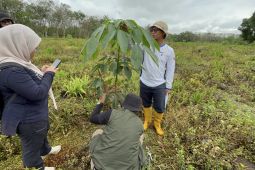
S Kalimantan (ANTARA) - Indonesia's Environmental Fund Management Agency (BPDLH) and Norway's Project Management Unit for the Norway Contribution (PMU-NC) on Friday assessed forest and land rehabilitation under the FOLU Net Sink 2030 program in Hulu Sungai Tengah, South Kalimantan.
The joint monitoring covered 82.86 hectares of rehabilitated land, including 17.26 hectares in Tanah Habang village, Batang Alai Selatan sub-district, and 65.6 hectares in Tapuk village, Limpasu sub-district, according to South Kalimantan's Forestry Office.
Head of Watershed Management and Forest and Land Rehabilitation at the South Kalimantan Forestry Office, Alip Winarto, led the field verification team in Hulu Sungai Tengah to evaluate plant conditions, growth rates, and vegetation development across the rehabilitation sites.
"We reviewed the sites to ensure forest and land rehabilitation activities are being implemented in accordance with regulations and to determine plant survival rates, which serve as a key indicator of the program's achievements," Winarto said.
The evaluation is intended to measure the effectiveness of rehabilitation efforts carried out by local forest farmer groups and identify maintenance needs to ensure long-term environmental and socioeconomic benefits.
"We hope this initiative will deliver sustainable benefits. In addition to improving the quality and quantity of land cover, forest farmer groups in Hulu Sungai Tengah can also earn additional income from commodities developed through rehabilitation activities," Winarto said.
At the Tanah Habang site, farmers have planted IRR 112 rubber, Bawor durian, and mahogany trees. Rehabilitation areas in Tapuk village feature IRR 112 rubber, Bawor durian, and longan, selected for both ecological and economic value.
Most rehabilitation areas use an intercropping system, combining tree species with short-term crops such as chili peppers, tomatoes, eggplants, and other horticultural commodities.
The approach enables communities to generate short-term income while waiting for the main crops to become productive, supporting livelihoods alongside ecosystem restoration.
The South Kalimantan Forestry Office expects farmer groups participating in Phase II and III of the FOLU Net Sink 2030 program to continue maintaining the plantations to sustain rehabilitation gains and contribute to Indonesia's long-term forestry emissions reduction targets.
Related news: Indonesia pushes FOLU Net Sink 2030 through Mount Ciremai model
Related news: Govt optimistic to achieve reduction in deforestation by 2030
Related news: Forestry sector to contribute 60 pct to Indonesia's emissions cut
Translator: Tumpal Andani Aritonang, Martha Herlinawati Simanj
Editor: Azis Kurmala
Copyright © ANTARA 2026
View original source — Antara News ↗
Related stories
Indian Express
TechnologyJun 19, 2026 · 1 min
Knowledge Nugget: What is the Bonn Challenge? India’s progress towards its 2030 restoration goal
Indian Express

AllAfrica
TechnologyJun 8, 2026 · 1 min
Senegal: How Did a Major Mangrove Restoration Project in Senegal End Up Selling 'Ghost Carbon'?
AllAfrica

Antara News
NewsJun 9, 2026 · 1 min
Indonesia seeks stronger social forestry through agroforestry
Antara News
Indian Express
NewsJun 17, 2026 · 1 min
Chief Minister Bhupendra Patel launches Miyawaki forest, Green Oxygen Park in Bharuch
Indian Express