Indian Express
Indian Express··4 min read
UPSC aspirant to berry farmer: How a Satara man turned failure into a fresh start
When Sanket Shinde failed to crack the civil services exam, he did what very few expected of an agriculture graduate from a small village in Satara – he went back to farming. But not the kind his father knew. Today, his 3-acre farm in Koregaon grows blueberries, raspberries, and white strawberries, fruits that are mostly imported, in a semi-arid region.
“I had appeared for the UPSC civil services exam, and MPSC mains in agriculture as well as forest services, but couldn’t make it to the final list,” he recalled. “After years of hard work and repeated attempts, I eventually decided to quit government exam preparation during COVID, when the exams kept getting postponed. It was a difficult decision, but it opened a door.”
“After thinking deeply, I felt that instead of doing a job, I wanted to start something of my own,” says Shinde, who hails from Chaudharwadi village in Koregaon taluka of Satara district. He decided to join his father, who had been into strawberry farming for several years, but Shinde had something more unconventional in mind.
The pandemic years proved to be a turning point in more ways than one. As health consciousness surged across the country, Shinde noticed a sharp rise in demand for antioxidant-rich fruit. “During COVID, I observed that the demand for fruit like blueberries, rich in antioxidants, was huge among health-conscious individuals. After analysing the market, I found that most of these blueberries were being imported at higher costs,” he says. “So I thought there was potential in this crop and decided to attempt its farming.”
The challenge, however, was daunting. Koregaon falls in a semi-arid region of Satara, far removed from the cool, temperate climates where blueberries traditionally thrive. Traditional blueberry varieties require cold winters and long ‘chilling hours’, and scorching summers, often exceeding 40°C, can damage leaves and disrupt fruit development. The region’s alkaline soils and high water sensitivity added further complexity to the project.
Shinde did not proceed blindly. He sought the guidance of Dr Bharat Bhojane, an expert in berry variety management, and meticulously planned his cropping strategy. He decided to diversify from the outset, adding raspberries and white strawberries alongside blueberries to spread risk and maximise returns.
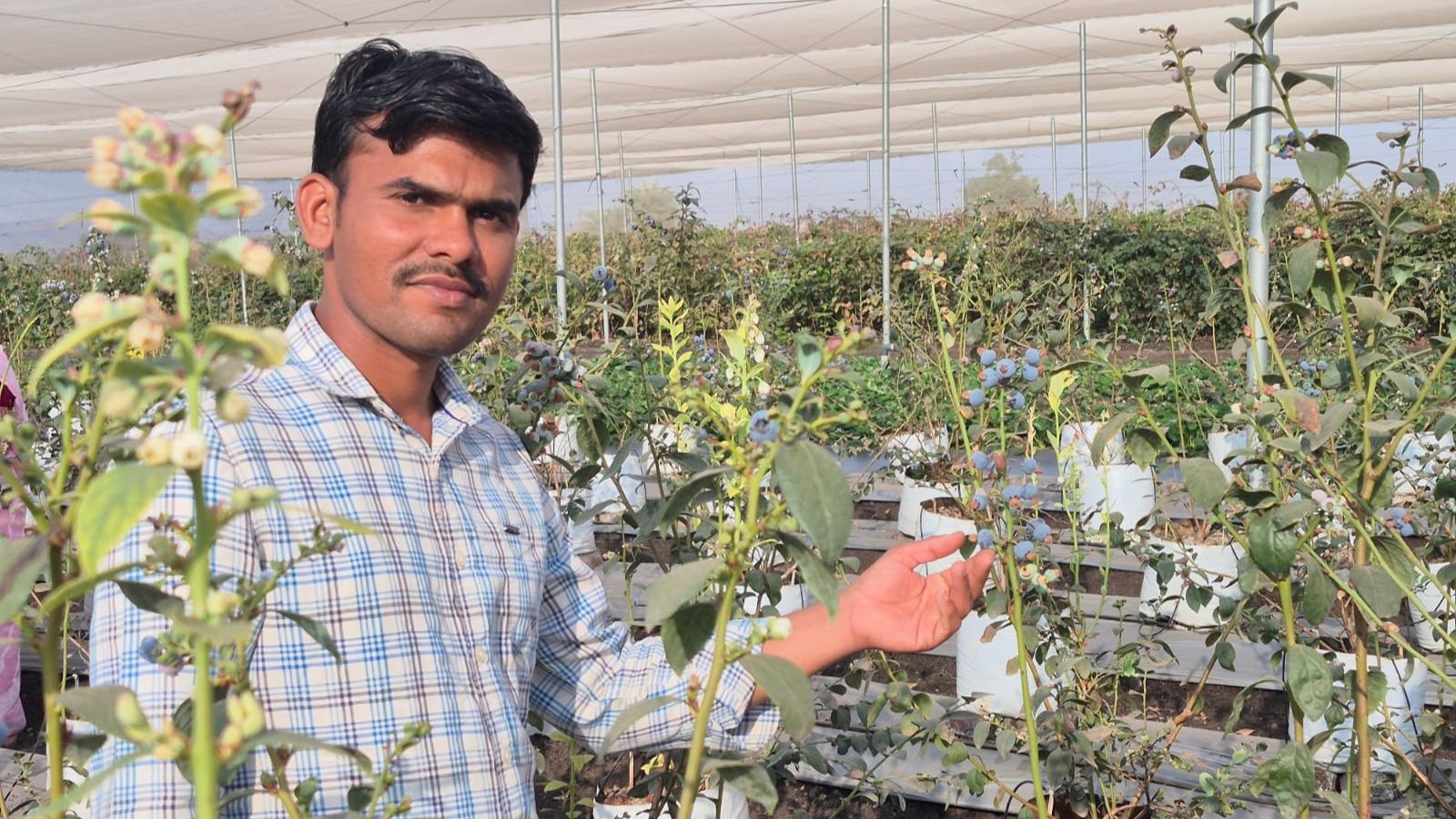
Blueberry plants bearing fruit inside a shade-net enclosure at Sanket Shinde’s farm in Koregaon, Satara.
In December 2024, he sourced 500 blueberry and around 2,000 raspberry plants from Europe. Setting up the farm, including irrigation systems and shade-net infrastructure, took approximately two months across the 3-acre project, with one acre each dedicated to blueberries, raspberries, and white strawberries.
Story continues below this ad
The investment was not small. “The total investment went to around Rs 50 lakh,” Shinde says. The costs included not just infrastructure, but also plant royalties; each blueberry plant carries a royalty fee of one US dollar per year, while raspberry plants require a royalty of one euro per plant.
The results in the very first season have been encouraging. Blueberries, which harvest once a year from January to March, fetched between Rs 1,200 and Rs 1,500 per kg. Raspberries, which, once established, produce fruit perennially for three to four years, are priced at Rs 1,500 to Rs 1,800 per kg. White strawberries command Rs 800 to Rs 900 per kg. “All produce is currently sold domestically, and I expect to recover all input costs by the end of 2026,” Shinde said.
Challenges
Success in berry farming, he cautions, does not come without its share of challenges. “Even the produce is delicate, so training labour to handle it carefully so it reaches the consumer intact is a real challenge,” he says. Post-harvest market linkages are another concern. “There is demand, but one of the biggest challenges is securing a market well in advance,” he adds.
Climate variability remains an ever-present threat. “With a delayed monsoon this year, sustained high temperatures are posing a serious risk to the produce. We had scheduled blueberry cutting in June, but it had to be postponed because of the heat – if done now with high temperatures, the plants may die,” Shinde explains.
Story continues below this ad
Shinde gave advice to those considering it: do not proceed without expert guidance, and plan your market before you plant. And for those still chasing civil services, he has a word of encouragement from personal experience.
“If one wishes to get into civil services, one should give their best. But in case they can’t get through, they should explore other options with passion,” he says. “Even while pursuing this project, there was huge financial risk – I had to convince my parents. Such experiments need continuous hard work and passion. It can feel like a gamble, just like civil services with its huge competition. But it’s a gamble worth taking if you put your heart into it.”
View original source — Indian Express ↗
Related stories

BBC Sport
SportsJun 5, 2026 · 1 min
Potter's Zlatan texts, overcoming failure & finding joy in Sweden
BBC Sport
ABC News
NewsJun 4, 2026 · 1 min
Farmers are increasingly embracing change, and it's bringing them hope
ABC News

Indian Express
EntertainmentJun 18, 2026 · 1 min
Dhanush’s Jagame Thandhiram was a necessary failure for Karthik Subbaraj to dream bigger
Indian Express

The Guardian
SportsJun 5, 2026 · 1 min
Graham Potter: ‘I feel very Swedish when I’m working – I look a bit Swedish’
The Guardian