Indian Express
From protests to approval: MP launches controversial Indore-Ujjain corridor after land row
4 min readBhopalJun 20, 2026 08:33 PM IST
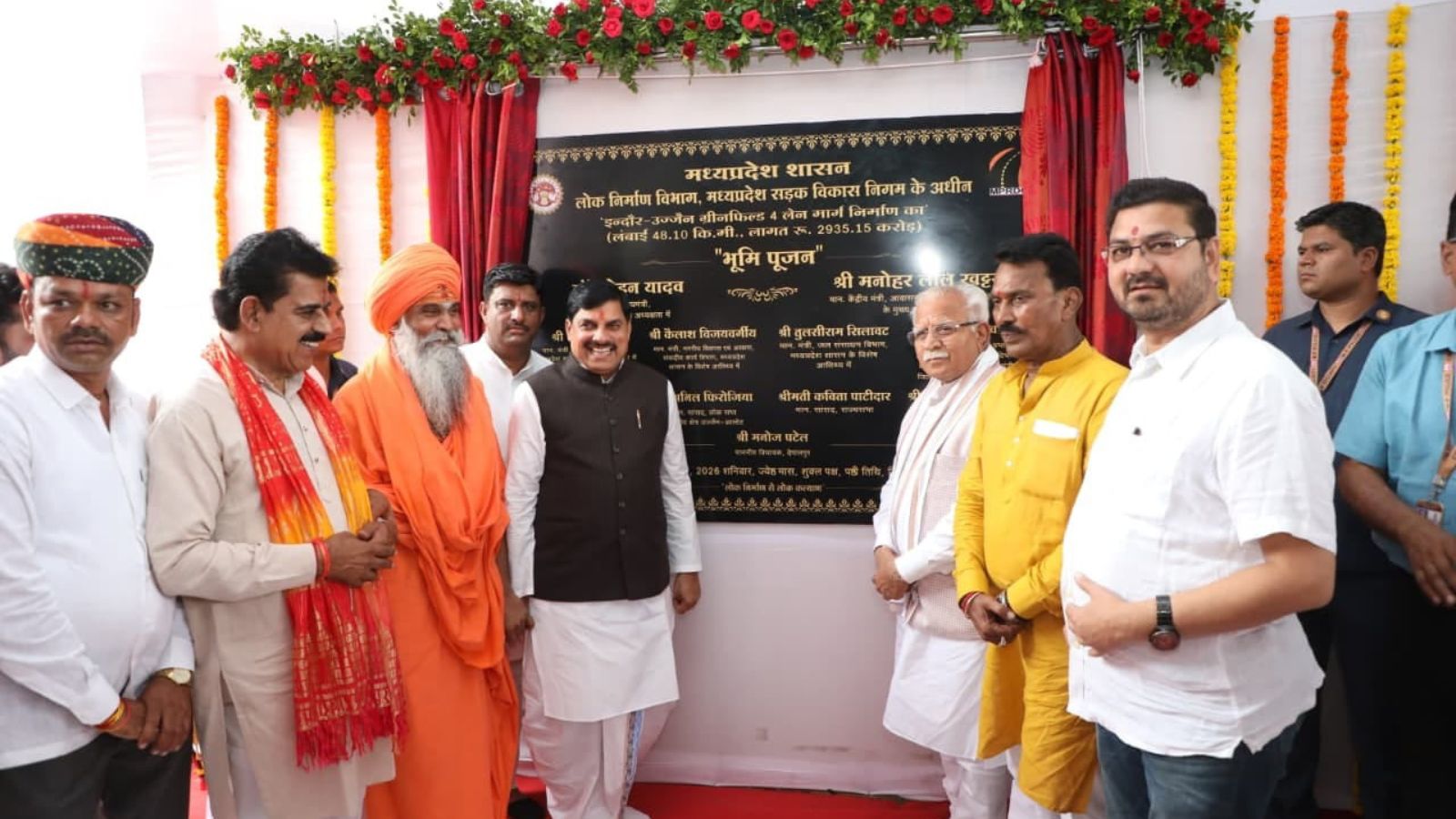
Chief Minister Mohan Yadav and Union Housing and Urban Affairs Minister Manohar Lal Khattar greenlit the Rs 2,935-crore project at a programme in Indore. (Special Arrangement)
Nearly two years after plans for a new highway connecting Indore and Ujjain began encountering resistance from farmers over land acquisition and compensation, the Madhya Pradesh government Friday formally launched construction of the 48.1-km Indore-Ujjain Greenfield Four-Lane Corridor — a project expected to reshape connectivity between the state’s commercial and religious hubs ahead of Simhastha 2028.
Chief Minister Mohan Yadav and Union Housing and Urban Affairs Minister Manohar Lal Khattar greenlit the Rs 2,935-crore project at a programme in Indore. The state government said 916 farmers from 28 villages have received compensation amounting to Rs 816 crore for land acquired for the road.
The launch marks a significant milestone for a project that spent much of the past year at the centre of negotiations between the government and landowners.
Farmer groups had repeatedly objected to acquisition terms, compensation rates and aspects of the proposed design, arguing that agricultural land along the corridor had appreciated considerably due to its proximity to Indore and emerging industrial and logistics zones.
The corridor is being developed by the Madhya Pradesh Road Development Corporation (MPRDC) as a controlled-access greenfield route connecting the Indore region with Ujjain through Sanwer and Fatehabad. Officials say the project is intended to provide a “faster alternative to the existing Indore-Ujjain highway, reduce travel time between the two cities and improve access to the Mahakaleshwar temple city before the 2028 Simhastha congregation”.
The road is also being positioned as part of a broader economic corridor linking industrial areas around Pithampur and Indore with western Madhya Pradesh and transport networks connected to the Delhi-Mumbai Expressway.
While Friday’s ceremony focused on the project’s expected benefits, the road’s progress has been shaped by months of resistance from farmers in villages located along the alignment. In October last year, farmers from Indore and Ujjain districts organised tractor rallies and demonstrations, alleging that compensation offered for acquired land did not reflect prevailing market rates. Several farmer organisations sought revision of compensation calculations and raised concerns about the impact of elevated sections on access to agricultural fields.
Story continues below this ad
Government officials subsequently held a series of consultations with affected landowners. According to the state government, “modifications were made to the design after these discussions”. Speaking at the launch event, Yadav said the road’s “height had been reduced” in response to farmers’ demands so that movement across adjoining agricultural land would not be disrupted.
The government has claimed the project is expected to benefit 20 villages in Indore district, eight villages in Ujjain district, and 40–50 surrounding village
The corridor is being built through one of Madhya Pradesh’s fastest-changing economic belts, where farmland around Indore, Sanwer and Fatehabad has increasingly come under pressure from industrial expansion, warehousing projects and real-estate development. That has made land acquisition both more expensive and more politically sensitive, with many farmers arguing that compensation failed to keep pace with market values.
For the state government, however, the project is central to a larger plan of linking Indore’s industrial economy with Ujjain’s growing role as a religious and tourism hub. Officials have increasingly spoken of an Indore-Ujjain metropolitan region that would extend across parts of Dewas, Dhar, Ratlam and Shajapur districts, creating a single economic zone anchored by road, rail and airport connectivity.
Story continues below this ad
The significance of the corridor lies as much in freight movement as in passenger traffic. The route is expected to strengthen links between Pithampur’s manufacturing cluster, logistics facilities around Indore and markets across western Madhya Pradesh. Pithampur is home to hundreds of automobile, engineering and pharmaceutical units that depend heavily on road transport for movement of raw materials and finished goods. Industry representatives say faster connectivity to major highways and the Delhi-Mumbai Expressway network could lower transport costs, shorten delivery timelines and improve access to distribution centres.
The road is also expected to alter development patterns along the Indore-Ujjain axis. Previous highway projects in the region have attracted industrial parks, townships, warehouses and commercial activity along their corridors, pushing up land prices and changing the economic profile of surrounding villages. With Simhastha 2028 approaching and Ujjain receiving increasing public investment, planners expect the new corridor to become one of the principal growth routes in western Madhya Pradesh over the coming decade.
Anand Mohan J is an award-winning Senior Correspondent for The Indian Express, currently leading the bureau’s coverage of Madhya Pradesh. With a career spanning over eight years, he has established himself as a trusted voice at the intersection of law, internal security, and public policy.
Based in Bhopal, Anand is widely recognized for his authoritative reporting on Maoist insurgency in Central India. In late 2025, he provided exclusive, ground-level coverage of the historic surrender of the final Maoist cadres in Madhya Pradesh, detailing the backchannel negotiations and the "vacuum of command" that led to the state being declared Maoist-free.
Expertise and Reporting Beats
Anand’s investigative work is characterized by a "Journalism of Courage" approach, holding institutions accountable through deep-dive analysis of several key sectors:
National Security & Counter-Insurgency: He is a primary chronicler of the decline of Naxalism in the Central Indian corridor, documenting the tactical shifts of security forces and the rehabilitation of surrendered cadres.
Judiciary & Legal Accountability: Drawing on over four years of experience covering Delhi’s trial courts and the Madhya Pradesh High Court, Anand deconstructs complex legal rulings. He has exposed critical institutional lapses, including custodial safety violations and the misuse of the National Security Act (NSA).
Wildlife Conservation (Project Cheetah): Anand is a leading reporter on Project Cheetah at Kuno National Park. He has provided extensive coverage of the biological and administrative hurdles of rewilding Namibian and South African cheetahs, as well as high-profile cases of wildlife trafficking.
Public Health & Social Safety: His recent investigative work has uncovered systemic negligence in public services, such as contaminated blood transfusions causing HIV infections in thalassemia patients and the human cost of the fertilizer crisis affecting rural farmers.
Professional Background
Tenure: Joined The Indian Express in 2017.
Locations: Transitioned from the high-pressure Delhi City beat (covering courts, police, and labor issues) to his current role as a regional lead in Madhya Pradesh.
Notable Investigations: * Exposed the "digital arrest" scams targeting entrepreneurs.
Investigated the Bandhavgarh elephant deaths and the impact of kodo millet fungus on local wildlife.
Documented the transition of power and welfare schemes (like Ladli Behna) in Madhya Pradesh governance.
Digital & Professional Presence
Author Profile: Anand Mohan J at Indian Express
Twitter handle: @mohanreports ... Read More
View original source — Indian Express ↗
Related stories
Indian Express
PoliticsJun 6, 2026 · 1 min
Cockroach Janta Party gets permission for Jantar Mantar protest as Abhijeet Dipke lands in Delhi
Indian Express

Indian Express
SportsJun 19, 2026 · 1 min
FIFA World Cup: Iran to lodge protest with FIFA over travel restrictions
Indian Express
Indian Express
NewsJun 18, 2026 · 1 min
Will bring proposal to construct Lucknow-Unnao-Kanpur rapid rail corridor, says CM Yogi Adityanath
Indian Express

Bloomberg
BusinessJun 9, 2026 · 1 min
Alberta to Propose ‘General Corridor’ for Pipeline to West Coast
Bloomberg