Indian Express
The ocean’s most unusual love story: A pufferfish that builds art to win a mate
3 min readNew DelhiJun 21, 2026 02:59 PM IST
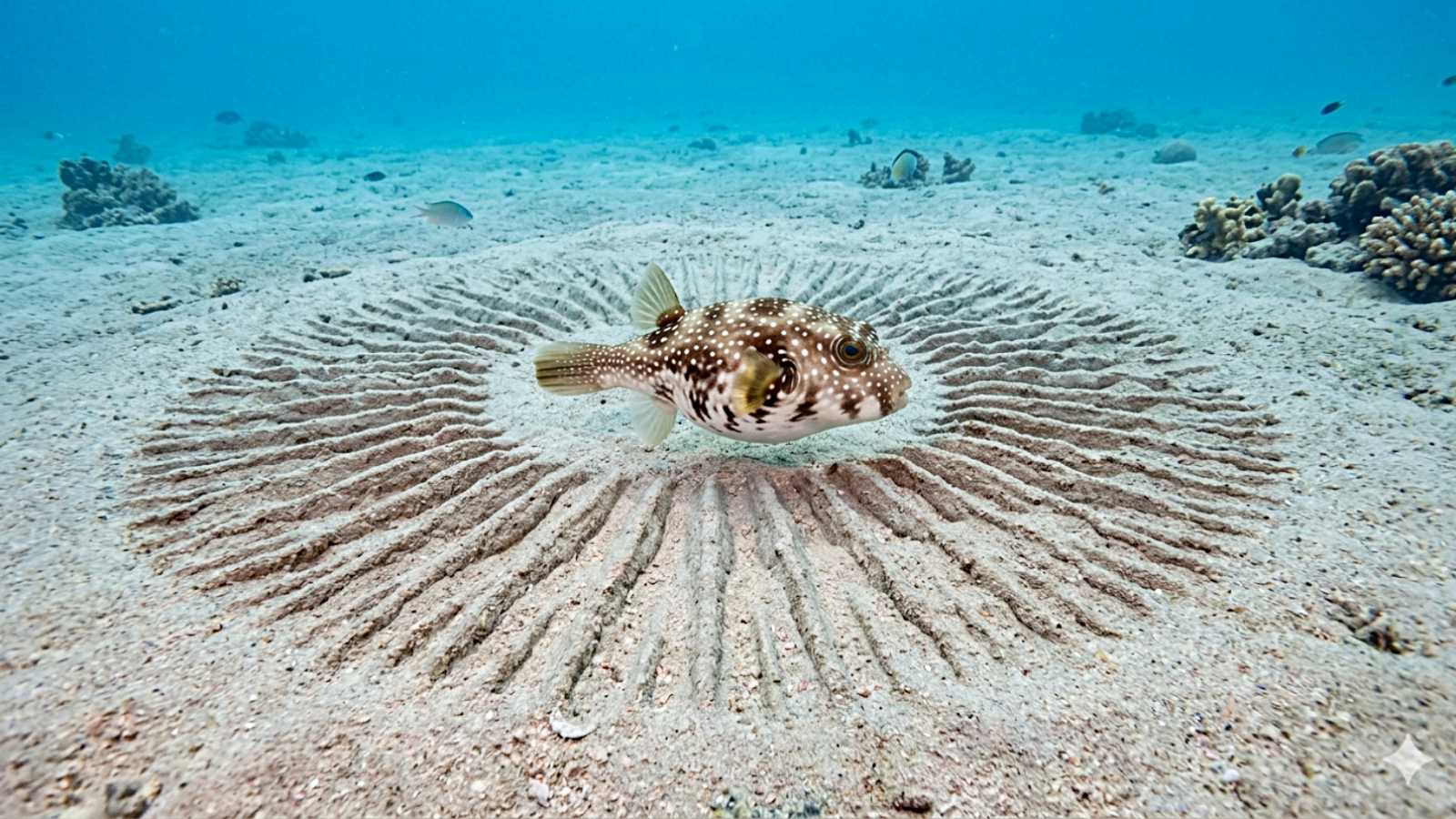
Torquigener albomaculosus was discovered in 2014 near Japan's Ryukyu Islands (Image: Gemini Generated)
How far are you willing to go to attract a lover? Maybe sing a song, break into a dance performance, or buy her flowers? But are you willing to make a stunning geometric artwork at the bottom of the ocean, like a pufferfish?
Pufferfish, specifically the small male species known as the white‑spotted pufferfish (Torquigener albomaculosus), found off the southern coast of Japan, transform the seabed into an elaborate spawning nest with sand, shells, and corals.
On the ocean floor, where currents quietly shape the sand and sunlight filters down in wavering beams, the tiny artist gets to work. There are no brushes, no colours, just movement, instinct, and an extraordinary sense of design.
A love story written in sand
At first glance, the patterns it creates seem almost unreal. Perfectly circular, intricately detailed, and strikingly symmetrical, these formations can span up to two metres across.
With ridges radiating outward and delicate grooves etched in between, they look less like something made by a fish and more like carefully planned geometric art.
Yet each one is the result of days of meticulous effort. Using its tiny fins, the male pufferfish glides over the sand, fluttering and sculpting, pushing grains into raised ridges and smoothing others into fine textures.
It works tirelessly, often for more than a week, repeating the process again and again until the structure is just right.
Story continues below this ad
Impressing a mate
As beautiful as these designs are, they are not created for decoration. They are, in fact, an elaborate courtship and nesting ritual. The male builds these intricate circles to attract a mate. The more precise and symmetrical the pattern, the higher his chances of success.
Scientists believe the ridges also serve a functional purpose by helping direct water currents toward the centre, where finer sand particles gather. This creates a softer, safer spot for eggs.
When a female arrives, she carefully inspects the structure. If she is impressed, she lays her eggs at the centre of the circle. If not, she swims away, leaving the male to begin again from scratch.
What makes this even more fascinating is how temporary these creations are. Ocean currents can easily wash them away, erasing hours — sometimes days — of work in moments. And yet the fish persists, often rebuilding new nests in the same general area each breeding season.
Story continues below this ad
In a quiet corner of the ocean, far from human eyes, this tiny creature continues to create something extraordinary, structures that are fleeting, purposeful, and deeply tied to survival.
View original source — Indian Express ↗
Related stories

Lovin Malta
EntertainmentJun 21, 2026 · 1 min
Maltese Film Żejtune Secures Second International Award
Lovin Malta

Variety
EntertainmentJun 21, 2026 · 1 min
‘Yugly’ Sells Wide Ahead of Annecy World Premiere, as nWave Team Enthuses at Quirky Characters, European CG With Heart…
Variety

Indian Express
EntertainmentJun 21, 2026 · 1 min
Ranvir Shorey: Typecasting has always haunted me
Indian Express

Variety
EntertainmentJun 21, 2026 · 1 min
Banijay Kids & Family Close Latin America Deals on ‘Totally Spies’ Season 8, ‘MiniHeroes of the Forest,’ ‘The Game…
Variety