Antara News
Indonesia Q1 growth outpaces G20, ASEAN averages, minister says
Jakarta (ANTARA) - Indonesia's economy grew by 5.61 percent year-on-year in the first quarter of 2026, outperforming the average growth of G20 and ASEAN economies while keeping inflation under control, Finance Minister Purbaya Yudhi Sadewa said.
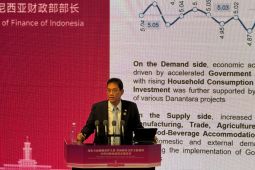
Speaking at a public lecture at Nankai University in Tianjin, China, Purbaya said Indonesia entered 2026 with strong economic momentum, stable prices, and credible policy resilience despite global uncertainties.
"Indonesia continues to stand out with first-quarter 2026 GDP growth of 5.61 percent year-on-year, outperforming many G20 and ASEAN countries. At the same time, we have maintained price stability with May 2026 inflation at 3.08 percent," Purbaya said, according to a statement received in Jakarta on Saturday.
The minister said the performance demonstrated the country's ability to sustain growth while preserving macroeconomic stability. Purbaya also highlighted Indonesia's resilience to potential global energy disruptions.
Based on an analysis presented during the lecture, Indonesia was categorized among countries with low exposure to energy shocks and strong economic buffers.
Indonesia's energy resilience score stood at 77 percent, slightly higher than China's 76 percent, he said.
The country's resilience was supported by prudent fiscal management, with the budget deficit maintained below 3 percent of the gross domestic product, providing sufficient room for the state budget to absorb external shocks.
Several domestic indicators also pointed to solid economic activity, including a manufacturing purchasing managers' index (PMI) at the expansion threshold of 50.0, growth in broad liquidity of 14.8 percent year-on-year, and bank lending growth of 11.5 percent year-on-year.
On the external front, Indonesia recorded a trade surplus for 72 consecutive months, while foreign exchange reserves reached US$144.9 billion, equivalent to 5.6 months of imports and sufficient to cover government external debt payments.
Purbaya said robust economic growth had translated into improvements in the labor market. Indonesia created 1.9 million new jobs, helping lower the open unemployment rate to 4.68 percent in 2026.
Poverty also declined, with the rate falling from 8.57 percent in September 2024 to 8.25 percent in September 2025, supported by government social protection programs.
To sustain growth momentum, the government is implementing eight national priority program clusters aimed at translating development strategies into tangible outcomes.
The priorities include food sovereignty, energy and water self-sufficiency, education, healthcare, infrastructure, housing, and disaster resilience, Purbaya said.
At the same time, the government is accelerating structural transformation through downstream industrial development and industrialization, while strengthening community-based economic programs, rural development, and integrated poverty reduction measures.
These initiatives will be reinforced by improvements in defense and security, law enforcement, governance, digitalization, and economic diplomacy to ensure growth remains inclusive, resilient, and well-coordinated.
"This proves that Indonesia's economic growth is not only resilient at the macro level, but is also being transformed into job creation, poverty reduction, and broader and more equitable prosperity for the people," Purbaya said.
Related news: BI sees stable growth despite 100-basis-point rate hike
Related news: Indonesia to maintain fiscal stability while funding key 2027 programs
Translator: Bayu Saputra, Martha Herlinawati Simanjuntak
Editor: Arie Novarina
Copyright © ANTARA 2026
View original source — Antara News ↗
Related stories

Dawn
BusinessJun 21, 2026 · 1 min
'Peace requires give and take': Vance, Shehbaz address summit opening ceremony ahead of US-Iran talks in Burgenstock
Dawn

Rio Times
BusinessJun 21, 2026 · 1 min
Africa Builds Its Own Bank for Oil and Gas as Western Money Retreats
Rio Times

Rio Times
BusinessJun 21, 2026 · 1 min
South Africa’s Absa Bets $239 Million on Deeper Control of Its Kenyan Bank
Rio Times

Rio Times
BusinessJun 21, 2026 · 1 min
Kenya Lines Up a $750 Million World Bank Loan, Tied to Reform
Rio Times