Indian Express
Indian Express··5 min read
NEET re-exam: Photostat kiosks shut in Rajasthan district, police frisk students in Assam
4 min readGuwahati, JaipurUpdated: Jun 21, 2026 06:00 PM IST
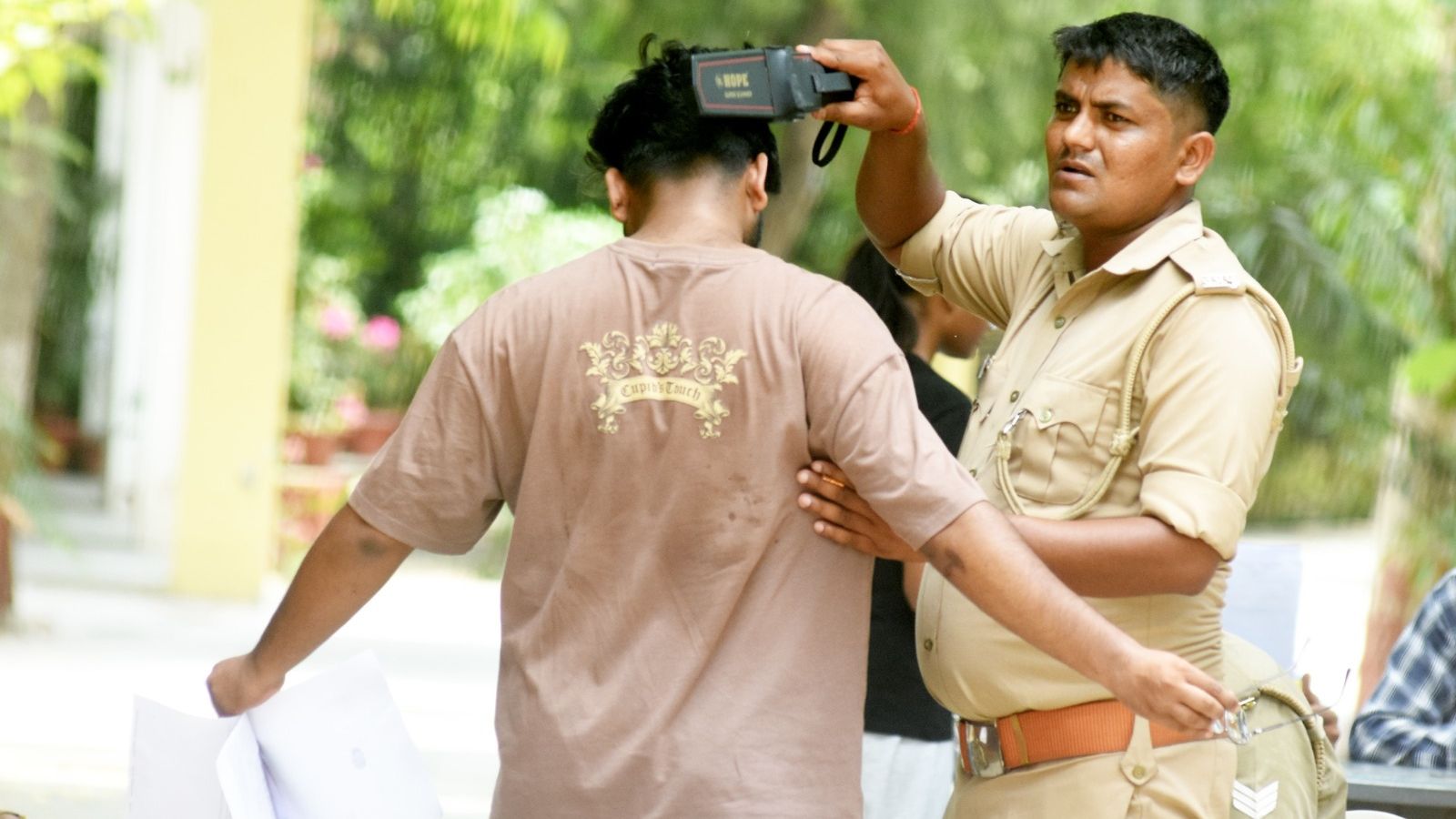
Arriving to write the exam for the second time in one and a half months, some aspirants said they stayed calm through the chaos of this period. (Express photo by Vishal Srivastava)
The re-examination for the National Eligibility cum Entrance Test (Undergraduate) was held across the country on Sunday, with strict security measures reported from different states to prevent any potential malpractice, including a Rajasthan district administration’s decision to shut photostat kiosks, and reports from Assam of police frisking students ahead of the exam.
Originally held on May 3, the national-level entrance exam for medical aspirants was cancelled following allegations of a question paper leak. The re-test was scheduled for Sunday, June 21. It is being held from 2 pm to 5.15 pm.
Assam
At the exam centre at Gauhati Commerce College, where 432 candidates were writing the exam, 10 police personnel were stationed. Police frisked the students first at the entry to the campus, and then again as they entered the section of the campus with the examination rooms, which was also equipped with a metal detector.
Ahead of the re-test, the Assam government had announced a slew of security measures, including double frisking, the imposition of Section 244 of the BNSS in a 100-metre radius of exam centres, 24-hour police protection of the centres and mobile jammers.
Arriving to write the exam for the second time in one and a half months, some aspirants said they stayed calm through the chaos of this period.
“In my mind, I had approached the May exam as a mock test. It was my first attempt, so I am feeling okay today as well,” said Aryan Chakravarty (18). But for most candidates, the period approaching this re-test was fraught with stress.
Mohammad Yasin (19) had travelled from central Assam’s Hojai to write the test, and he said his confidence had been failing him in the run-up to Sunday.
Story continues below this ad
“For those of us who had dropped a year just to prepare for the test, it (the cancellation of the May 3 test) was a very big ‘jhatka’. I found it very difficult to rebuild the flow of preparation once it was broken after the May test. It was like all my planning went out of the window, so I am not feeling very confident today. I am not feeling a 100%, and I am quite nervous,” he said.
Rajasthan
The state that is seen as a hub of coaching for competitive exams like NEET saw the re-test conducted under extensive security arrangements and strict monitoring by district administrations.
In Jaipur, the district administration set up 103 examination centres, including 84 government and 19 private institutions. Out of the registered 37,359 candidates, 36,508 appeared for the test, while 851 were absent.
As many as 24 Rajasthan Administrative Service officers were part of flying squads deployed across Jaipur to ensure there is no malpractice. District Collector Sandesh Nayak personally monitored the examination process and visited centres along with Additional District Collector and district nodal officer Narendra Kumar Verma. CCTV surveillance, biometric verification, jammers and police deployment were put in place to ensure a fair and smooth examination.
Story continues below this ad
Kota city, one of the country’s largest coaching hubs, had 32,715 candidates appearing for the examination at 92 centres. In Barmer, 3,475 candidates appeared for the examination at eight centres located at the district headquarters. Administrative and police officers remained stationed at all centres, while candidates underwent two-level frisking before entering and after leaving examination venues.
The district administration also ordered the closure of photostat shops, e-Mitra kiosks and cyber cafes within a 300-metre radius of examination centres. Officials warned that strict action would be taken against anyone involved in malpractice, information leaks or the spread of rumours related to the examination.
To facilitate travel for candidates, North Western Railway operated a special examination train between Barmer and Bhagat Ki Kothi with halts at Baytu, Balotra, Samdari and Luni.
© The Indian Express Pvt Ltd
Sukrita Baruah is a Principal Correspondent for The Indian Express, based in Guwahati. From this strategic hub, she provides comprehensive, ground-level coverage of India's North East, a region characterized by its complex ethnic diversity, geopolitical significance, and unique developmental challenges.
Expertise and Experience
Ethnic & Social Dynamics: Deep-dive coverage of regional conflicts (such as the crisis in Manipur) and peace-building efforts.
Border & Geopolitics: Tracking developments along India’s international borders and their impact on local communities.
Governance & Policy: Reporting on state elections, tribal council decisions, and the implementation of central schemes in the North East.
Specialized Education Background: Prior to her current role, Sukrita was a dedicated Education Correspondent for The Indian Express in Delhi. This experience provided her with a sharp analytical lens for:
Policy Analysis: Evaluating the National Education Policy (NEP) and university-level reforms.
Student Affairs: Covering high-stakes stories regarding campus politics, national entrance exams, and the challenges within the primary and secondary education sectors. ... Read More
Parul Kulshrestha is a Principal Correspondent for The Indian Express, based in Rajasthan. A lawyer turned journalist, she brings a unique cross-disciplinary perspective to her reporting, blending legal precision with deep social inquiry to cover one of India's most culturally and politically vibrant regions.
Expertise and Experience
Legal-Journalistic Synergy: Parul’s transition from a legal background to mainstream journalism provides her with a distinct advantage in interpreting policy, legislation, and judicial impacts. This expertise allows her to "read between the lines" of government orders and court rulings affecting the public.
Diverse Beat: With years of experience across both mainstream newsrooms and independent journalism, she has built high-level authority in several critical areas:
Nomadic Tribes & Marginalized Communities: She is recognized for her sensitive and in-depth reporting on the struggles and rights of Rajasthan's nomadic populations, often giving a voice to those outside the traditional political spotlight.
Gender & Social Justice: Parul focuses on the intersection of law and gender, covering issues ranging from women’s safety and reproductive rights to the socio-economic empowerment of rural women.
Environmental & Political Reporting: She tracks Rajasthan’s complex political landscape—including electoral shifts and bureaucratic changes—alongside critical environmental concerns like water scarcity and land use.
Academic & Professional Pedigree: Her background as a lawyer, combined with her rise to the rank of Principal Correspondent at a national broadsheet, establishes her as a senior voice in the media landscape. ... Read More
Tags:
NEET
View original source — Indian Express ↗
Related stories

ESPN
SportsJun 21, 2026 · 1 min
World Cup Daily: NASA astronauts kick ball around ...
ESPN

Sky Sports
SportsJun 21, 2026 · 1 min
Broad: England's Oval hammering shows how much they need Stokes
Sky Sports

Sky Sports
SportsJun 21, 2026 · 1 min
'We share same vision' - McCullum says Stokes has not tarnished relationship
Sky Sports

Bloomberg
BusinessJun 21, 2026 · 1 min
Efforts Underway for Safe Evacuation of Strait of Hormuz
Bloomberg