Times of Israel
US, Iran kick off talks on Lebanon, nuclear issues; Vance says progress already made
The United States and Iran began talks in Switzerland on Sunday after signing a preliminary agreement to end their war, but with the conflict in Lebanon threatening to derail the deal.
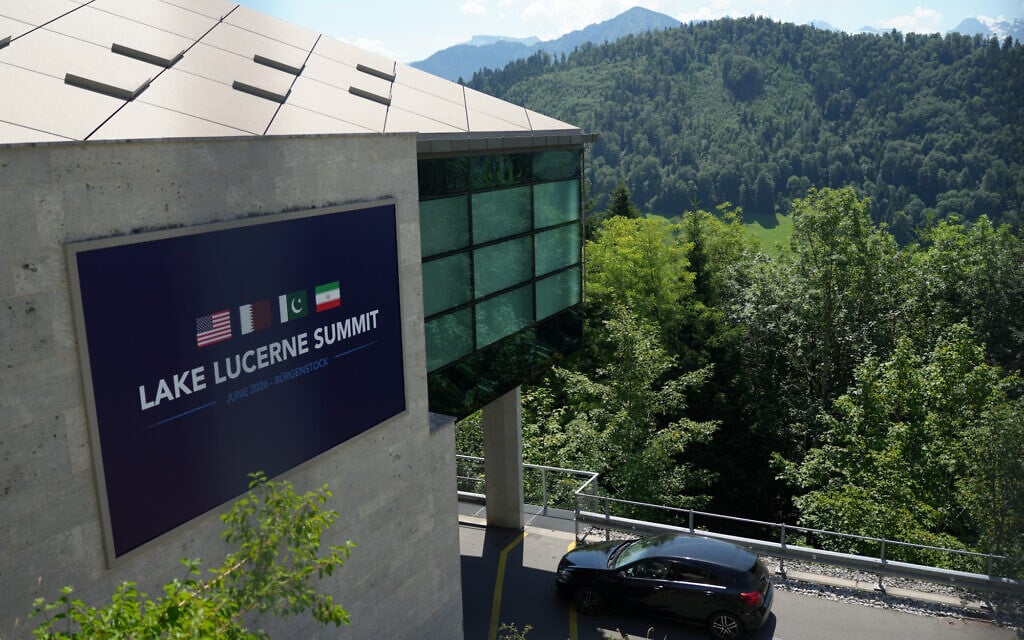
American and Iranian representatives gathered alongside delegations from mediators Pakistan and Qatar at the luxury Swiss resort of Burgenstock, perched high above Lake Lucerne.
US Vice President JD Vance headed the American delegation opposite Iran’s parliament speaker, Mohammad Bagher Ghalibaf. They previously met at the only known face-to-face talks so far, more than two months ago.
“We already made progress in the last several hours and I expect we will make additional progress in the hours to come,” Vance said, standing in front of reporters for a brief press conference alongside the prime ministers of Pakistan and Qatar. Though Iran’s representatives were not standing alongside them, there were several Iranian officials present toward the back of the room.
Vance called the meeting “historic” due to the high level of face-to-face engagement between Tehran and Washington, and said that US President Donald Trump had asked American negotiators to turn over “a new leaf” to transform the relationship with Iran, adding that the technical talks in Switzerland would allow for both sides to sit together and work to resolve issues.
Get The Times of Israel's Daily Edition
by email and never miss our top stories
By signing up, you agree to the terms
Referencing the US desire to see a truce in Lebanon as part of the deal inked last week with Iran, Vance said Trump remains committed to a “full regional ceasefire.”
He acknowledged that such truces can “be a little bit messy,” but claimed a lot of progress was made over the last two days to ensure a ceasefire in Lebanon. He stopped short of calling for Israel to pull out of southern Lebanon as Iran has demanded citing the US-Iran memorandum of understanding’s requirement that all military operations in Lebanon cease.
Israel had no part in negotiating the MOU, and Prime Minister Benjamin Netanyahu has distanced himself from it. Still, the terms of the opening clause, permanently ending the war and ruling out any resumption, indicate that it is binding on the US, Iran “and their allies.” Israeli officials are bitterly opposed to the deal’s terms, which resolve none of the war’s key goals — notably, eliminating Iran’s nuclear and ballistic missile programs, and creating the conditions for the fall of the regime.
While Vance expressed optimism that the fighting in Lebanon would soon end, Trump threatened to resume strikes on Iran if it could not stop Hezbollah from “causing trouble.”
In a Truth Social post shortly after Vance’s statements to reporters, Trump said: “Iran must immediately stop their highly paid PROXIES in Lebanon from causing trouble.”
“If they don’t, we’ll hit Iran very hard again, just like we did last week, only harder!” he added.
The post notably appeared to place the blame for the recent flare-up in Lebanon on Hezbollah and made no mention of Israel. Trump repeatedly criticized Jerusalem in recent days for operating in Lebanon in ways that he has said were indiscriminate. Like Vance, he did not call for Israel to pull out of southern Lebanon.
The MOU that the US signed last week with Iran also states that the sides will “refrain from the threat or use of force against each other,” though Trump has repeatedly taken to threatening the Iranians in recent days.
Iran says Lebanon issue tops agenda
A day before the talks kicked off, tensions flared as Iran said it was again closing the vital Hormuz waterway, citing Israeli strikes in Lebanon, as Vance and mediators scrambled to Switzerland to stave off a crisis that threatened to collapse the entire deal.
The negotiations to end a war that sowed chaos across the Middle East and rattled the global economy are meant to trigger a 60-day period to settle broader issues that have dogged US-Iranian relations for decades, from Iran’s nuclear program to crippling sanctions placed on the regime.
However, Iran said that the conflict in Lebanon between Israel and Hezbollah would top the agenda in talks with the US, as well as issues such as frozen Iranian funds and the sale of the country’s oil.
“It is not possible to enter the negotiation phase for a final agreement,” foreign ministry spokesman Esmaeil Baghaei wrote on X before Sunday’s meetings, saying no deal was possible unless there was an end to the war in Lebanon.
In a video shared by the IRNA state news agency, Baghaei said, “The Zionist regime continues to violate its commitment in Lebanon. This issue will be the main topic of discussion in today’s talks.”
A special session to discuss the conflict between Israel and Hezbollah was added to the schedule for the talks on the US-Iran deal in Switzerland, CBS News reported.
The outlet, citing a diplomat attending the talks, said the discussion is the first thing on the agenda.
Neither Israel nor the terror group is represented at the talks.
Preparatory talks with mediators took place first, with the office of Pakistani Prime Minister Shehbaz Sharif releasing footage of him and army chief Asim Munir greeting Vance with a hug.
Washington and Tehran’s MOU, signed earlier in June, extended the truce in the war that began in late February with US-Israeli strikes on Iran. It included a provision to end fighting in Lebanon between Israel and Hezbollah, which began attacking northern Israel in support of Iran a few days after the first US-Israeli strikes.
The latest fighting between Israel and Hezbollah has repeatedly threatened to derail peace efforts.
On Friday, planned US-Iranian talks were postponed after Hezbollah killed a four-man IDF tank crew and Israel launched deadly strikes in response.
Washington announced a renewed ceasefire in the country later the same day, but Israeli troops again clashed with Hezbollah fighters on Saturday, trading accusations of truce violations. Another soldier was killed in combat, the fifth fatality since the US-Iran deal was reached.
Lebanese state media reported Israeli air raids on around 20 locations, with authorities counting more than 30 dead, though they do not distinguish between fighters and noncombatants.
Citing a US “breach of contract” and “the Zionist regime’s continuous and relentless violation of the ceasefire in southern Lebanon,” Iran’s central military command said “the Strait of Hormuz will be closed to vessel traffic.”
But US Central Command said after Iran’s announcement that safe passage there had “remained intact.”
Asked Saturday whether the fighting in Lebanon was threatening to derail the talks, Vance said as he left for Switzerland, “Things are actually getting better there, and things are slowing down a little bit.”
“[Secretary of State Marco Rubio] and the entire team have been actively managing what’s going on in Lebanon,” he added.
“The big problem is that you have somebody will shoot and then somebody will respond, and you kind of have a chicken and egg problem where you’ve just got to stop the shooting for long enough to get the ceasefire to keep hold, that’s what we’re going to try to do.”
U.S. Vice President JD Vance has departed for Switzerland to attend the U.S.-Qatar-Pakistan-Iran talks. pic.twitter.com/UykxL0iZ5G
— Conflict Radar (@Conflict_Radar1) June 20, 2026
By Sunday afternoon, however, there had been no reports of Israeli strikes or continued fighting in Lebanon since the day before. Prime Minister Benjamin Netanyahu instructed the IDF to “hold its fire” in Lebanon, Channel 12 reported Saturday.
Israel insisted, however, that its troops would stay inside what it calls a “security zone” in southern Lebanon, despite the US-Iran deal.
Defense Minister Israel Katz, who has said in the past that Israel is not bound by the US-Iran MOU, said in a statement that there was and is no restriction on Israeli soldiers to act to eliminate threats in Lebanon, with troops remaining in positions in the security zone.
Nuclear sticking points
Lebanon aside, there has been no indication that Iran’s support for armed groups across the region, the ending of which was one of the ostensible targets of the war, will be addressed in the negotiations.
“I think we’re going to hopefully make progress on the nuclear issue, make progress on the Lebanon ceasefire issue. Those are the two big things that I think we’re to be focused on,” Vance told reporters before departing from Joint Base Andrews, saying he could only join the talks “for a day or two.”
There remained skepticism from Tehran, however, with Mohsen Rezaei, a military adviser to Supreme Leader Ayatollah Mojtaba Khamenei, posting on X that “the enemy has shown itself to be a promise-breaker.”
Speaking on Sunday, Iranian President Masoud Pezeshkian said Tehran would not relinquish its right to enrich uranium, though he repeated Iran’s denial that it wants nuclear weapons.
“We can also state in writing that we have no intention of building a bomb,” he said on the presidential website.
Iran, which is avowed to destroy Israel, has enriched uranium to 60 percent, a short technical step from the 90% needed to make an atomic bomb, and a level which has no peaceful application.
Rafael Grossi, chief of the UN nuclear watchdog — the International Atomic Energy Agency — met with Swiss Foreign Minister Ignazio Cassis on the sidelines of the gathering in Switzerland to negotiate the deal between the US and Iran.
A source familiar with the matter told The Times of Israel that Grossi is slated to participate in technical talks.
Baghaei, meanwhile, said the unfreezing of Iranian assets and “issuing the necessary licenses for the sale of Iranian oil, will also be on the agenda.”
US negotiators Jared Kushner and Steve Witkoff were already in Switzerland handling “some of the technical elements” and had reported that “things are going well,” Vance said in an interview with Fox News Saturday.
Vance said he planned to be in Switzerland for just “a day or two,” leaving much of the detailed negotiations to be spearheaded by Witkoff and Kushner.
View original source — Times of Israel ↗
Related stories

ESPN
SportsJun 21, 2026 · 1 min
Kraken pick up RFA Samoskevich in Panthers deal
ESPN

ESPN
SportsJun 21, 2026 · 1 min
McCollum stays with Hawks on 1-year extension
ESPN
ESPN
SportsJun 21, 2026 · 1 min
Oilers re-sign Dickinson to 5-year, $20M contract
ESPN
Sky Sports
SportsJun 21, 2026 · 1 min
Sooryavanshi left out of India ODI squad vs England despite 11-ball 50
Sky Sports