Indian Express
Indian Express··3 min read
Faces of a lost civilisation: Rakhigarhi skeletons to undergo DNA, facial reconstruction studies
The Archaeological Survey of India (ASI) has sent nearly 5,000-year-old skeletons unearthed at Haryana’s Rakhigarhi, the largest known site of the Harappan civilisation, for scientific examination and facial reconstruction.
Four skeletons recovered during the latest excavation were sent to the Anthropological Survey of India (AnSI) in Kolkata on Friday, while DNA samples from one of the skeletons have been forwarded to the Birbal Sahni Institute of Palaeosciences (BSIP), Lucknow.
Speaking to The Indian Express, Manoj Saxena, Superintending Archaeologist, ASI, said three skeletons, along with soil samples, had been sent to Kolkata, while only skeletal remains were sent in the fourth case. A fifth skeleton has been retained by the ASI.
Of the five skeletons recovered, three are believed to be female and two male. Preliminary assessments suggest all five individuals were between 30 and 40 years old, though their exact ages will be determined through detailed scientific analysis.
Saxena described the discovery as significant because the remains date back nearly 5,000 years to the Harappan period. He said the studies would help determine whether the individuals died of natural causes or disease and, if disease was involved, identify the nature of the ailments. The research is also expected to reveal details about their ancestry, height, physical features and social status.
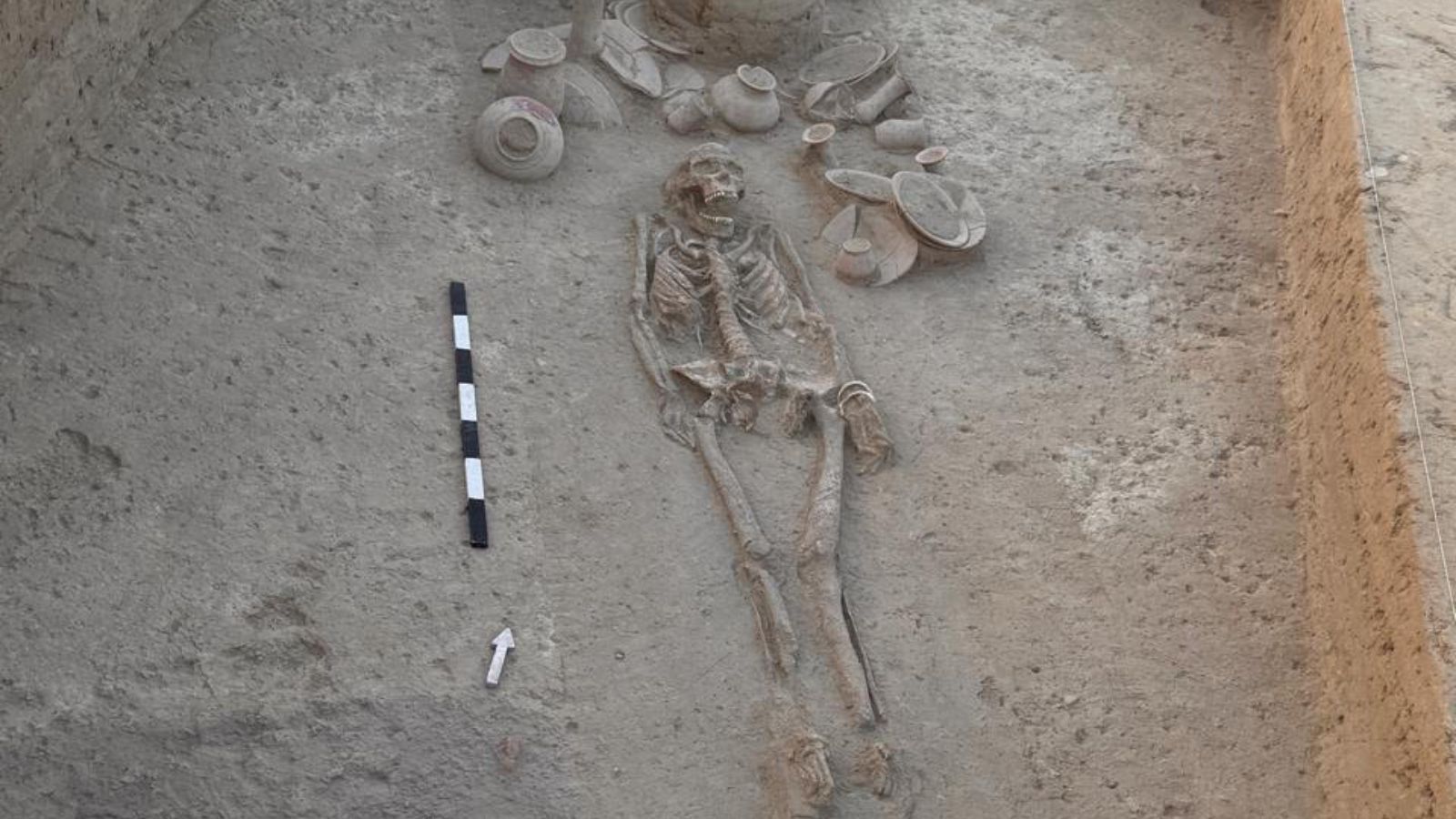
Besides human remains, archaeologists uncovered painted earthen pots, multipurpose earthen stands and other artefacts that offer valuable insights into daily life during the Harappan period. (Photo: Special Arrangement)
One of the key objectives of the study is facial reconstruction, which could provide a visual representation of what inhabitants of the Harappan civilisation may have looked like. According to Saxena, anthropological and DNA studies will be combined to produce a comprehensive report.
Researchers are also expected to reconstruct the palaeo-environment of the period to better understand the human populations that inhabited the region and identify areas requiring further study.
Story continues below this ad
Apart from the five complete skeletons, archaeologists recovered three additional burials from Mound No. 7, the ancient cemetery area of the site. However, these burials contained only fragmentary remains. One yielded only a skull, another contained damaged bones, while a third had a broken skull.
Archaeologists believe these remains were disturbed by agricultural activity over the years, as they were located just 15 to 20 centimetres below the surface.
The excavation also produced an unprecedented number of burial offerings. In some graves, archaeologists found up to 40 pottery offerings accompanying the deceased, surpassing the previous highest count of 22 found at the site.
According to Saxena, such offerings indicate a person’s social standing and importance within the community. He said the number of objects buried alongside an individual may reflect the respect and recognition they enjoyed during their lifetime.
Story continues below this ad
The latest phase of excavation began on January 22 and concluded on June 12 at the 550-hectare archaeological site in Rakhigarhi village. The ASI has planned a three-year excavation programme, with three more phases to follow. After the completion of the first phase, the next round of excavations is expected to begin after Diwali and continue until April 2027.
To date, nearly 70 skeletons have been recovered from the site through excavations conducted by the ASI and Deccan College, Pune. Researchers will compare findings from the current excavation with earlier reports to identify similarities and develop a more comprehensive understanding of Harappan society.
Besides human remains, archaeologists uncovered painted earthen pots, multipurpose earthen stands and other artefacts that offer valuable insights into daily life during the Harappan period. Saxena noted that some of the earthen stands appear to have functioned much like modern table stands used to hold household items.
Rakhigarhi comprises seven mounds. Excavations have previously been carried out at Mound No. 7 in 2005-06, 2015 and 2023, while limited excavations were conducted at Mound No. 6 in 2005-06 and 2015.
Story continues below this ad
Earlier excavations revealed residential structures, streets, drainage systems and what is believed to have been a jewellery-manufacturing unit. Archaeologists also recovered copper and gold ornaments, terracotta toys, seals and thousands of earthen pots.
Dating back to approximately 4200 BCE, Rakhigarhi is considered one of the two largest Harappan sites in India, alongside Dholavira in Gujarat. The site is among 15 archaeological locations identified by the Centre for development as cultural heritage destinations.
Announcing the initiative in the Union Budget earlier this year, Finance Minister Nirmala Sitharaman said excavated landscapes would be opened to the public through curated walkways and supported by interpretation centres, conservation facilities and immersive storytelling technologies to enhance visitors’ understanding of India’s ancient civilisations.
View original source — Indian Express ↗
Related stories

ESPN
SportsJun 21, 2026 · 1 min
Kraken pick up RFA Samoskevich in Panthers deal
ESPN

ESPN
SportsJun 21, 2026 · 1 min
McCollum stays with Hawks on 1-year extension
ESPN
ESPN
SportsJun 21, 2026 · 1 min
Oilers re-sign Dickinson to 5-year, $20M contract
ESPN
Sky Sports
SportsJun 21, 2026 · 1 min
Sooryavanshi left out of India ODI squad vs England despite 11-ball 50
Sky Sports