Times of Israel
‘Regime change’: High Court tears into coalition bid to control judicial appointments
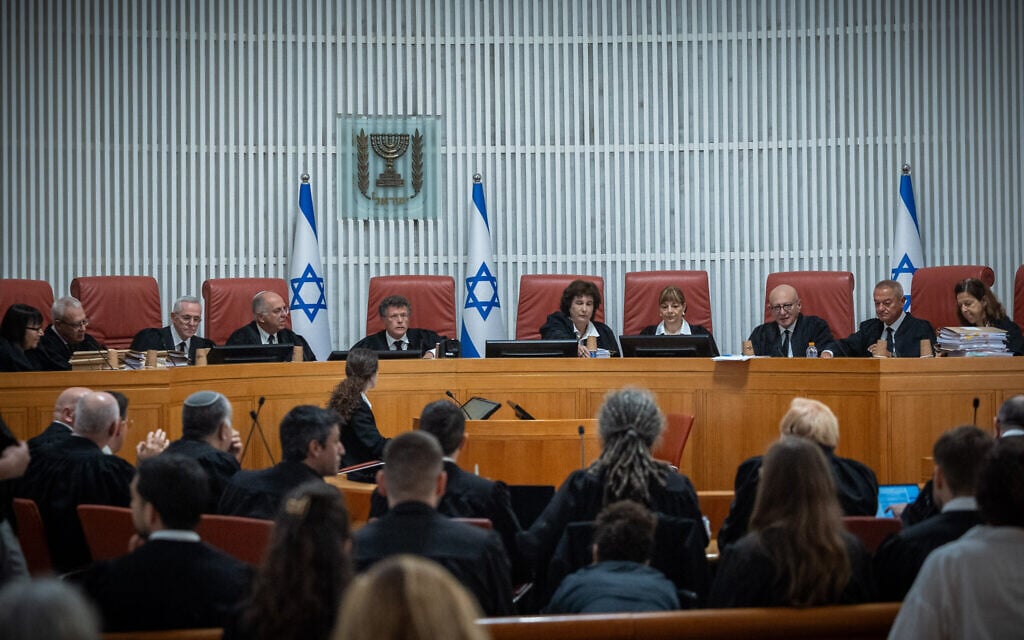
The government’s highly controversial judicial overhaul agenda returned to the public stage in dramatic fashion on Sunday, as numerous High Court justices tore into a law passed by the coalition last year that would greatly increase political control over judicial appointments.
During a hearing over the measure, justices from both the court’s liberal and conservative wings asserted that the law would politicize not only the Supreme Court but the entire judiciary, and radicalize it at the same time.
Supreme Court President Isaac Amit said the law, if allowed to stand, would “implant a political chip” in every Supreme Court judge and “write on their foreheads” that they were appointed by the coalition or opposition.
In another comment, Amit said the law, an amendment to Basic Law: The Judiciary, constituted “a change of regime,” in response to comments by one of the government’s lawyers that governments are entitled to change Israel’s constitutional arrangements.
Justice Alex Stein, a conservative, asserted that the new method for appointing judges would incentivize judges to adjust their rulings to curry favor with politicians in order to obtain promotions, while Justice Yechiel Kasher, a conservative-leaning moderate, insisted it would lead to extremist judges being appointed to the Supreme Court.
Get The Times of Israel's Daily Edition
by email and never miss our top stories
By signing up, you agree to the terms
Of the 11 judges presiding over the hearing, nine were critical of one or more components of the law, indicating that the legislation may not survive the court’s judicial review.
The court’s two staunchest conservatives, Deputy President Noam Sohlberg and Justice David Mintz, were dubious as to the need for judicial intervention over the legislation, and repeated their previously expressed opposition to judicial review over Israel’s quasi-constitutional Basic Laws.
The oral arguments over the petitions, filed by several liberal government watchdog groups and the Yesh Atid opposition party, were heard by all 11 justices currently serving on the court, which only convenes its full roster to review the most constitutionally significant cases.
MK Simcha Rothman, who, as chairman of the Knesset Constitution, Law and Justice Committee, advanced the law through the legislative process, denounced the court for even holding a hearing over the legislation, since it was passed as an amendment to a Basic Law, which Rothman and many other coalition figures argue is not subject to judicial review.
“A judge who rules on the question of how judges are appointed in a democratic country and in a Basic Law that was passed in the Knesset by a majority of 68 Knesset members is a criminal,” declared Rothman of the far-right Religious Zionism party, who, together with Justice Minister Yariv Levin, has been one of the key architects of the government’s judicial overhaul agenda.
Sunday’s hearing was only the third case in which the High Court has reviewed a Basic Law on a substantive basis. The court struck down the current government’s law annulling the use of the judicial doctrine of reasonableness in 2024, and in 2021 upheld the nation-state law passed by a previous government led by Prime Minister Benjamin Netanyahu.
The law under review was passed by the coalition last March, and will come into effect in the next Knesset, meaning after the upcoming election.
The legislation is the flagship law of the government’s judicial overhaul agenda, by which it is seeking to assert control over the judiciary and greatly restrain its ability to check executive power.
Under the terms of the law, the two representatives of the Israel Bar Association will be removed from the nine-member Judicial Selection Committee and be replaced with two private lawyers, one to be selected by the coalition and one by the opposition. Two government ministers will also have a place on the committee, as they do today, along with one coalition MK, one opposition MK, and three Supreme Court justices.
Unlike the current system, a lower court appointment would need at least one vote each from committee representatives of the coalition, opposition, and the Supreme Court, granting all sides a veto, whereas no side has a veto over such appointments under the current arrangements.
In another radical change, Supreme Court justices could be appointed without the votes of any of the Supreme Court justices on the Judicial Selection Committee, meaning that there could be no professional input whatsoever on appointments to the top court. Supreme Court appointments would, however, need the vote of at least one opposition member.
But a further, highly controversial aspect of the law would create a deadlock-breaking mechanism in the event that the coalition and opposition cannot agree on Supreme Court appointments within a year of positions opening up on the court bench, whereby both sides nominate three candidates and the other side must pick one of them to join the court.
If either side refuses to choose, the coalition and opposition each get to appoint one justice each to the court. The deadlock mechanism could only be used once per Knesset term.
During Sunday’s hearing, Justice Yael Wilner lambasted the deadlock mechanism of the new law in particular, arguing that there would be no incentive to compromise during the normal judicial selection process.
“The politicians know that if there is no agreement, they can choose their own candidate. Do you understand what [great] incentive there is to get to this dark corner?” she demanded of Yitzhak Bart, the attorney representing the Knesset, which has demanded that the petitions be rejected.
Wilner also said that the deadlock mechanism could, and likely would, lead to a situation in which Supreme Court justices are appointed without a vote of the Judicial Selection Committee, something she said was unprecedented in Israel and practically unheard of anywhere in the world.
Justice Yechiel Kasher, together with Wilner, argued that the judges elected to the Supreme Court under the new system would be the most extreme candidates possible, since if one side appointed a moderate, they would risk the balance of power on the court if the other side appointed a radical.
“The coalition will put up three candidates who will be the most extreme…the opposition will do the same… You don’t want someone who’s a centrist — that’s no good. No one will gamble on someone who is in the middle because then you’ve wasted your power,” argued Kasher.
Perhaps the strongest words against the law were uttered by Amit himself, who asserted that the new judicial selection process would politicize the Supreme Court in particular.
“The benches of the Supreme Court will fill up, so that within 15 years the judicial system in Israel will change completely… and a political chip will be implanted in the body of every judge whether he wants it or not,” said Amit.
“Within a year of the [next] Knesset being elected, two judges will be elected [to the Supreme Court] who will have written on their foreheads ‘one of us was elected by the opposition and one by the coalition.’ The judges will be politically identifiable, even if they don’t want to be,” he warned.
The justices did, however, also ask tough questions of the attorney general’s representative, Aner Helman, and the legal representatives of petitioners, with Sohlberg and Mintz in particular expressing concern over the use of the court’s power to strike down a Basic Law.
“Maybe you and the petitioners think that the balance [on the Judicial Selection Committee] isn’t right, has been breached. The question is, are we in a situation that demands judicial review over a Basic Law, where the situation will be so terrible if this amendment doesn’t get annulled?” asked Mintz.
Sohlberg noted that although he did not believe the law to be “ideal,” it did include a requirement for agreement between coalition and opposition.
Justice Gila Canfy Steinitz, who was highly critical of the law when questioning the government representatives, also expressed concern over the potential impact of striking down a Basic Law, noting that the court did so relatively recently with the reasonableness law.
“One cannot ignore the price of these decisions… There is harm done to relations between the branches of government, to public trust. If the political system gives an answer… why does the court need to stick its head in?”
View original source — Times of Israel ↗
Related stories

Portugal Resident
PoliticsJun 21, 2026 · 1 min
Iniciativa Liberal criticises proposed sovereign wealth fund
Portugal Resident
South China Morning Post
PoliticsJun 21, 2026 · 1 min
Iran vows forces are ready to respond after Trump’s threat to ‘hit Iran very hard again’
South China Morning Post

The Hill
PoliticsJun 21, 2026 · 1 min
Graham asks Trump to move forward with Clayton’s DNI nomination
The Hill

The Guardian
PoliticsJun 21, 2026 · 1 min
‘A shift has taken place’: Starmer faces the music after weekend of reflection
The Guardian