Indian Express
Indian Express··5 min read
Some nervous, most relieved: For students and parents, NEET retest end of an ordeal
On Sunday, the father of a medical aspirant appearing for the exam in Mumbai expressed relief regarding the stricter security arrangements in place. “There are police personnel deployed on the campus. We are hopeful she will perform better this time and no hiccups will occur,” said retired postman Mohan Chavan, 65, waiting outside the Sardar Patel College of Engineering examination centre for his daughter, Aditi Chavan.
Candidates were asked to report to their examination centres between 11 am and 1.30 pm to complete document verification, biometric checks and frisking procedures. The NEET-UG re-test was conducted from 2 pm to 5.15 pm, with the National Testing Agency (NTA) extending the examination window by 15 minutes to accommodate mandatory formalities. As the centres closed their doors at 1.30 pm, some candidates who arrived late at centres in Mumbai and other cities were denied entry.
Students emerging from examination centres in the evening offered mixed reactions. Vrushali Parmar from Goregaon felt the paper was relatively easy and comparable to the earlier exam. “Chemistry was a little different and more difficult this time. It was lengthy and had several organic chemistry questions. Overall, though, it was not bad. I had scored 545 marks in the previous exam,” she said.
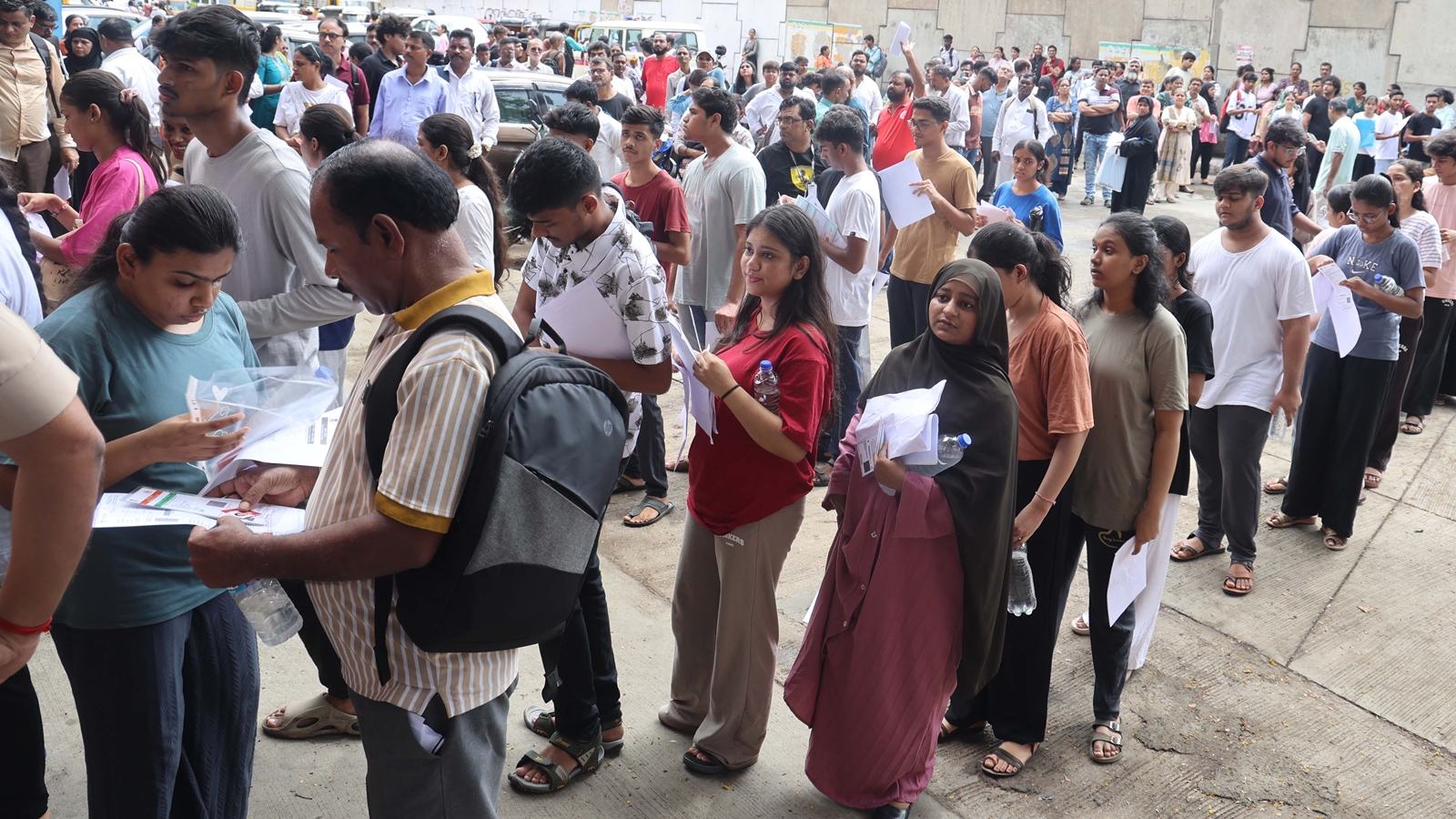
NEET UG 2026 aspirants arrive at an examination centre for the retest amid heightened security, June 21, 2026.
For Shreya Gupta from Nalasopara, the paper was “moderate to easy”. “Some students felt physics was difficult, but I did not find it too challenging. I just want to secure an MBBS seat somehow,” she said.
Vinit Chaturvedi from Thane arrived at his examination centre in Andheri, accompanied by his mother, Rinku Chaturvedi. Waiting outside the centre along with other parents, Rinku said her son was anxious because of his determination to pursue medicine. “He wants to become a doctor like his father. We keep telling him not to stress or overthink. If things don’t work out this time, there are several other options available,” she said.
Traffic concerns
Story continues below this ad
In Kolkata, students said concerns about traffic jams amid International Yoga Day celebrations, including at Howrah Bridge, prompted many to leave their homes very early. In the Jadavpur University exam centre, many reached well before 11 am – the time at which they are allowed inside.
After the exam, students said dealing with the stress of the last one and a half months was more difficult than the exam itself. “The real challenge was coping with the stress caused by the paper leak controversy. It has deeply affected us,” said a candidate, Tanmoy Roy.
In Assam, at the exam centre at Gauhati Commerce College, where 432 candidates were writing the exam, police frisked the students first at the campus entrance, and then again as they entered the section of the campus with the examination rooms, which was also equipped with a metal detector.
Arriving to write the exam for the second time this year, some aspirants said they stayed calm through the chaos of this period. “In my mind, I had approached the May exam as a mock test. It was my first attempt, so I am feeling okay today as well,” said Aryan Chakravarty (18).
Story continues below this ad
But for most candidates, the period leading up to this re-test was fraught with stress. Mohammad Yasin (19) had travelled from central Assam’s Hojai to write the test, and he said his confidence had been failing him in the run-up to Sunday.
“For those of us who had dropped a year just to prepare for the test, it (the cancellation of the May 3 test) was a very big jhatka (jolt). I found it difficult to rebuild the flow of preparation once it was broken after the May test. It was like all my planning went out the window, so I am not feeling very confident today. I am not feeling 100%, and I am quite nervous,” he said.
Photostat shops closed
Rajasthan, a state seen as a hub of coaching for competitive exams like NEET, saw the retest conducted under extensive security arrangements and strict monitoring by district administrations.
As many as 24 Rajasthan Administrative Service officers were part of flying squads deployed across Jaipur to ensure there is no malpractice. District Collector Sandesh Nayak personally monitored the examination process and visited centres along with Additional District Collector and district nodal officer Narendra Kumar Verma. CCTV surveillance, biometric verification, jammers, and police deployment were implemented to ensure a smooth examination.
Story continues below this ad
In Barmer, the district administration ordered the closure of photostat shops, e-Mitra kiosks and cyber cafes within a 300-metre radius of examination centres. Officials warned that strict action would be taken against anyone involved in malpractice, information leaks or the spread of rumours related to the examination.
Kota city, one of the country’s largest coaching hubs, had 32,715 candidates appearing for the examination at 92 centres.
In Delhi, schools hosting the examination had arranged shaded waiting areas, drinking water, coolers, tea and first-aid facilities for parents. Aspirants noted that the security was much tighter than before.
“Earlier, religious threads on our arms were allowed,” said 18-year-old Tulsi, a first-time candidate from Dwarka. “This time, they made us remove everything. They even asked me to take off my hairband.”
Story continues below this ad
Inside a government school in Dwarka Sector 6, candidates underwent multiple rounds of document verification, biometric authentication and physical frisking before being allowed to enter examination halls.
“They checked my documents twice and frisked me, too,” said Shilpa, a Delhi University student appearing for her second attempt.
Messaging apps monitored, drones deployed
In Ahmedabad, Inspector General of Police (Law and Order) Makrand Chauhan, who was appointed as the state’s nodal officer for the exam, said messaging apps like WhatsApp and Telegram were under close scrutiny to prevent any attempt to leak exam-related material or spread any misinformation.
Ahmedabad Deputy Commissioner of Police (Control Room) Reema Munshi said that eight drones are being used for aerial monitoring around examination centres, while the Cyber Crime Branch and social media cell are conducting continuous online patrolling to curb rumours and misinformation.
Story continues below this ad
Parents said security arrangements were strict at the centres. “Along with jewellery and ornaments like earrings, bracelets were also removed, and the security personnel deployed at the entrance had even removed the kalawa, neck threads and rudraksh bracelet of my son,” said Dipak Patel, one of the parents at the R J Tibrewal College centre in Ahmedabad.
View original source — Indian Express ↗
Related stories

ESPN
SportsJun 22, 2026 · 1 min
How Clark battled the crowd and the course to win ...
ESPN

The Hindu
PoliticsJun 22, 2026 · 1 min
West Asia war LIVE: Iran Foreign Minister Abbas Araghchi says ‘major progress’ in U.S. talks
The Hindu

The Hollywood Reporter
EntertainmentJun 22, 2026 · 1 min
Aubrey Plaza Says Her Animated Series ‘Kevin’ Has Been Canceled at Amazon’s Prime Video
The Hollywood Reporter

Indian Express
SportsJun 22, 2026 · 1 min
Alireza Beiranvand’s story: Belgium’s tormentor once slept on streets, washed cars
Indian Express