Times of Israel
Sharaa rules out Syria intervening in Lebanon after Trump again suggests it fight Hezbollah
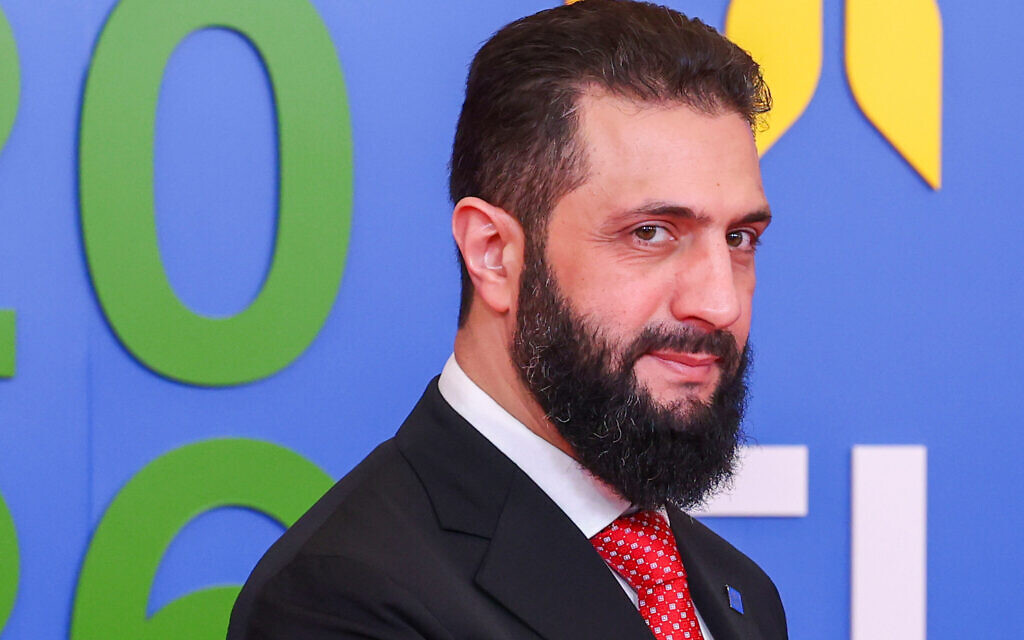
Syrian President Ahmed al-Sharaa on Sunday ruled out intervening militarily in the Israel-Hezbollah conflict in Lebanon, after US President Donald Trump again suggested Damascus could get involved and expressed frustration with Israel’s fight against the Iran-backed terror group.
Trump’s comments to Fox News on Sunday came as the conflict in Lebanon has threatened to derail US-Iranian negotiations underway in Switzerland. On Sunday, Prime Minister Benjamin Netanyahu doubled down on the Israeli military’s need to maintain a buffer zone in southern Lebanon, as the IDF reportedly urged Israel’s political leadership to intensify negotiations with the Lebanese government. The sides are slated to meet again this week.
Trump and US Vice President JD Vance have both repeatedly complained about Israel’s conduct in the Lebanon conflict, portraying it as a possible spoiler of the talks with Iran. Trump lashed out at Hezbollah in a social media post earlier on Sunday, but has chided Israel both for civilian casualties in its Lebanon strikes, and for not defeating Hezbollah quickly enough.
He repeated those sentiments in an interview with Fox News on Sunday, saying he is “disappointed Israel can’t put Hezbollah away.”
“They can’t do anything without knocking buildings down,” the president added. Then, referring to the fight against Hezbollah, he said, “I’m close to giving it over to Syria.”
Get The Times of Israel's Daily Edition
by email and never miss our top stories
By signing up, you agree to the terms
But Sharaa, who has been focused on rebuilding Syria and gaining domestic and international legitimacy since his Islamist forces ousted longtime ruler Bashar al-Assad in late 2024, rejected the idea of Syrian forces going to war against Hezbollah, a former Assad ally.
“The crisis in Lebanon is very serious and there is a deadlock in political solutions,” Sharaa told Arab news outlet Al Mashhad. “Syria offers a different approach to solving it, but the most important thing is first of all to stop the war.”
He added, “The solution for Lebanon will not come through war and the bombing of cities. President Trump expressed concern about the current situation in Lebanon, and his words were misunderstood. He spoke about Syria’s role in seeking a safe and peaceful solution, but people understood him as if Syria would enter Lebanon tomorrow morning.”
“We are looking for economic channels between Lebanon and Syria, not military ones,” he said. “Our vision is based on restoring support for the Lebanese state, strengthening its institutions, and seeking a solution that everyone can believe in. Stopping what is happening in Lebanon now requires creative solutions, not traditional and outdated ones.”
Responding to a question about whether he would sit at the table with Hezbollah, Sharaa said that “if this serves Lebanon’s interests and safeguards Syria’s interests, why not?”
Trump also criticized Israel’s conduct in Lebanon last week in terms similar to those he used on Sunday.
“Israel is fighting Hezbollah too long and too many people are being killed,” Trump said at the G7 conference of global leaders. “And you don’t have to knock down an apartment house every time you’re looking for somebody. Because there are a lot of people in those apartment houses. And they’re not all Hezbollah, that I can tell you.”
He added later, “I’m not happy with the way Israel has handled themselves with Lebanon and with Hezbollah. They should have been able to do the job faster. It just goes on forever. And when that happens, it throws a negative light on the big deal, and that’s the deal with Iran.”
But on Sunday, Trump also aimed his rhetorical fire at Hezbollah and its sponsor, Iran, in a social media post that roiled the talks in Switzerland.
“Iran must immediately stop their highly paid PROXIES in Lebanon from causing trouble,” he wrote in a Truth Social post. “If they don’t, we’ll hit Iran very hard again, just like we did last week, only harder!”
The post notably did not place blame on Israel. The US-Iran memorandum of understanding signed last week, which Israel was not party to, calls for a ceasefire in Lebanon, though the US has not called on Israel to withdraw from its buffer zone there, as Iran has. A truce has appeared to hold in Lebanon since Saturday.
Netanyahu defends buffer zone: ‘What would America do?’
Netanyahu, meanwhile, issued another defense of Israel’s security zone in southern Lebanon. His remarks came as reports on Channel 12 and Haaretz said Israel was considering partial withdrawals from the Lebanese territory it holds.
“As long as we need to protect our people, we will remain in the security zone in south Lebanon. And the reason is perfectly understood. No country would be asked to do otherwise,” the premier said, speaking at the Jewish News Syndicate International Policy Summit in Jerusalem.
He argued that the US would act the same way Israel does if it were confronted with terrorist threats on its borders.
“What would America do? Would it say, well, there’s nothing we can do? Let’s hold our fire? Is that what America would say? No! You know damn well what America would do. It would cross the border, create a security zone, kill the terrorists, and protect its people until the threat is removed. That’s exactly what we are doing.”
Following the rebukes from Trump and Vance, Netanyahu claimed that no army “goes to such lengths like the Israeli army to target terrorists and minimize civilian casualties.”
“We target the terrorists, but there are some civilian casualties in every such war, in every such urban warfare. And normally the ratio of noncombatants to combatants killed is about seven to one, eight to one,” he continued. He added that, according to the research arm of the Defense Ministry, Israel’s ratio in Lebanon is one civilian killed for every five combatants, which he called an “unheard of” achievement.
“We should be commended for it, not condemned. We do everything in our power to protect our people. We don’t have a war with Lebanon. We have a war with Hezbollah, who terrorizes Lebanon and seeks our destruction,” he said.
IDF said urging Israeli leaders to intensify talks with Beirut
Israel and Lebanon are set to meet for their next round of talks in Washington, DC, from Tuesday to Thursday. As that meeting approaches, the IDF is reportedly urging Israel’s political echelon to intensify the negotiations amid fears that ongoing US-Iran talks will hamper the military’s offensive against Hezbollah.
The goal of these intensified negotiations would be to isolate Hezbollah and reach a potential agreement with Beirut on its own terms, rather than face the prospect of American pressure to act in accordance with Iranian demands.
The US decided to launch the Israel-Lebanon talks in order to prevent Iran from having a say in what happens in Lebanon. But that separate channel has proven to have a limited influence, as the Lebanese government isn’t strong enough on its own to disarm Hezbollah — the main goal of the talks.
“We need to be cautious about our moves in Lebanon so that it doesn’t get us in trouble,” a senior security official told Channel 12.
Per the report, the IDF is currently insisting on two specific aims in Lebanon: preserving a buffer zone in the country’s south and succeeding in destroying a major underground Hezbollah facility underneath the Ali Taher ridge, near Nabatieh.
View original source — Times of Israel ↗
Related stories

ESPN
SportsJun 22, 2026 · 1 min
Cape Verde cause latest WC shock, deny Uruguay
ESPN

Japan Times
SportsJun 22, 2026 · 1 min
Serena Williams to return to singles competition at Wimbledon
Japan Times

Al Jazeera
SportsJun 22, 2026 · 1 min
Cape Verde fight back for second World Cup draw 2-2 against Uruguay
Al Jazeera

ESPN
SportsJun 22, 2026 · 1 min
As UNC rallies past Oklahoma, the Heels' fathers r...
ESPN