Indian Express
As regional parties splinter, BJP seeks to isolate Congress, reshape Opposition
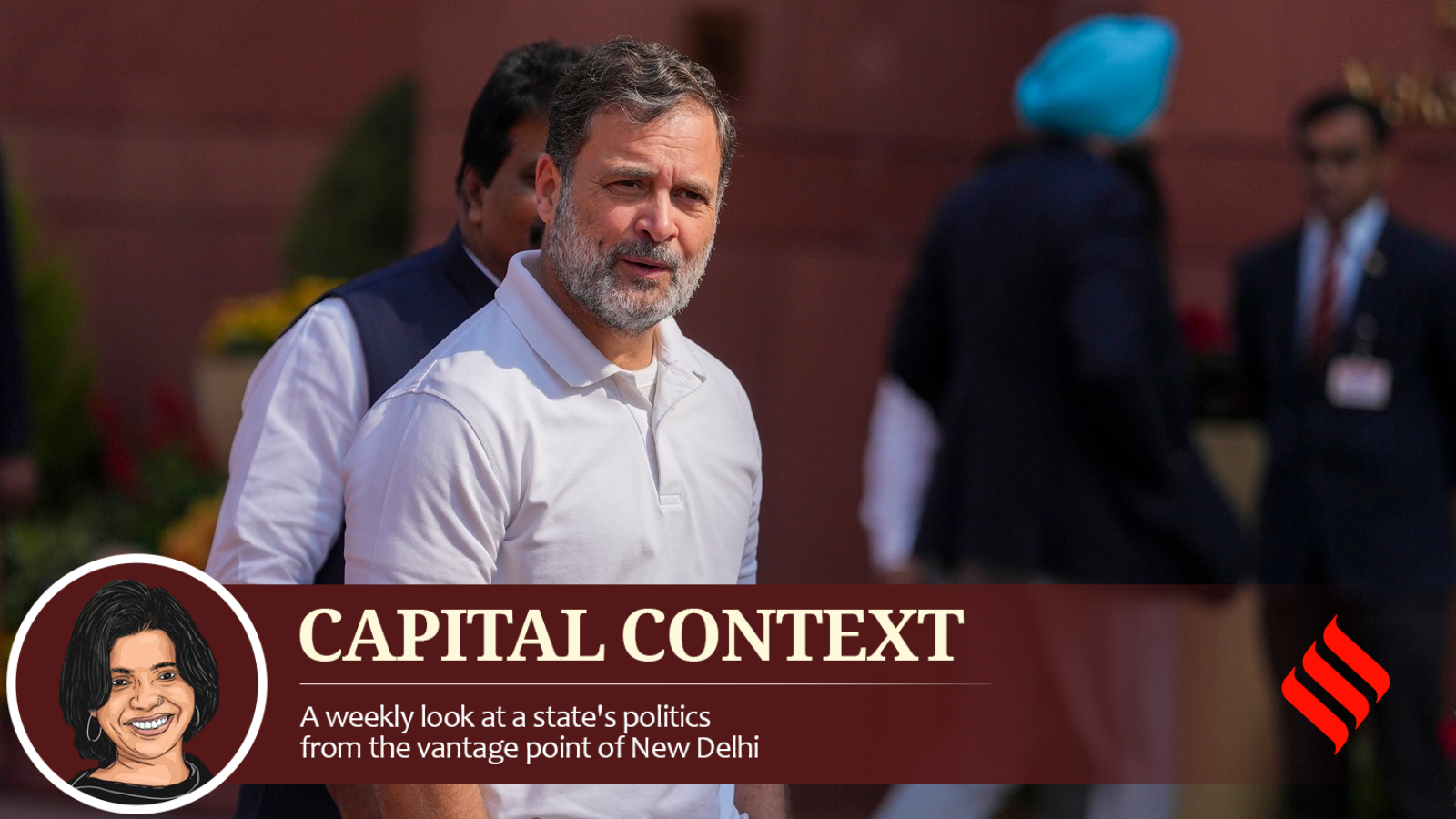
The results of the recent Assembly election have opened up an opportunity for the BJP to weaken the Congress, which had shown signs of revival in the 2024 Lok Sabha elections, and undercut Leader of the Opposition (LoP) Rahul Gandhi.
BJP sources said the BJP’s political strategy since the 2024 Lok Sabha election has been aimed at isolating and systematically weakening the Congress, eroding its traditional support bases, and diminishing Gandhi’s political influence. Critics, however, argue that these aggressive moves stem from the BJP’s disappointment with its below-expectation performance in the last Lok Sabha polls.
The party’s resolve to expand its parliamentary strength intensified further after the government suffered a significant setback in April when the Lok Sabha defeated the Constitution (One Hundred and Thirty-First Amendment) Bill, 2026, BJP leaders said.
With the Uddhav Thackeray-led Shiv Sena (UBT) heading towards a split — at least two-thirds of the party’s Lok Sabha MPs are expected to merge with the Shiv Sena led by Maharashtra deputy Chief Minister Eknath Shinde — the BJP may be moving closer to securing the number required for pushing through key Constitutional amendments. In recent times, both the Trinamool Congress (TMC) and the Aam Aadmi Party (AAP) have witnessed groups of MPs breaking away, with some extending support to the NDA and others joining the BJP. The DMK, which has 22 MPs in the Lok Sabha and has distanced itself from the INDIA bloc, is also learnt to be considering issue-based support to the BJP-led government at the Centre.
In the 543-member Lok Sabha, the BJP-led NDA already has 293 MPs and the newly formed bloc of 20 TMC MPs has also declared support to the alliance. With the current strength of the Lower House being 540, the two-third mark is 360.
Some cautious
A section in the BJP is, however, cautious that the fragmentation of regional parties could be perceived by voters as the result of the BJP using its political influence and resources to engineer splits. Such developments, they argue, may not necessarily translate into corresponding gains on the ground.
However, a few other leaders pointed out that the Congress’s rise from 44 seats in 2014 to 52 in 2019 and 99 in the current Lok Sabha was driven substantially by alliances with strong regional parties.
Claiming that the political churn was triggered by the Assembly results, a senior BJP leader said that the 2026 elections prompted the regional parties to rethink their future in the shadow of the Congress, whether consciously or otherwise.
“If one goes by simple arithmetic, the vote bases of the Congress and the Samajwadi Party (SP) in Uttar Pradesh, the TMC in West Bengal, the DMK in Tamil Nadu, and the Shiv Sena (UBT) in Maharashtra overlapped because they were united on an anti-BJP platform. The Congress could increase its Lok Sabha tally to 99 largely because of support from allies in Uttar Pradesh, Maharashtra and Tamil Nadu,” the leader said.
“The upward trajectory that the Congress highlights is not necessarily evidence of a return to its dominant position. Gandhi’s political momentum after the Bharat Jodo Yatra was aided by support from INDIA bloc partners. So the BJP will naturally draw attention to that support if it begins to weaken,” the leader said.
Sources in the BJP acknowledged that much of the party’s strategy since 2024 has focused on Gandhi and on politically isolating the Congress. While Prime Minister Narendra Modi has consistently targeted the Congress in his speeches, party strategists have also sought to corner the party both inside and outside Parliament. Gandhi remains the principal focus of the BJP’s political attacks.
At a recent event in Bengaluru, Modi sharpened his criticism of the Congress. “The Congress’s identity now is that of a parasite party. At the first opportunity, it will betray even its allies. It needs another party to piggyback on to remain relevant. They are blaming the whole world for their electoral losses — the Constitution, democracy, Constitutional processes and the courts. In my public life, I have never seen a mainstream party behave this way,” he said.
Modi was referring to the Congress’s decision to part ways with the DMK, one of its oldest allies and a key constituent of the INDIA bloc, and join hands with the Tamilaa Vettri Kazhagam (TVK) led by actor-politician Joseph Vijay to form the government in Tamil Nadu after the recent Assembly elections.
The BJP argues that it has not abandoned its coalition partners, despite instances of allies leaving the NDA, whereas the Congress, it claims, sidelines alliance partners when political power is at stake.
The BJP also believes that Gandhi is increasingly relying on southern India to sustain the Congress’s political relevance. As part of its strategy for the 2029 Lok Sabha elections, the BJP will look to redouble its efforts in the South, especially in Karnataka and Telangana.
“By being in power in Karnataka and Telangana, winning in Kerala and securing a share in power in Tamil Nadu, Gandhi believes the Congress is the only national party with a strong presence in the South. The BJP has to challenge that perception if it wants to expand its pan-India support base,” said a BJP leader from the region.
View original source — Indian Express ↗
Related stories

Antara News
PoliticsJun 22, 2026 · 1 min
Gibran pushes development of Asmat museum as cultural showcase
Antara News

Antara News
PoliticsJun 22, 2026 · 1 min
VP supports Asmat sago school to boost local food
Antara News

Philippine Daily Inquirer
PoliticsJun 22, 2026 · 1 min
Senate security gearing up for Sara Duterte impeachment trial
Philippine Daily Inquirer

Bangkok Post
PoliticsJun 22, 2026 · 1 min
US and Iran conclude high-level talks in Switzerland, mediators say
Bangkok Post