Indian Express
Indian Express··8 min read
BluSmart’s shutdown left a vacuum in Delhi’s EV cab market.
For months after the ride-hailing service BluSmart shut down, Arjun Pratap Chauhan continued to make the same small mistake. Before leaving home in Delhi, the 24-year-old musician would unlock his phone, type the company’s name into the search bar and only then remember that there was no car to book.
The app had become a habit. If he was meeting friends in Gurgaon or heading anywhere across the city for dinner, he would reserve a ride in advance and expect, with little thought, that it would arrive. What he misses now is not the electric vehicles that helped make BluSmart one of national capital’s most recognisable mobility startups.
It is the certainty. “The cars were cleaner. Drivers cancelled less often,” Arjun said. “I haven’t found anything that works the same way.”
In April 2025, Blusmart suspended operations after allegations of fund diversion surfaced around related party entity Gensol Engineering. More than a year later, Arjun says he still hasn’t found a replacement. “I don’t mind paying Rs 100 extra,” he said. “I just haven’t found something that works like Blusmart.” His complaint is not unusual.
In Delhi-NCR, Blusmart’s shutdown left behind more than idle electric vehicles and displaced drivers. It also left behind customers who had grown accustomed to a more reliable ride experience. And yet, industry insiders say, no new entrant in the NCR has emerged as a clear successor. Industry insiders say replacing Blusmart has proven more difficult than simply launching another electric cab fleet. Part of the challenge is operational: inconsistent charging infrastructure and the complexity of running tightly controlled fleets.
But executives and analysts also point to a larger business problem – maintaining that level of service, in NCR, requires significant investment, and scaling it sustainably remains difficult.
The contenders
For some founders, Blusmart’s exit created space to build something new.
Sahil Jindal, Managing Director of the DS Jindal group, says he had explored entering the EV cab business for nearly two years but held back while BluSmart dominated the market.
Instead, he and his associates briefly considered moving upmarket into luxury mobility before shelving the idea. BluSmart’s shutdown changed that.
“That is when I thought this is the right space,” he said. “There was a complete vacuum in the market.” Soon after, Sahil launched Trevel, an electric cab company. Today, Trevel operates 25 electric cabs in Gurgaon and plans to deploy 20,000 vehicles over the next five years.
Others, too, have placed their bets on the market. The largest bet so far has come from Refex Mobility, a Chennai-based fleet operator led by Anirudh Arun, the former chief executive at BluSmart. Refex operates roughly 2000 cars across India; 1600 of them are electric.
Lakshmi Kumari drives her electric cab. (Express Photo: Gajendra Yadav)
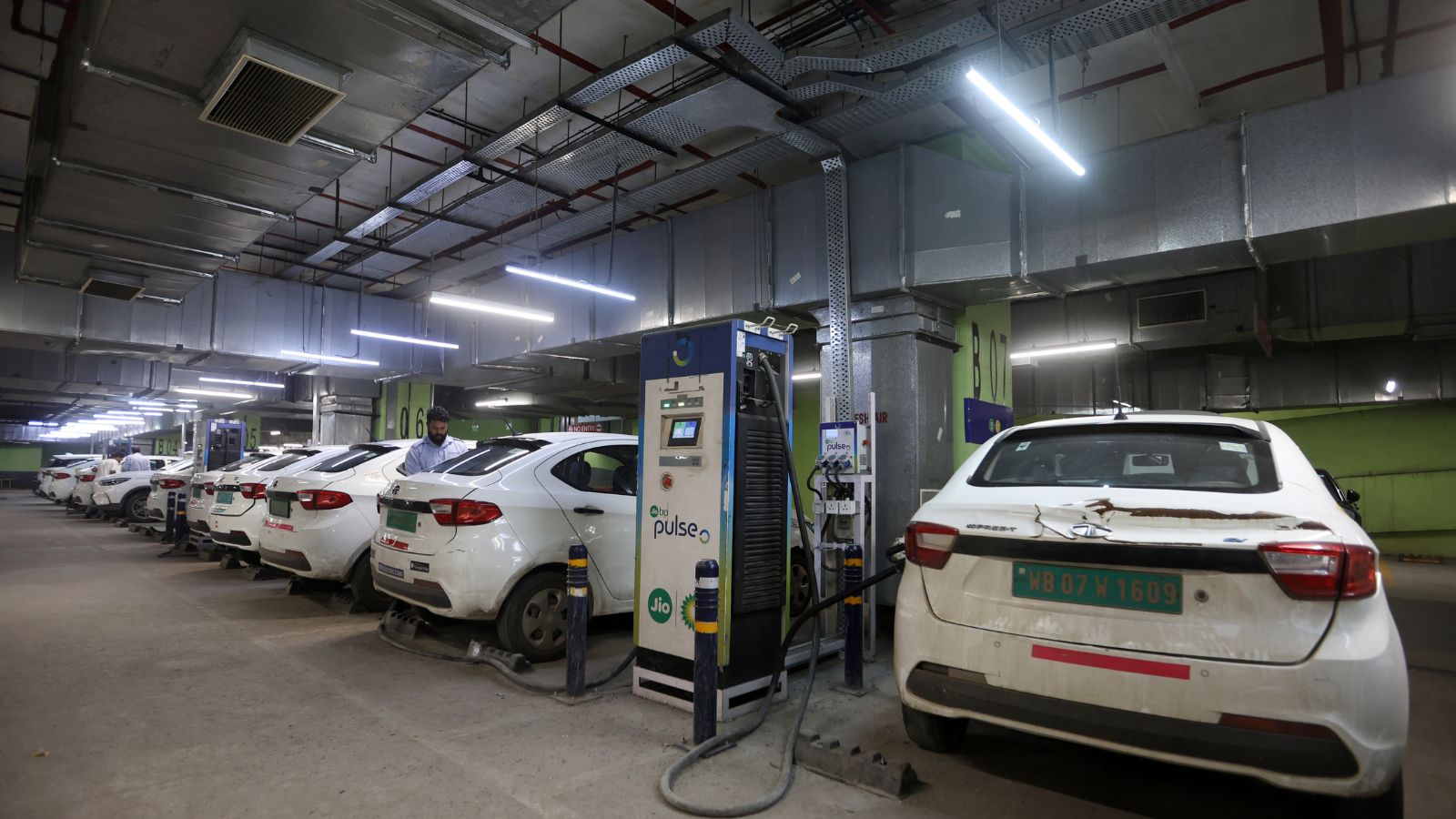
One afternoon in Gurgaon, at an underground charging hub beneath a shopping complex in Sector 29, drivers gathered beside rows of plugged-in electric vehicles waiting for their next assignments. Among them was Kapil, who, like most of his fellow drivers, fleet managers, and the CEO, worked at Blusmart.
Work has been slower than he expected. “I do only two or three rides a day right now,” he said. The lower number of rides Kapil and other drivers complete is a deliberate choice. Rather than compete immediately for every consumer booking, Refex, Anirudh says, has concentrated on transporting office (B2B) employees along fixed routes.
For electric vehicles, predictability matters. A taxi stranded with a depleted battery can disrupt an entire chain of rides. Scheduled corporate commutes are easier to manage than the uncertainty of on-demand travel across the sprawling NCR.
“When we had thousands of cars at BluSmart, if one vehicle ran out of charge, another nearby could take over the booking,” Anirudh said. “Today we don’t yet have that scale.” However, Refex has now started offering on-demand rides but only on a small scale for now.
For customers like Arjun, however, this new EV fleet makes little difference. That may change soon, though: another fleet operator, which launched in Delhi-NCR just a few weeks ago, could soon become available to customers like him.
Vietnamese green-mobility company Green SM entered India’s cab-hailing market earlier this month with a fleet of 1,000 turquoise electric SUVs in Delhi-NCR.
India becomes the company’s fifth market after Vietnam, Laos, Indonesia, and the Philippines. At a launch event held on June 5, Manoj Ravikanti, Green SM India’s Chief Operating Officer, outlined a more consumer-facing approach. “We will get around 80% of our commuters directly, while getting the remaining through B2B tie ups and partnerships,” he said.
The arrival of a global player suggests that confidence in electric mobility has not disappeared with BluSmart. “Delhi represents India with all of its diversity. We want to test our model and stabilize our operations here, after which we will look at other markets,” Manoj said.
Industry insiders say that Green SM entered with 1,000 vehicles from the outset because scale itself is part of its strategy to attract customers. “It is important for people to see your cars on the road to build a customer base, and for that, you need scale,” says Shyamasis Das, who works on electric mobility at Delhi-based think-tank Centre for Social and Economic Progress (CSEP).
Why replacing BluSmart is harder than it looks
The problem, industry insiders say, was never finding customers. The problem was everything that happened after a customer pressed ‘Book’. For years, ride-hailing companies in India have relied on a relatively simple arrangement: drivers supply their own vehicles, platforms supply passengers, and fuel stations are rarely more than a few minutes away.
Electric fleets change that equation. “EV operations are not as straightforward as they seem,” Anirudh says. “Consider a cab dispatched to Noida, where charging options may be sparse. If the vehicle runs low on battery mid-route, the disruption affects not just the driver but the rider as well.”
Charging remains another constraint for electric mobility, experts say. Unlike ICE vehicles, EVs spend longer off the road to recharge, limiting daily trips and, in turn, earnings.
“Operations have to be planned to maximise bookings and minimise non-revenue kilometres, such as trips to charging stations. EVs need to be used as much as possible: while they cost more upfront than petrol or CNG cars, their running costs are lower,” Shyamasis says.
Uber and Rapido did not respond to queries about their electrification efforts. The obstacles are also partly technological and financial, industry insiders point out.
Platforms such as Uber and Rapido largely rely on drivers bringing their own vehicles and using the app to find customers. BluSmart took the opposite approach, owning or leasing vehicles in an effort to standardise maintenance and customer experience.
“In the West, many Uber drivers work part-time and treat their car as a personal asset, so they maintain it well,” said Anmol Sharma, founder of Naviget, a new EV-first ride-hailing startup. “In India, drivers often depend entirely on the vehicle for income, which can lead to heavy usage and less maintenance.”
To deliver a more consistent service, BluSmart retained control of its fleet. Ownership gave the company tighter control over quality, said Shivani Palepu, senior principal analyst at Gartner, adding that such operators rely on strict technological and operational checks to maintain their vehicles.
Companies also tend to own EVs because high upfront costs and uncertainty over battery life make drivers less likely to buy them, Anirudh said.
But ownership creates another problem. Buying and maintaining vehicles requires significant capital expenditure. “Quality of service generally diminishes as you scale, so that will have to be tightly controlled,” Shivani said. Even operators that entered the electric cab market while BluSmart was still active have expanded cautiously.
Vikas Bardia, founder of Shoffr, a Bengaluru-based electric taxi company which runs around 90 cars in Delhi-NCR and around 160 in Bengaluru and Hyderabad, said the company does not want to be the biggest player. “Our focus is on solving underlying challenges – building a dependable pipeline of drivers, improving operational efficiency and developing our own servicing and technology capabilities as we grow,” Bardia said.
Anmol says there is a third option: don’t own the cars – partner with fleet owners instead. “Owning a vehicle is very expensive, and then you have to deal with wear and tear on these expensive assets. This is also where Blusmart was wrong,” he says.
Anmol argues that fleet operators should own the vehicles while technology companies focus on setting standards and supplying demand. His company works with fleet partners, providing training protocols, maintenance requirements and bookings through its platform.
Whether that model succeeds remains uncertain. The company is still small, completing only a handful of rides each day. As new startups continue trying to solve the riddle of scaling the BluSmart model without bleeding cash, for many drivers, meanwhile, the disruption has proved more enduring.
The people left behind
Three years ago, when Lakshmi Kumari was handed the keys to a Tata Tigor. At the time, she was among the first women recruited by BluSmart. For Laxmi, then in her early twenties, the position offered something she had rarely experienced before: predictability. She could plan her finances. She could continue her studies. “Everything was going so well,” she recalled. “Customers were respectful, and I was earning more than other cab drivers.”
Then came the allegations that engulfed the company.
When news of the crisis began spreading in April 2025, Laxmi initially struggled to believe it. In the weeks that followed, she found herself on the phone with other women drivers, exchanging job leads.
What happens now?
The answer arrived slowly. “Some drivers left the industry altogether. Others moved between employers searching for work,” she recalls. Eventually, Laxmi heard that former BluSmart employees were being hired by Refex. She joined months later.
The job restored a measure of stability.“However, pay was lower. The hours were longer,” she says. By then, Laxmi had completed her undergraduate degree and enrolled in a master’s program in public administration. Balancing work and study became increasingly difficult.
“Drivers were expected to work fixed 12-hour shifts; taking more than one day off beyond the required 26 working days in a month meant a deduction of Rs 1,000,” she says.
Over time, the schedule began to compete with her studies. In December, she left again – this time for Giriraj Mobility Services, where the pay is lower but the hours are easier to manage.
“The salary is the lowest here,” she said, “but I have more freedom.”
What Laxmi misses is not simply a former employer, but the stability BluSmart briefly provided. She is not alone. Hundreds of former drivers are still rebuilding after the company’s collapse. And many, like Laxmi, are still waiting to see whether anyone can fill the vacuum BluSmart left behind.
View original source — Indian Express ↗
Related stories

ESPN
SportsJun 22, 2026 · 1 min
Salah leads rally as Egypt get first-ever WC win
ESPN

ESPN
SportsJun 22, 2026 · 1 min
Latest NBA buzz: Everything we're hearing ahead of...
ESPN

ESPN
SportsJun 22, 2026 · 1 min
NBA trade tracker: Thunder send Aaron Wiggins to H...
ESPN
TASS
SportsJun 22, 2026 · 1 min
Egypt claims first-ever World Cup match victory with win over New Zealand
TASS