Indian Express
Knowledge Nugget: Why are the Western Ghats back in headlines?
Take a look at the essential events, concepts, terms, quotes, or phenomena every day and brush up your knowledge. Here’s your UPSC Current Affairs knowledge nugget for today on Western Ghats.
Twelve years after it issued the first draft notification, the Centre is finally ready to finalise and notify the demarcation of Ecologically Sensitive Areas (ESA) in the Western Ghats region, at least in the three states in which contentious issues have more or less been resolved, The Indian Express has learnt.
In this context, let’s know about the Western Ghats and its significance.
1. Over 56,000 square km of land in six states are proposed to be demarcated as ESA, based on the 2013 recommendations of a high-level working group led by former ISRO chairman K Kasturirangan.
2. Activities like new mining and quarrying projects, setting up of thermal power plants, operation of most-polluting red-category of industries, new and expansion projects of buildings and construction with a built-up area of 20,000 square metres or above, are proposed to be completely banned or heavily restricted.
3. The Centre’s original draft notification had come in 2014, and has undergone five revisions since then, but disagreements with the state governments on the areas earmarked for declaration as ESAs within their jurisdictions have not been fully resolved. Even now, the states of Kerala and Karnataka have been holding out. Kerala wants its own area to be further reduced, while Karnataka has been continuing to question the entire exercise.
What is ESA?
The ESA is buffer areas demarcated around protected areas to minimise the negative impact of anthropogenic activities such as mining, hydropower projects, etc.
4. Gujarat, Goa and Maharashtra are the states where the areas to be demarcated are almost agreed upon, top officials from the Environment Ministry said. Tamil Nadu, the sixth affected state, does not have any major divergences on this issue.
Story continues below this ad
5. Though the negotiations with Kerala and Karnataka are continuing, the Centre is learnt to be preparing to notify the ESA in the states where an agreement on this issue has either been achieved, or is close to being finalised. This is different from the previous attempts in which the Centre had issued draft notifications for ESAs in all the states together.
6. A final notification, when it happens, will give more legal teeth for protecting the fragile biodiverse area of the Western Ghats under the Environment Protection Act, 1986, and prohibit activities that threaten the sensitive environment of the region.
What is the ecological significance of Western Ghats?
1. Western Ghats are among the four of the world’s 36 biodiversity hotspots located in India. The other three biodiversity hotspots are the Himalayas, the Indo-Burma region, and the Sundaland.
2. Older than the Himalaya mountains, the 1,600 km long Western Ghats mountain chain was recognised by the United Nations Educational, Scientific and Cultural Organisation (UNESCO) as one of the world’s eight hotspots of biological diversity in 2018.
Story continues below this ad
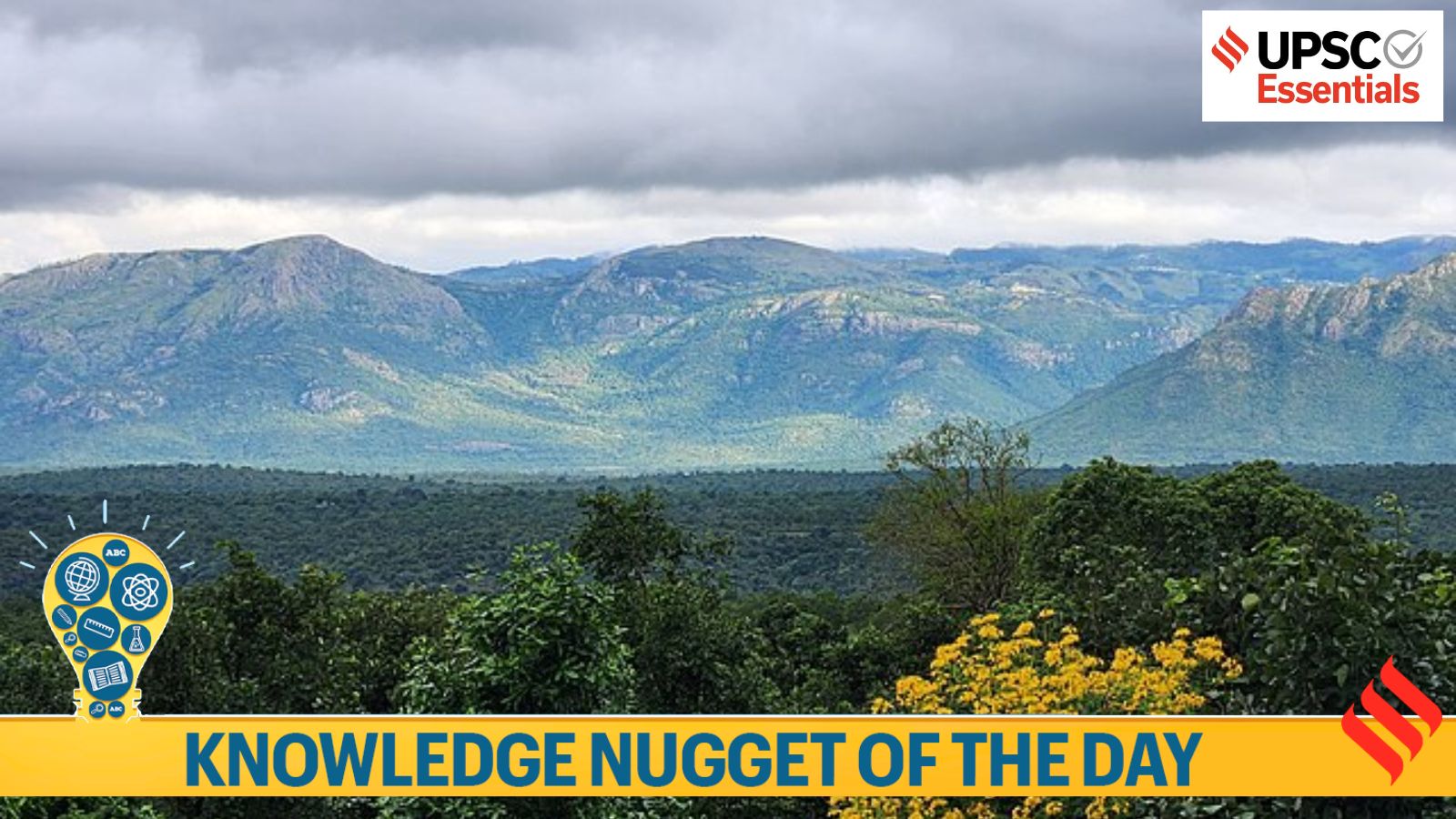
3. The Western Ghats, also known as the Shayadari hills, hold immense ecological and biodiversity value, making them one of the most critical natural assets of India and the World. The region has outstanding universal value due to its exceptional biodiversity, endemism, and its role in maintaining vital ecological and climatic processes.
4. It stretches along the western coast of the Indian peninsula, spanning six states – Gujarat, Maharashtra, Goa, Karnataka, Kerala, and Tamil Nadu.
5. Ecologically, the Western Ghats serve as a crucial climatic regulator for peninsular India. Acting as a barrier to the South-West monsoon, the range ensures high supporting lush forests and numerous rivers that sustain millions of people.
The Western Ghats are home to diverse ecosystems, threatened species.
6. The Ghats are also home to diverse ecosystems, including tropical evergreen forests, grasslands, Myristica swamps, and the distinctive shola forest. These ecosystems harbour a wide variety of flora and fauna, many of which are endemic.
Story continues below this ad
7. Western Ghats are the habitat for several threatened species, such as lion-tailed macaque, Nilgiri Tahr, and tiger.
8. It is the source of several west-flowing rivers such as Krishna, Godavari, Cauvery, Mandovi, Periyar and Sharavathi, giving it the tag of the water tower of peninsular India.
BEYOND THE NUGGET: Committees on the Western Ghats
1. Efforts to demarcate ecologically sensitive areas within the Western Ghats began in 2010 with the formation of the Madhav Gadgil committee. Gadgil, one of India’s best-known ecologists, submitted his committee’s report in August 2011 and recommended that the entire area of Western Ghats, a total of 129,037 square km of land, be declared as ESA, with varying degrees of restrictions on activities based on relative fragility.
2. Following protests by every affected state, the Centre referred the report to a high-level working group led by former ISRO chairman K Kasturirangan in August 2012.
Story continues below this ad
3. After a ground-truthing exercise, the Kasturirangan panel suggested that an area of about 60,000 square km be declared as ESA. This was based on the categorisation of ‘natural landscapes’ which largely represented a contiguous band of vegetation over 1,500 km of the Ghats, as opposed to ‘cultural landscapes’ which were already dominated by human settlements, agriculture, plantations.
Post Read Questions
(1) Consider the following statements: (UPSC CSE 2017)
1. In India, the Himalayas are spread over five States only.
2. Western Ghats are spread over five States only.
3. Pulicat Lake is spread over two States only.
Which of the statements given above is/are correct?
(a) 1 and 2 only
(b) 3 only
(c) 2 and 3 only
(d) 1 and 3 only
Q2. ‘Gadgil Committee Report’ and ‘Kasturirangan Committee Report’, sometimes seen in the news, are related to (UPSC CSE 2016)
(a) constitutional reforms
(b) Ganga Action Plan
(c) linking of rivers
(d) protection of Western Ghats
Answer Key
1. (b) 2. (d)
(Sources: Exclusive: 13 years later, protection for Western Ghat areas in 3 states almost ready, Why Western Ghats are classified as natural site of ‘significant concern’ )
Story continues below this ad
🚨 Click Here to read the UPSC Essentials magazine for June 2026. Share your views and suggestions in the comment box or at [email protected]🚨
Subscribe to our UPSC newsletter. Stay updated with the latest UPSC articles by joining our Telegram channel – Indian Express UPSC Hub, and follow us on Instagram and X.
View original source — Indian Express ↗
Related stories

The New York Times
TechnologyJun 22, 2026 · 1 min
A Loophole Brings Cystic Fibrosis Patients a ‘Miracle Drug’ in Generic Form
The New York Times

TechRadar
TechnologyJun 22, 2026 · 1 min
Amazon just dropped the price on HP printers ahead of Prime Day — and the free ink perk makes them an absolute steal
TechRadar

The Next Web
TechnologyJun 22, 2026 · 1 min
China’s green-power target for AI data centres runs into the grid
The Next Web

Lovin Malta
TechnologyJun 22, 2026 · 1 min
Watch: ‘It’s Busy For A Reason’ – Travel Instagrammer Defends Comino Against Overtourism Complaints
Lovin Malta