Indian Express
Indian Express··6 min read
Eye treatment blinds man in one eye, 15-year legal battle ends in Rs 5 lakh payout
Presiding member Dr Inder Jit Singh and member Justice Dr Sudhir Kumar Jain were hearing a revision petition filed by one Rakesh Kumar Shukla against Alok Eye Health and Optical Centre, challenging the orders of the district and state consumer commissions, which had earlier denied him relief.
“The act of prescribing allopathic medicines by a person not possessed of a recognised medical qualification and not registered under the Indian Medical Council Act, 1956, constitutes deficiency in service and negligence by operation of law,” the national consumer commission said on June 13.
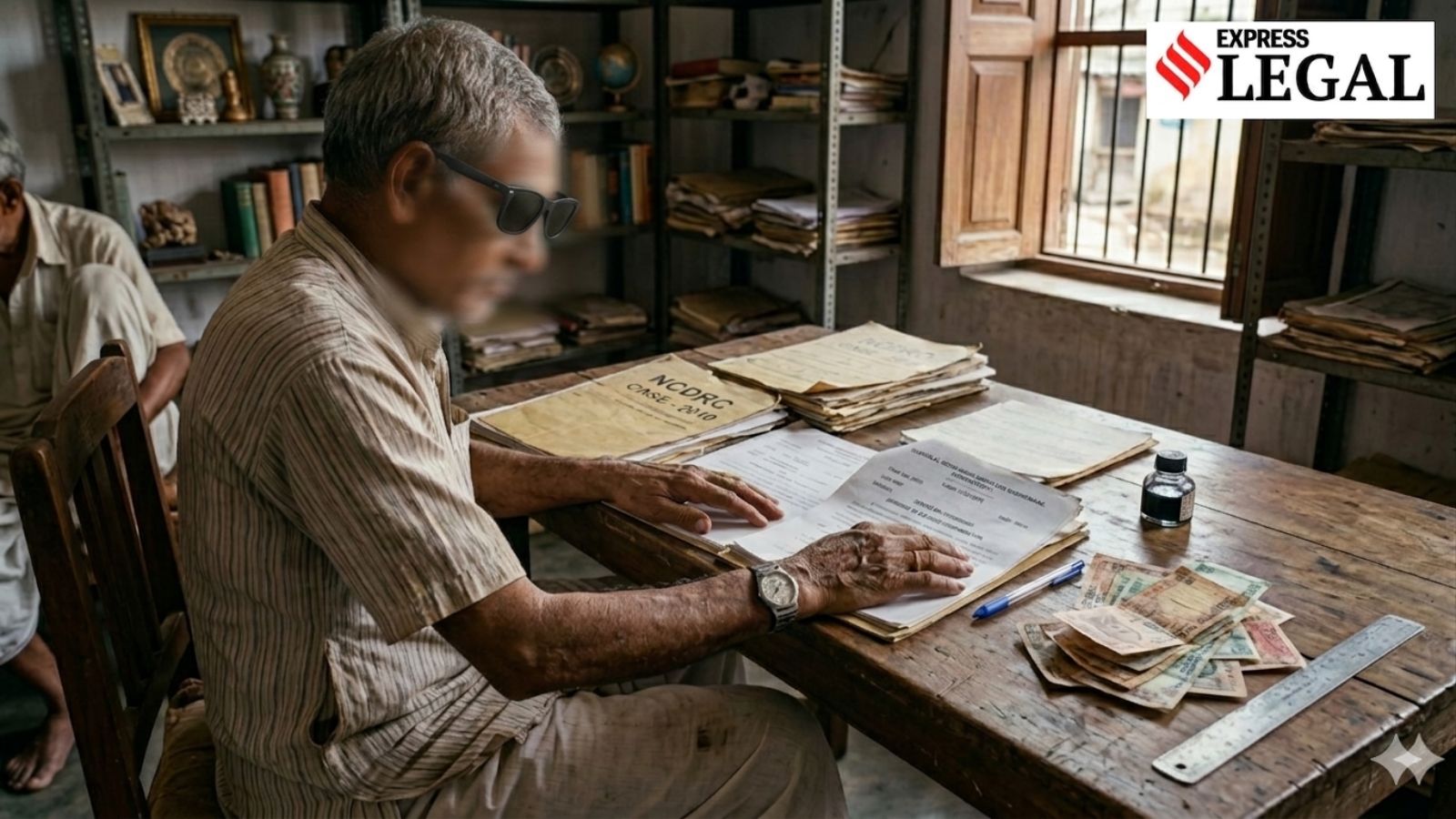
Petitioner’s left eye turned red on June 9, 2010 and the next day, he visited Alok Eye Health and Optical Centre in Shravasti, Uttar Pradesh, for treatment. (Image generated using AI)
Total payout
The centre was directed to pay Rs 2 lakh as compensation, along with 9 per cent simple annual interest from the date of filing of the complaint and Rs 20,000 towards litigation costs.
Given that the consumer complaint was filed in 2011 and the order was passed in 2026, the interest component alone is likely to exceed Rs 2.7 lakh, taking the total liability to around Rs 4.9 lakh.
Red eye complaint turned into loss of vision
According to the case record, Shukla’s left eye turned red on June 9, 2010. The next day, he visited Alok Eye Health and Optical Centre in Shravasti, Uttar Pradesh, for treatment.
He alleged that the respondent examined him, prescribed medicines and eye drops, prepared a handwritten prescription and charged Rs 500 in cash for consultation and treatment.
However, instead of improving, his condition allegedly deteriorated rapidly.
Story continues below this ad
The complaint stated that on June 11, 2010, Shukla travelled to Bahraich and consulted eye specialist Dr A K Mishra, who diagnosed a severe infection. On June 19, 2010, he sought a second opinion from another eye specialist, Dr Kishan Lal, who also found the eye to be badly infected.
As the condition worsened, Shukla was admitted to Dr Rajendra Prasad Eye Centre, New Delhi on July 10, 2010. Despite treatment, he permanently lost vision in his left eye. He claimed to have spent around Rs 2 lakh on medical treatment.
In 2011, he approached the consumer forum seeking compensation of Rs 5 lakh, reimbursement of medical expenses, interest and damages for the loss suffered.
Optical centre denied allegations
The optical centre denied all allegations of negligence.
Story continues below this ad
It claimed that Shukla had actually visited the establishment to get spectacles made and that he was found to have only a minor refractive error. According to the respondent, the medicines prescribed could not have caused the alleged damage.
The respondent also denied charging any consultation fee and argued that Shukla could not be treated as a consumer under the Consumer Protection Act because there was no proof of payment.
It further contended that the loss of vision was not linked to any treatment provided by the optical centre.
The respondent maintained that the complaint was based on false and unsubstantiated allegations and sought its dismissal.
Story continues below this ad
District forum dismissed complaint
The District Consumer Disputes Redressal Forum, Shravasti, dismissed Shukla’s complaint on January 31, 2017.
While the forum noted that the respondent did not possess the qualifications required to prescribe allopathic medicines, it held that Shukla had failed to prove payment of consideration for the services. As a result, it concluded that he was not a “consumer” under the Consumer Protection Act and dismissed the complaint.
The forum, however, observed that he could pursue remedies before another competent court under other legal provisions.
State commission also refused relief
Aggrieved by the dismissal, Shukla filed an appeal before the Uttar Pradesh State Consumer Disputes Redressal Commission.
Story continues below this ad
In October 2024, the state commission upheld the district forum’s decision and dismissed the appeal, forcing Shukla to approach the NCDRC through a revision petition.
Before the national commission, Shukla argued that both lower forums had failed to examine the most important issues in the case, including whether the respondent was legally qualified to prescribe medicines and whether such treatment led to the loss of his eyesight.
He also contended that consumer forums had overlooked evidence showing that the respondent had examined him, prescribed medicines and accepted payment for treatment.
Serious errors in district, state commission orders
The NCDRC agreed that serious errors had been committed by the district and state commissions.
Story continues below this ad
The commission observed that the district forum had dismissed the complaint solely on the issue of maintainability without deciding the core allegations relating to medical negligence, deficiency in service and unauthorised medical practice.
It further noted that the state commission had effectively accepted Shukla as a consumer by treating his affidavit regarding payment of Rs 500 as sufficient proof. However, despite doing so, it failed to adopt the legally correct approach.
The national commission held that once the state commission accepted the existence of a consumer relationship, it ought to have properly addressed the substantive issues involved in the dispute.
Diploma holders can’t prescribe allopathic medicines
The commission referred to the Indian Medical Council Act, 1956, the National Medical Commission Act, 2019 and the Supreme Court‘s judgment in Baharul Islam & Others vs Indian Medical Association & Others delivered on January 24, 2023.
It said that only persons possessing recognised medical qualifications and registration under the relevant laws are legally entitled to practise modern medicine and prescribe allopathic drugs.
According to the NCDRC, even if the respondent possessed a diploma in optometry or a related field, such a qualification did not confer any legal authority to prescribe allopathic medicines.
The commission said the state commission’s finding that a diploma holder could prescribe allopathic medicines was contrary to central legislation and settled law laid down by the Supreme Court.
“The diploma in optometry or any allied field does not confer any statutory authority or entitlement to prescribe allopathic medicines,” the commission observed.
Rs 2 lakh compensation awarded
After examining the record, the commission concluded that the state commission’s order could not be legally sustained.
Story continues below this ad
Allowing the revision petition, the NCDRC directed the respondent to pay Rs 2 lakh as compensation for the injuries suffered by Shukla due to the negligent acts of the respondent.
It also awarded simple interest at 9 per cent per annum from the date of filing of the complaint until realisation, along with Rs 20,000 towards litigation costs.
The commission held that the respondent’s prescription of allopathic medicines, despite lacking the legally recognised qualifications, amounted to negligence and deficiency in service.
Consumer takeaway
The ruling is a reminder that consumers should verify the qualifications of individuals providing medical treatment, especially when medicines are being prescribed.
Story continues below this ad
Patients should preserve prescriptions, bills, receipts and medical records, as these documents can become crucial evidence if a dispute arises later.
The judgment also reinforces that professionals cannot operate beyond the scope of their qualifications.
Even where a practitioner possesses a diploma in a related field, that qualification does not automatically authorise the prescription of allopathic medicines.
For consumers, the decision underscores that unauthorised medical treatment can attract liability under consumer protection laws.
For consumer-related grievances, individuals may contact consumer helpline in their respective states or call the National Consumer Helpline at 1915 for assistance.
View original source — Indian Express ↗
Related stories

The Punch
NewsJun 22, 2026 · 1 min
LAUTECH doctors urge Makinde to disburse training fund, pay arrears
The Punch
The Punch
PoliticsJun 22, 2026 · 1 min
S’Korea ex-justice minister jailed 25 years over martial law disaster
The Punch
The Punch
PoliticsJun 22, 2026 · 1 min
South-West APC hails Ekiti voters over Oyebanji’s re-election
The Punch
The Punch
NewsJun 22, 2026 · 1 min
You were my anchor when my mother died, Alex Ekubo’s wife pens tribute
The Punch