Dawn
UK PM Starmer announces resignation amid mounting pressure, says will give successor 'full, unequivocal support'
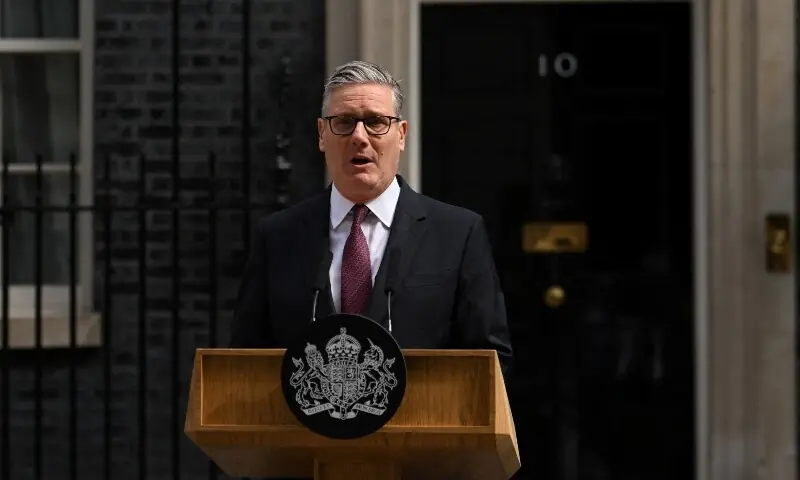
Prime Minister Keir Starmer on Monday resigned from his position, paving the way for Britain’s seventh leader in a decade.
Addressing the press outside 10 Downing Street, Starmer said he would accept his party’s decision with “good grace”, and would extend his unequivocal and full support to his successor.
“Every decision I have taken has been about putting the country I love first, and that is why I will resign as leader of the Labour Party.”
He added that he informed Britain’s King Charles III of his decision in the morning.
Starmer said he had asked the Labour Party’s National Executive Committee to set out a timetable opening on July 9 and completed by the summer recess.
“In the case of a contest, this will ensure a new leader is in place before parliament returns in September,” he said, stating that he will remain in post as prime minister “until a contest is complete”.
“I will do everything I can to ensure an orderly handover of power,” he added.
Starmer’s main rival, veteran politician Andy Burnham, is due to be sworn in as a member of parliament on Monday after winning a crucial special election on Thursday, allowing him to return to parliament and clearing his path to run for party leader.
At the outset of his press briefing, Starmer said that being elected as a Labour PM two years ago was the “proudest moment” of his life.
“A new Labour government in 14 years, a page in our country’s history turned after years of disappointment and despair, the chance to change the lives of millions of people for the better,” he said, citing it as the reason he entered politics.
“Six years ago, I inherited a Labour Party that was politically, financially and morally bankrupt,” Starmer said, recalling that he was told, “time and time again that my party was finished”.
“That we were consigned to history and that the majority of the general election, let alone a landslide majority, was not possible,” he said; however, he stressed that the critics were proved wrong as the party went through a transformation.
“We changed our party, ripping out anti-semitism, restoring trust in the economy, defence, national security and becoming a party that once again stood proudly with, not against, our national flag,” Starmer said.
He said the reform was brought about with a “singular purpose”, which was to “change Britain for the better, to build a fairer country, with dignity and respect where everyone is seen, everyone is valued and wealth and opportunity for all, not just a privileged few”.
Starmer stated that in the past two years, his government had achieved a robust economy and increased wages against inflation “every single month”.
“Investments secured, infrastructure being buil, an end to austerity with the fastest fall in NHS waiting lists for 17 years, the biggest improvements in rights for workers and renters in a generation, the biggest uplift in defence spending since the cold war, small boat crossings falling, asylum hotels closing, protecting young people from social media, and half a million children being lifted out of poverty because of the choices I made,” Starmer said, as he recalled his government’s achievements.
He said under his tenure, the country’s global reputation had been restored.
“Change promised by a Labour government, change fought for by a Labour government, and change delivered by a Labour government.”
He admitted that his party was asking “whether he was best placed” to lead them to the next general election.
“I have heard the answer of my parliamentary party to that question, and I accept that answer with good grace,” he said as he announced his decision to step down.
Extending his “unequivocal support” to his successor, Starmer said the next PM will inherit a country “far stronger and fairer than the one I inherited two years ago”.
He expressed hope that his successor will be ready for challenges and ensure a second term in office for the Labour Party.
“I want to thank all of those friends and colleagues who have been by my side for these past six years or so. For their incredible commitment, service and support,” Starmer said.
Concluding his speech, the UK PM thanked his family and expressed hope to spend more time with them.
“When I leave the biggest job in the country, I shall spend more time on the most important job: being the best husband I can to my fantastic wife [..] who has been a rock by my side through good times and bad and being the best dad I can to my beautiful children who are my pride and my joy.”
Less than two years after Starmer won a landslide election victory that promised to end Britain’s chaotic politics, one source said he had spent the weekend considering whether to step aside or fight a leadership contest.
“Keir likes to think about things,” said the source on condition of anonymity.
Pressure building for months
The threat to Starmer, which has been building for months, increased sharply on Friday when Burnham, the Greater Manchester mayor, decisively won a parliamentary election to return to Westminster, beating a candidate from Nigel Farage’s Reform UK party, which has led national opinion polls for more than a year.
That victory gave hope to Labour lawmakers that Burnham, a career politician known for his communication skills, could transform the fortunes of a party that has lost support under Starmer, whose popularity ratings have sunk to the lowest for any British leader.
But the widely expected change of leader is not without risk. Beyond saying that the country needs fundamental change and to bring down the cost of living, Burnham has yet to make clear his approach to foreign affairs, the economy and defence.
Like Starmer, he could find he has little room to manoeuvre, hemmed in by bond market investors opposed to any additional borrowing, and confronted by an angry electorate who believe the country is not working properly.
Britain already has the highest borrowing costs in the Group of Seven wealthy nations due to its high debt and interest payments, years of anaemic economic growth, its struggles to cut spending and the need to invest in areas like defence.
Investors spoken to by Reuters were divided over whether Burnham, who said last September that Britain had to get “beyond this thing of being in hock to the bond markets”, would respect the need to reassure markets.
He has since said he was misrepresented.
“In our view, a Burnham premiership would inherit a precarious fiscal situation with few tools to deliver meaningful change,” economists at Citibank said on Friday.
Starmer pledged to fight any challenge
Until the weekend, Starmer had insisted he was going to fight on and remain as prime minister as he fought off challenges and calls to step down.
He has clung to that position for months after multiple scandals and high-profile resignations that piled the pressure on him and his Labour party.
Starmer’s widely anticipated announcement comes a day before the 10-year-anniversary of the Brexit referendum, which triggered the UK’s exit from the European Union and an unprecedented churn of prime ministers.
Starmer has been credited with reshaping Labour into an election-winning party which clinched a decisive victory in 2024, ending 14 years of Conservative rule.
But his term was derailed by missteps ranging from benefits cuts to criticism over defence spending plans. He was nearly ousted in March over his ill-fated decision to appoint Peter Mandelson, a known associate of the late US sex offender Jeffrey Epstein, as the UK’s ambassador to Washington.
He has also struggled to fight off the rapid rise of the far-right, anti-immigration Reform UK party — which defeated Labour in local elections in May, further weakening Starmer’s position.
Related stories

CNBC
BusinessJun 22, 2026 · 1 min
CNBC Elite Advisors: Top ultra-high net worth wealth management firms for 2026
CNBC

TASS
BusinessJun 22, 2026 · 1 min
Iran awaits US Treasury's announcement on lifting of oil sanctions — news agency
TASS

Lovin Malta
BusinessJun 22, 2026 · 1 min
Malta’s Banks Remain Resilient Despite Global Risks CBM Report Finds
Lovin Malta
Philippine Daily Inquirer
BusinessJun 22, 2026 · 1 min
AirAsia to refresh Philippine fleet with new A220s
Philippine Daily Inquirer