The Guardian
How paragliding soldiers carrying bombs rain destruction on Myanmar’s villages
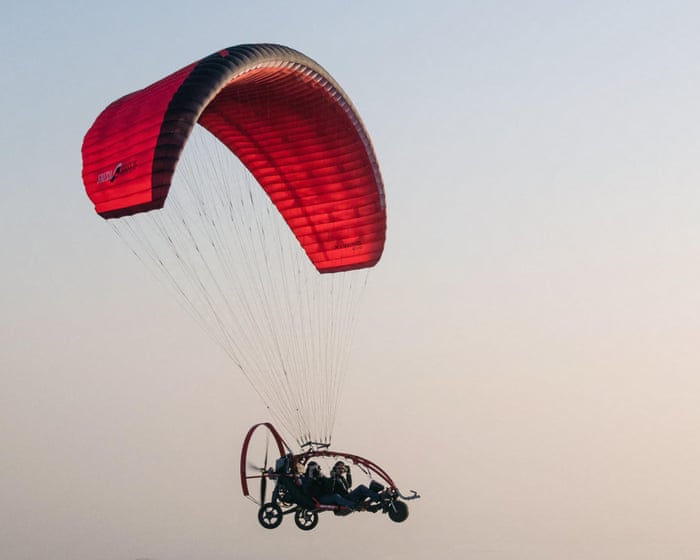
They appear after midnight, slowly crossing Myanmar’s skies. The motorised paragliders are improvised aircraft, suspending small metal frames from brightly coloured sails. They drift over a patchwork of villages, farmland, forests and winding rivers.
Each “paramotor” has two or three soldiers strapped in – one piloting, the others holding the bombs. Their craft are powered through the sky by small, rattling engine propellers, heading towards the lowland villages. Finally, switching their engines off to glide low and near silently through the dark, the men throw their explosives.
The destruction is immediate and devastating. Attacks can last several minutes, with bombs weighing up to 16kg (35lb) each dropped in quick succession. Homes are torn apart, schools and religious buildings destroyed – and civilians killed or injured as they sleep. The villages descend into panic and confusion, with families fleeing into the darkness and emergency workers digging through debris for the wounded.
“People try to run to the bomb shelters. But there is usually not enough time,” says Lwan Thu, an activist in the Sagaing region, which has been heavily bombed by the paramotors. “There are scores of dead and injured after the strikes.”
Often, as rescue teams are still digging through the rubble, the telltale chainsaw-like sound of engines heralds the gliders’ return. In these “double-tap” attacks, more bombs are dropped, striking people who have rushed to help victims of the first blasts.
What began as a handful of attacks in late 2024 has rapidly evolved into a nationwide tactic as Myanmar’s civil war grinds into its sixth year. Data collected by the conflict monitor Acled recorded just two incidents involving paramotors in 2024. By 2025, that figure had surged to 353. More than 100 attacks were recorded in the first five months of this year alone.
In 2025, the Myanmar military added another aerial asset: the gyrocopter, a small rotor-propelled aircraft capable of flying faster, higher and over longer distances than paramotors. Acled recorded 69 incidents involving gyrocopters in 2025 and a further 74 in the first four months of 2026.
The data suggests the attacks have resulted in hundreds of casualties and deaths, though analysts say the true toll is probably higher.
“We’re facing constant strikes by these new aircraft,” says Lwan Thu. “They are using them to attack everything – civilians, hospitals, religious ceremonies, residential homes.”
Myanmar’s military junta seized power five years ago, crushing a decade of democratic reforms and imprisoning much of the elected government. Peaceful protests against the coup met lethal force, igniting a nationwide conflict between the junta, pro-democracy resistance groups and long-established ethnic armed groups. Thousands of people have since been killed and more than 3.6 million displaced, according to UN figures.
In recent years, resistance forces have seized territory from the military, prompting the junta to expand its air power with improvised aircraft – typically used by explorers and hobbyists – to strike opposition-held areas beyond the reach of its ground troops. “It’s a significant development in this conflict,” says Su Mon, a senior Asia-Pacific analyst at Acled. “The impact is devastating.”
Unlike military jets, these lightweight aircraft require little infrastructure, use small amounts of fuel, are cheap to buy and are hard to track, evading detection from early-warning systems. Soldiers can be trained to operate them in a matter of days, rather than the years needed to fly conventional aircraft.
Buying paragliders, which are widely available commercially, also allows the junta to evade international sanctions targeting the military’s access to arms.
“The junta essentially buys and assembles commercial motorised paragliders. Then they send up soldiers to drop mortar shells,” says Shayna Bauchner, a Human Rights Watch researcher.
The geographic spread of the attacks appears to be increasing. Acled data shows paramotor attacks were recorded in 42 townships during 2025. In the first four months of 2026, they were used in an additional six townships.
For every two attacks there is at least one death recorded, says Acled, with some leading to dozens of fatalities. The group has recorded at least 321 deaths from paramotor and gyrocopter attacks since 2025.
One attack on a Buddhist festival at a primary school in October killed at least 24 people, including three children, and wounded 61. A witness told Fortify Rights, a human rights organisation: “[The paramotors] had no lights … I didn’t hear any engine sounds at all.
“We later found out that the paramotors turned off their engines when they approached the school compound and glided over with their parachutes.”
One woman told Agence France-Presse in the aftermath: “Children were completely torn apart.” The next day, she said, they were still “collecting body parts”.
In January, a gyrocopter attacked a hospital in the Salingyi township, killing the hospital’s chief doctor and two other hospital staff. The next day, another gyrocopter bombed the cemetery where the doctor was due to be buried.
Lwan Thu says the last attack he witnessed was in March. At midnight, the air force bombed the area with a jet fighter, then attacked with paramotors. “Three people were killed and five buildings were destroyed. The bodies were only recovered in the morning,” he says.
On 1 June, the Mandalay Free Press, a Myanmar-based news agency, released a poster campaign advising civilians on how to protect themselves from a gyrocopter attack. “Immediately take cover in a well-built bomb shelter,” read one poster. “Avoid villages, densely populated schools, monasteries, hospitals and military bases as they may be targeted.”
Human rights groups say the consequences of the attacks are worsened by severe restrictions on aid access. “The ability for people who are injured, but not immediately killed, in these attacks to get the necessary medical care is extremely limited,” says Bauchner.
“Often we hear that a smaller number of people were killed directly, but then larger numbers die because of the lack of access to medical care and aid.”
The junta has systematically dismantled Myanmar’s healthcare system during its campaign of terror. It has arrested more than 870 healthcare workers affiliated with the anti-coup movement, closed private hospitals and attacked at least 263 healthcare facilities, according to Human Rights Watch.
Analysts and rights researchers say these aircraft are part of a wider pattern of escalating air attacks that have repeatedly been accused of violating international humanitarian law.
“The military is continuing to carry out war crimes, both deliberate and indiscriminate attacks on civilians, like how it is carrying out these paramotor and gyrocopter attacks,” says Bauchner.
She says the junta is continuing such operations, despite recent attempts to rehabilitate its image on the global stage.
Su Mon anticipates paramotor and gyrocopter attacks will expand across the country in the coming months, particularly given the limited ability of resistance groups to defend against low-flying aircraft.
“The result is not only physical danger but a profound psychological impact,” she says. “They are left feeling constantly insecure and constantly in fear.”
View original source — The Guardian ↗
Related stories

ESPN
SportsJun 22, 2026 · 1 min
32 teams, 32 surprises: Which players stood out on...
ESPN

ESPN
SportsJun 22, 2026 · 1 min
World Cup Daily: Crying Belgium fan saved by VAR; ...
ESPN

ESPN
SportsJun 22, 2026 · 1 min
USMNT's World Cup success brings dilemma: Rotate t...
ESPN

ESPN
SportsJun 22, 2026 · 1 min
Four years later, same debate for Portugal: Why is...
ESPN