BBC
'I witnessed Maradona's Hand of God' - a goal still talked about 40 years on
46 minutes ago
Lourdes HerediaBBC World Service
I wasn't supposed to be there.
I was 17, I had never been to a football match and I wasn't interested in the sport. But that afternoon, walking into the Azteca Stadium in Mexico City, I was about to watch Argentina play England in a World Cup quarter-final - and to witness something I would only fully understand many years later.
That morning, we had no plans. Then the phone rang. A friend of my father had two tickets he couldn't use. Would my mum and I like them?
My father wasn't sure about his "princesses" going. This was less than five years since the end of the Falklands War and he was worried that tensions between Argentinian and English fans would spill over.
My mother didn't hesitate. This was the World Cup, after all. A once-in-a-lifetime opportunity and she wasn't going to let her daughter miss out.
The excitement started as soon as we were en route, as we headed to cross the city to the stadium. Flags hung from car windows and strangers shouted chants across traffic.
I joined in, of course-shouting "Viva México!" with everyone else, even though our team had already been knocked out of the tournament. Football didn't matter much to me, but being part of the moment did.
If anything, I treated it more like a party than a match. I dressed up, wore far too much make-up, and imagined the stadium would be full of handsome foreign fans rather than legendary players. My mother raised an eyebrow, but let it slide.
Inside the Azteca, the scale of it all was overwhelming. The noise, the colours, the sense that the whole world had gathered in one place. Around us were fans from everywhere - singing, laughing, dressed in costumes, faces painted in bright colours. I remember thinking less about the game itself and more about how exciting it felt to be there among them.
When the match started, I barely followed what was happening on the pitch. I was too busy joining in the Mexican wave - known as "la ola" in Spanish - caught up in the rhythm of the crowd. The football felt distant, almost secondary.
Suddenly, everyone was on their feet. For a second there was celebration then confusion, arguments, noise swelling in different directions.
It was a moment that would be talked about for decades.
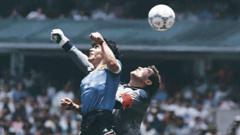
The ball was airborne above the England penalty area. Argentina's star player Diego Maradona launched himself into an aerial contest with English goalkeeper Peter Shilton who had also leapt up in an attempt to punch the ball away. But instead it bounced off Maradona and crossed the goal line.
It looked as if he had headed the first goal - and that is when things changed for me. Suddenly it was the football that mattered.
People around me started questioning whether it was really a goal or not - did he head the ball into the net or... was it his hand that pushed it in? You could hear loud protests from the English fans.
I turned to the man next to me, a bit confused. "Porque tanto alboroto [what happened]?" I asked. He said Maradona had punched the ball into the net with his hand but the referee didn't see it, and allowed the goal.
I was puzzled and at that moment I certainly never thought that what we had just seen would become one of the most talked about events in sporting history.
In time, it became known globally as the "Hand of God" incident - coined by Maradona himself: "[The goal was scored] a little bit with my head and a little bit with the hand of God," he famously said.
But so intense was the debate in the stands that day about what we had just seen that, four minutes later when the next goal game from Maradona, we almost missed it.
And here's the thing. When I think back to being one of thousands of people in the stadium that day, it's not the "Hand of God" that I immediately recall - it was that second goal. Unlike Maradona's first spectacle, the whole stadium went quiet when he was charging forward with the ball.
He began in his own half with a pirouette to escape the attention of two England players, then you could see him advancing up the pitch, weaving from one side to the other, eluding tackles, then into England's penalty box and then - boom! The ball in the back of the net. The stadium exploded.
I remember thinking: "This is why people love football - now it makes sense."
I looked around and was amazed to see that, unlike the first goal, this one was celebrated by everyone, even some of the English fans nearby.
After the game ended with the now famous 2-1 Argentinian victory, my mother and I left the stadium and walked towards our car.
At that moment, what stayed with me wasn't the match but the overwhelming feeling of having been inside the Azteca itself - this vast, iconic place that carried so much of Mexico's history within its walls. It wasn't just a stadium; it was part of our collective memory.
Even then, the echoes of the 1985 earthquake, when whole sections of Mexico City were reduced to rubble, were still vivid for me - the weeks when the air smelled of dust and loss, and the city seemed to hold its breath. I knew that the Azteca had been one of the great places of refuge, where families who had lost everything found shelter and hope. Being there felt deeply moving, almost solemn, and yet outside it transformed into something joyful and alive.
As my mum and I walked, talking and eating tacos and fruit drenched in chilli and lime from street vendors, we felt immense pride in being Mexican. We laughed about how we embraced every stereotype - the sombreros, bright colours, all of it worn with humour and defiance, and how, as hosts, we gave warmth, laughter and generosity to the world.
Even the World Cup mascot, a chilli pepper with a sombrero, seemed to capture that spirit perfectly - bold, playful, and unmistakably ours.
It was only years later that I understood that I had witnessed a truly magical moment. Football itself never really became that exciting for me, even after being at that game, but that particular moment has stayed with me.
Yes, the first goal was controversial, and enraged many - not just around me that day but in England and all over the world for many years.
When I subsequently lived and worked in Argentina, people regularly brought up the Hand of God, and my Argentinian friends never missed an opportunity to mention it to my English colleagues.
But this is to forget that the second goal was just spectacular - almost unbelievable if I hadn't seen it with my eyes.
Personally, I would be much keener to boast about that one.
Related stories

ESPN
SportsJun 22, 2026 · 1 min
Bilas' 2026 NBA draft superlatives: Most talented,...
ESPN

ESPN
SportsJun 22, 2026 · 1 min
Rotation depth? Clutch hitting? Biggest strengths ...
ESPN

ESPN
SportsJun 22, 2026 · 1 min
32 teams, 32 surprises: Which players stood out on...
ESPN

ESPN
SportsJun 22, 2026 · 1 min
World Cup Daily: Crying Belgium fan saved by VAR; ...
ESPN