Indian Express
Indian Express··4 min read
He left Canada dreams to earn 50 lakh a year from one acre in Haryana
What was once a plan to migrate to Canada has transformed into a thriving agri-enterprise generating nearly Rs 50 lakh in annual profits and providing employment to around 30 workers in Akanwali village of Haryana’s Fatehabad district.
For Kiratpal Singh (33), a graduate from a college in Tohana, 2018 was supposed to mark the beginning of a new life abroad. He had secured a visa, travelled to Canada and spent nearly 20 days there with a relative while exploring the possibility of permanent settlement. But a conversation with his elder brother, Avtar Singh, changed the course of his life.
“I had almost decided to settle in Canada. However, my elder brother advised me to start our own venture instead of working as labourers abroad. We decided to invest the money meant for migration into mushroom cultivation,” Kiratpal said.
The decision involved diverting nearly Rs 50 lakh that had been earmarked for immigration, work permits and settlement expenses.
“Even after spending such a huge amount, life abroad is not easy. One has to arrange a house, buy a vehicle and bear heavy living expenses. My brother felt it would be better to build something of our own here,” he said.
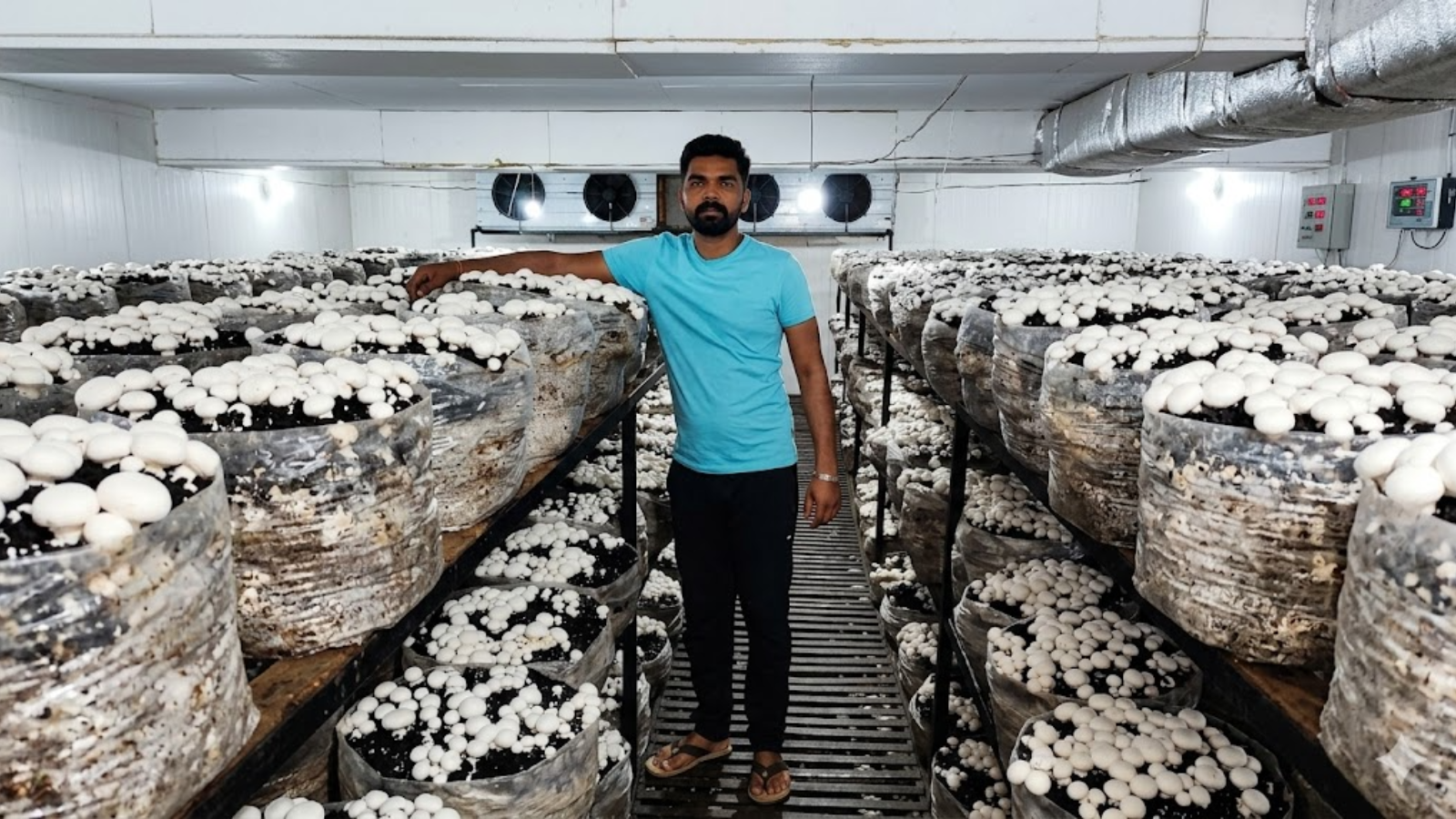
The idea of mushroom cultivation emerged from observations made during their visits to wholesale markets (Special Arrangement/Enhanced by AI)
The brothers started small. In 2018, they set up four to five temporary mushroom-growing sheds with an investment of around Rs 15 lakh. As returns improved, they gradually expanded operations. Today, the farm has 14 climate-controlled mushroom production chambers spread across one acre, with total investment exceeding Rs 3 crore.
“In 2023, we installed air-conditioned growing rooms for scientific cultivation. We plan to expand further in the coming years,” Kiratpal said.
Story continues below this ad
According to Avtar Singh (38), the enterprise now sells mushrooms worth nearly Rs 3 crore annually through the Ludhiana wholesale market.
“One room covers about 1,000 square feet. The cost of raising one crop in a room, including labour, electricity and other inputs, is around Rs 3.20 lakh. The produce fetches nearly Rs 4 lakh, leaving a profit of about Rs 80,000 per crop cycle,” he explained.
With nearly five crop cycles a year, each room generates profits of around Rs 4 lakh annually. Across all 14 rooms, the total annual profit works out to nearly Rs 50 lakh.
Avtar’s own journey into farming began under difficult circumstances. He discontinued his studies after matriculation following his father’s death and entered agriculture full-time in 2005.
Story continues below this ad
“I was involved in vegetable cultivation on nearly 20 acres along with my uncle’s family. Our joint family owns about 32 acres of land. After entering mushroom cultivation in 2018, we gradually phased out vegetable farming and focused entirely on this venture,” he said.
The brothers have also integrated value addition into their operation by establishing a composting unit and a cold storage facility.
“The spent mushroom substrate is converted into compost, reducing our dependence on chemical fertilisers such as urea and DAP. It has improved soil health significantly. While many farmers harvest around 22 quintals of wheat per acre, we are obtaining nearly 28 quintals per acre,” Avtar claimed.
The idea of mushroom cultivation emerged from observations made during their visits to wholesale markets.
Story continues below this ad
“When we used to take vegetables to the mandi, we noticed that mushrooms consistently fetched attractive prices. That prompted us to explore the crop seriously,” he said.
The brothers procure mushroom spawn from suppliers in Punjab’s Jalandhar district and Haryana’s Sonipat district at around Rs 80 per kilogram.
Despite the lucrative returns, Avtar described mushroom cultivation as a labour-intensive enterprise that demands constant supervision.
“My brother wakes up at 3 am every day to negotiate prices with commission agents in the Ludhiana mandi. In the initial years, he visited the mandi regularly to understand the trade, buyer preferences and market dynamics. That first-hand experience proved invaluable,” he said.
The Ludhiana mandi remains their principal market.
Story continues below this ad
“We have never had to bring our produce back unsold. At present, mushrooms are selling at around Rs 130 per kilogram. During the wedding season in October and November, prices can touch Rs 200 per kilogram,” Avtar said.
He believes their experience challenges the growing perception that opportunities exist only overseas.
“I never considered moving abroad. Except for those pursuing specialised education, many youngsters end up doing labour-oriented jobs overseas. My brother’s visa remained valid until 2025, but he never renewed it after the mushroom business became well established,” he said.
Fatehabad District Horticulture Officer Rajesh Swami said the brothers have emerged as a model for other farmers interested in high-value horticulture.
Story continues below this ad
“They have not only enhanced their own income but have also inspired other farmers to adopt modern farming systems capable of generating substantial returns from limited land,” Swami said.
He added that the Horticulture Department provides technical guidance as well as financial assistance to prospective mushroom growers.
“The department assists farmers in adopting scientific cultivation techniques and establishing mushroom production units. One of the key incentives available is capital subsidy for infrastructure such as growing rooms, composting facilities and related equipment. Eligible small mushroom units can receive assistance of up to 40 per cent of the approved project cost, subject to government norms,” he said.
View original source — Indian Express ↗
Related stories

ESPN
SportsJun 22, 2026 · 1 min
Aiyuk shouts 'Go Commanders' in latest video
ESPN

ESPN
SportsJun 22, 2026 · 1 min
Who's next at Michigan? Potential candidates to re...
ESPN

The Punch
NewsJun 22, 2026 · 1 min
Iran conflict sends Canada inflation to two-year high
The Punch
The Punch
NewsJun 22, 2026 · 1 min
SERAP urges FG to release Sowore, drop charges
The Punch